


Design preferences, material advances and global supply dynamics are aligning to elevate bold neutrals, earthy palettes and concrete accents as defining interior trends through 2026. This forecast explains the technical and commercial drivers behind that shift, highlights why Vietnam is strategically positioned as a supplier hub, and outlines specification and sustainability considerations for manufacturers and buyers. The article is structured in three chapters that cover aesthetics and materials, manufacturing and supply-chain considerations centered on Vietnam, and market demand with sustainability and consumer behavior implications.
Grounded Luxury: How Bold Neutrals, Earthy Palettes and Concrete Shape 2026 Interiors
Material and Aesthetic Shift

Design language for 2026 favors grounded luxury: warm neutrals pushed toward richer chroma, layered earth tones, and concrete as a tactile accent. Colors move beyond plain gray to greige, warm charcoal, mushroom, clay-infused greys, terracotta, ochre, and moss. These hues read neutral from a distance but reveal depth up close. The palette’s warmth comes from subtle undertones and deliberate contrast. Designers increase perceived richness by pairing honed concrete surfaces with soft natural fibers like linen and wool. Textures matter. Honed, brushed, acid-etched, and micro-polished concrete offer tactile variety. Matte honed finishes typically register below 15 gloss units at 60°. Polished concrete for furniture ranges 20–60 GU depending on densification and grit. Low porosity is essential. High-quality furniture mixes aim for water absorption under 0.5% to resist staining and moisture.
Material technology now makes sculptural concrete both practical and refined. Standard cast concrete performs at 20–50 MPa compressive strength. GFRC improves tensile behaviour and enables thin shells with flexural strength in the 6–15 MPa range. UHPC provides extreme durability, often 120–150 MPa, and suits slender, load-bearing furniture. Mix design matters: water-to-cement ratios of 0.28–0.45 are common. Superplasticizers, especially PCE types at roughly 0.5–1.2% by cement mass, lower the water demand while preserving workability. Silica fume and slag improve density and reduce permeability. Typical silica-fume replacement runs 5–10% and SCMs like fly ash or slag replace 10–40% of cement. These changes reduce shrinkage and improve microstructure, though silica fume increases demand for superplasticizer.
Color integration is technical, not accidental. Iron oxide pigments remain the standard for UV and alkali stability. Typical dosing sits between 0.2–3.0% of cement mass. Furniture mixes using integrated pigments may push 2–8% by mass, but higher pigment loads raise costs and require efflorescence control. Color consistency is achieved with spectrophotometry and delta E targets under 2.0. Sealers must be breathable and UV-stable; silane/siloxane impregnators, breathable acrylics, and two-component aliphatic polyurethanes are chosen to balance sheen and protection. Densifiers such as sodium or potassium silicates can reduce porosity by 30–70% after curing.
Manufacturing techniques have evolved to suit design ambitions. CNC-machined formwork and 3D-printed molds deliver complex geometries. Silicone or urethane flexible molds support small-batch reproduction. Vacuum-assisted and pressure casting reduce internal voids. GFRC spray-up systems accelerate thin-shell production. Typical demold times vary. A simple cast stool may demold in 12–24 hours with accelerated curing. UHPC elements often require 3–7 days for full strength without heat curing. Dimensional tolerances for furniture commonly fall between ±1–3 mm.
Vietnam emerges as a strategic manufacturing hub for these products. For concrete furniture companies, vertically integrated clusters provide mold makers, pigment suppliers, and finishing specialists.. Skilled labor and favorable trade agreements reduce landed costs for key markets. The country’s furniture export ecosystem supports rapid scaling of specialty concrete furniture, especially for premium hospitality and residential segments. For practical insight into mold production and facility-level workflows, see the detailed guide on creating molds for concrete furniture in Vietnam.
Sustainability now shapes material choices and specification. Baseline Portland cement emits about 0.8–0.95 kg CO2e per kilogram of binder. Replacing 20–40% of cement with SCMs or using Portland-limestone cements reduces embodied carbon by roughly 10–30%. Geopolymer binders and novel low-carbon cements can cut carbon by 40–70% but face cost and availability barriers. Designers should evaluate life-cycle impact over expected service life; durable concrete furniture often lasts 20–30 years or more, spreading embodied impact across many years. Recycled aggregate and glass content of 10–40% performs well when graded correctly. Circularity strategies include modularity for repair and designing for disassembly when concrete is used as insert or cladding.
Specification guidance must translate aesthetics into measurable criteria. Target compressive strengths should match the application: seating and thin cantilevered elements typically require a service design strength in the 40–80 MPa range for safety margins. Specify fiber reinforcement by expected load: polypropylene microfibers at 0.3–1.0% by volume reduce cracking, and AR glass fibers at 5–10% by mix mass suit GFRC shells. Define pigment types and dosing with delta E targets. Call out sealer chemistry: silanes for outdoor breathability, aliphatic polyurethanes for indoor abrasion resistance. Require EPDs and LCA summaries for procurement that values low-carbon credentials.
Maintenance and end-user guidance inform longevity. Recommend pH-neutral cleaners and avoid harsh acids unless a patina is desired. Topical sealers often need reapplication every 3–7 years depending on traffic. Routine inspection for microcracks preserves performance.
This convergence of palette, material science, and manufacturing strategy redefines premium interiors. Bold neutrals and earthy tones provide the emotional warmth. Concrete supplies structure, texture, and permanence. Together they create interiors that read as both modern and timeless. For a broader view of how these stylistic shifts appear in room-scale trends, see the external forecast summary here: https://www.decorilla.com/online-decorating/interior-design-trends-2026/
How Manufacturing, Supply Chains and Vietnam Propel the Bold Neutral and Concrete Movement
Manufacturing, Supply Chains and Vietnam’s Strategic Edge
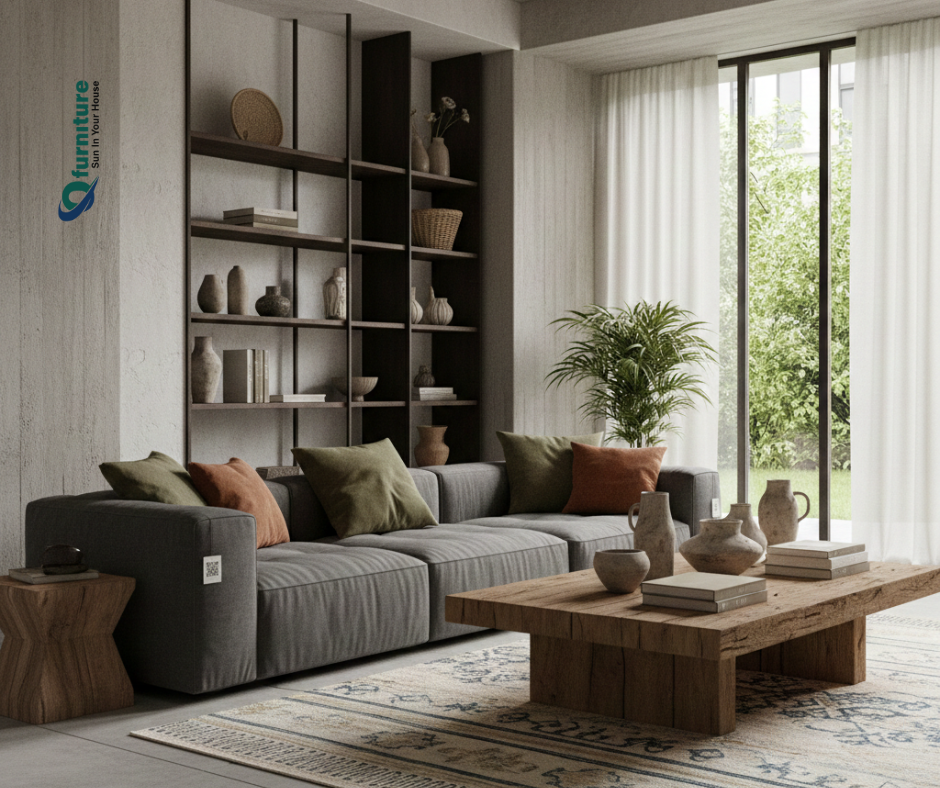
The aesthetic shift toward bold neutrals, earthy tones, and concrete accents is rooted in more than taste. It is driven by material innovation, production capability, and resilient supply chains. Concrete has evolved from a structural material to a design language. Advances in GFRC and UHPC, refined pigment systems, and modern finishing protocols make thin, tactile furniture feasible. These technical gains allow designers to push neutral palettes to richer, warmer chromas without sacrificing performance.
Vietnam sits at the centre of this transformation. The country offers a mix of skilled labor, dense supplier clusters, and preferential trade access that shortens time-to-market. Local ecosystems now include mold makers, pigment and coating formulators, and finish specialists. Production techniques range from CNC-cut formwork and 3D-printed molds to vacuum-assisted and pressure casting for thin-walled elements. Small-batch flexible molds coexist with automated CNC workflows, enabling both bespoke pieces and scaled runs.
Material science choices determine both look and lifecycle impact. Typical furniture-grade mixes use low water-to-cement ratios, often 0.28–0.45, with PCE-type superplasticizers at roughly 0.5–1.2% by cement mass. GFRC and fiber blends improve tensile behaviour and crack resistance in thin sections. UHPC gives designers the freedom to create slender profiles with compressive strengths in the 120–150 MPa range. Integral pigments—iron oxides at 0.2–3% by cement mass—deliver stable earth tones. Higher pigment dosing is possible, but it increases cost and requires stricter moisture control to avoid surface efflorescence.
Surface engineering completes the visual story. Densifiers and penetrating silanes reduce porosity and improve touch. Honed, brushed, and micro-polished finishes create warm neutrals that read as material-forward luxury. Gloss objectives are measurable: matte honed finishes typically register under 15 GU at 60°, while polished furniture may reach 20–60 GU depending on the polishing sequence. High-quality furniture-grade concrete targets water absorption below 0.5% by mass to minimize staining and moisture ingress.
Manufacturing tolerances and quality assurance are decisive for premium adoption. Dimensional tolerance commonly falls between ±1–3 mm. Non-destructive tests such as ultrasonic pulse velocity and infrared thermography detect internal defects in thin shells. Cycle times vary by system: simple cast pieces can demold in 12–24 hours with accelerated curing; UHPC parts often require 3–7 days for full strength without heat curing. These production realities shape pricing and distribution strategies.
Supply-chain resilience directly affects both cost and carbon footprint. Cement and SCM availability determine embodied-carbon outcomes. Replacing a portion of Portland cement with silica fume, fly ash, or slag reduces embodied carbon by 10–40%. Geopolymer binders offer steeper reductions, but cost and supply barriers limit near-term scale. Logistical factors matter too: pigments, specialty admixtures, and certain coatings remain regionally concentrated. Tariffs or shipping disruptions can add 5–20% to raw-material costs in some scenarios.
Vietnam’s trade agreements enhance competitiveness. Preferential access to major markets reduces tariff friction and encourages export-oriented production. Combined with lower labor costs and dense domestic suppliers, this makes Vietnam an attractive base for concrete-accent furniture destined for premium residential and hospitality projects. The country’s furniture export sector has shown robust growth; specialty concrete products now represent a niche but fast-growing segment within that export mix.
Sustainability practices are increasingly non-negotiable for specifiers. Long service life improves per-year carbon metrics for heavy materials like concrete. Manufacturers are responding by increasing SCM content, adopting low-carbon cements, and publishing EPDs. Circular strategies include designing for disassembly, incorporating recycled aggregate at 10–40% content, and enabling modular repair paths. These measures help mitigate risks from emerging carbon-border mechanisms and buyer procurement standards.
For designers and manufacturers, the brief is technical and precise. Specify compressive strength appropriate to thin elements, choose fibre reinforcement for intended load paths, and set pigment delta E tolerances below 2.0 for repeatability. Select breathable, UV-stable sealers for longevity. Build QA checkpoints for porosity and finish uniformity, and plan for routine maintenance such as topical sealer reapplication every 3–7 years.
Practical production knowledge is available for teams setting up concrete furniture lines. Guidance on mold creation, tooling strategies, and finish workflows supports reliable output. For a closer look at mold-making processes used in Vietnam’s factories, see this resource on creating molds for concrete furniture in Vietnam: creating molds for concrete furniture in Vietnam.
Vietnam also cultivates a cultural advantage. Designers there blend local craft heritage with contemporary concrete techniques. This combination resonates with global buyers seeking grounded luxury and tactile authenticity. As a result, Vietnam can supply both the technical demands of modern concrete furniture and the cultural narrative that makes bold neutrals and earthy palettes compelling in interiors.
Further context on the national trend publication and forecasts can be found at the Vietnam interior design trend launch: https://vnia.vn/en/launch-of-trend-26-the-first-trend-publication-of-vietnams-interior-design-industry-for-the-2026-2030-period/.
Demand, Desire and Durability: How Bold Neutrals, Earthy Tones and Concrete Shape 2026 Interiors
Market signals, consumer motives, and sustainable practice converge to make bold neutrals, earthy palettes, and concrete accents the defining language of 2026 interiors.

Consumers now seek spaces that feel lived-in, tactile, and honest. Warm greiges, mushroom taupes, clay-infused grays and terracottas replace colder minimalism. These colors work with sculptural, oversized furniture to create intimate, human-centered rooms. Curved silhouettes and layered textiles invite touch. Handcrafted details and embroidered accents add narrative and perceived longevity. Together, color and texture answer a simple brief: make interiors feel like long-term companions rather than short-lived trends.
Concrete plays a dual role. Visually, it anchors rooms with an elemental, modern weight. Tactilely, honed, brushed, and micro-polished surfaces provide pleasing contrasts to soft natural fibers. Functionally, concrete furniture promises durability and low-maintenance use, aligning with consumers who prioritize value over disposability. Manufacturers respond by refining mix design, pigmentation, and finishing to lower porosity and ensure color stability. This technical work underpins the emotional appeal: a piece that looks and performs like it will endure.
Sustainability is not an afterthought. Buyers increasingly demand transparency about embodied carbon and product life cycles. Blended cements, SCM substitutions, and recycled aggregates reduce cradle emissions. Long service life spreads environmental cost over many years, improving per-year footprints. Designers and specifiers now ask for EPDs and low-VOC finishes as standard. The result is a market advantage for makers who can prove lower-impact supply chains and provide simple repair pathways for concrete pieces.
Behavioral shifts amplify these material choices. Post-pandemic priorities favored comfort, craft, and home investment. Today, that preference is expressed through layered palettes, architectural detail, and furniture intended to anchor social routines. Pattern and personalization return as signals of individuality, while neutral-but-rich tones provide a backdrop that makes metals, leathers, and woods sing. Hospitality and premium residential sectors are early adopters, where tactile drama and durability justify higher price points.
Market dynamics support scaling. Search and sales data show rising interest in earth-toned schemes and concrete accents. Premium concrete furniture commands a wide price spectrum, driven by finish complexity, pigment dosing, and logistics. Manufacturing hubs with integrated clusters and favorable trade agreements can serve demand efficiently. Investment in CNC formwork, vacuum-assisted casting, and quality controls reduces defects and delivers consistent finishes.
Practically, designers should specify with both aesthetics and lifecycle in mind. Aim for dense, low-porosity mixes and UV-stable pigments. Choose breathable sealers that match use conditions. Provide maintenance plans and offer modular or repairable design details. For manufacturers, resilience in pigment and admixture sourcing and demonstrated LCA performance will be decisive in winning contracts.
For designers and makers exploring concrete at scale, practical production knowledge is essential. Resources on creating molds for concrete furniture in Vietnam highlight the intersection of craftsmanship and modern manufacturing.
For authoritative guidance on embodied-carbon reduction strategies and industry best practice, see the World Green Building Council: https://www.worldgbc.org/
Final Thoughts
Bold neutrals, earthy palettes and concrete accents are not a fleeting aesthetic but the result of converging material, manufacturing and market forces. Advances in GFRC and UHPC, improved pigment and finishing systems, and Vietnam’s manufacturing advantages make this trend commercially viable and scalable. For buyers and suppliers, priorities are pigment and supply resilience, embodied-carbon reduction through SCMs and PLCs, robust QA (porosity and color control), and product lines designed for repair and longevity. Track adoption in premium hospitality and residential segments, certify embodied-carbon performance, and reduce lead times to capture color and finish trends—practical actions that convert aesthetic forecasts into durable business value.
Choose Q Furniture – Choose your SUSTAINABILITY
About Us
With over 15 years of experience in furniture manufacturing, Q-Furniture offers clients a wide range of premium wood and concrete furniture products and services. Founded by individuals with a deep understanding of the industry, Q-Furniture has grown to deliver an extensive portfolio that caters to various customer needs.








