


Interior design in 2026 is moving toward spaces with permanence, texture, sustainability, and meaning. For furniture importers, hospitality buyers, resort developers, and design-led brands, this shift is creating stronger demand for architectural concrete furniture that can perform outdoors, tell a material story, and support long-term commercial value.
How 2026 Int erior Design Trends Are Increasing Demand For Architectural Concrete Furniture
Interior design in 2026 is not simply moving toward another look. It is moving toward a different way of buying, specifying, and evaluating furniture.
For years, the furniture market was shaped by speed. Fast production, fast styling, fast visual impact, and fast replacement cycles defined many residential and commercial interiors. But the mood has changed. Designers, developers, and end users are becoming more selective. They want furniture that feels intentional. They want materials that carry weight, texture, and authenticity. They want outdoor spaces that operate like fully designed extensions of architecture. They want products that do not look disposable after one season.
This is where architectural concrete furniture is becoming more relevant.
Concrete is no longer viewed only as a construction material. In furniture design, it has become a sculptural, tactile, and highly expressive medium. It can feel minimal without being empty. It can feel raw without being unfinished. It can support luxury hospitality environments without relying on decorative excess. For B2B furniture buyers, especially importers, brands, hospitality groups, resort developers, and interior designers, concrete offers a rare combination of visual distinction, durability, and long-term value.
The rise of concrete furniture trends is closely aligned with the wider interior design trends 2026 conversation: meaningful design, slow decorating, timeless interiors, material authenticity, sustainable living, and statement furniture that behaves almost like architecture.
For businesses that source, distribute, or specify furniture, the question is no longer whether concrete furniture is a niche material. The better question is how quickly buyers can build the right concrete furniture category before the market becomes more competitive.
The Cultural Shift Behind Interior Design Trends In 2026
View our bespoke architectural concrete lounge tables and terrazzo centerpieces for luxury resort projects.
The most important design movement in 2026 is not a color, a shape, or a decorative detail. It is a cultural shift away from interiors that feel temporary.
Consumers and commercial clients are becoming more aware of how spaces make them feel over time. A hotel lobby must do more than look good in photographs. A resort terrace must do more than fill empty square meters. A restaurant courtyard must do more than provide seating. These spaces are now part of brand identity, guest experience, operational value, and long-term asset planning.
This explains why meaningful design is becoming more influential. People want interiors with emotional value, not just visual styling. They want furniture that appears selected, not randomly purchased. They want texture, age, craft, and material presence. In high-end hospitality, this preference is even stronger because guests judge the quality of a property through every physical touchpoint.
At the same time, slow decorating is changing how designers and buyers think about procurement. Instead of filling a space quickly with generic items, more projects are built around fewer, better pieces. A sculptural table, a monolithic bench, or a concrete stool can define a zone more effectively than a full set of ordinary furniture. This creates an opening for materials with strong identity.
Sustainability also plays a role, but in a more mature way than before. Buyers are becoming skeptical of vague green claims. They want furniture that is durable, repairable, functional, and suitable for long-term use. A product that lasts longer and reduces replacement cycles may offer stronger sustainability value than a product marketed with environmental language but replaced frequently.
For importers and hospitality buyers, these shifts matter because they influence what sells, what gets specified, and what remains relevant beyond a short design season.
Why Concrete Furniture Aligns With 2026 Design Values
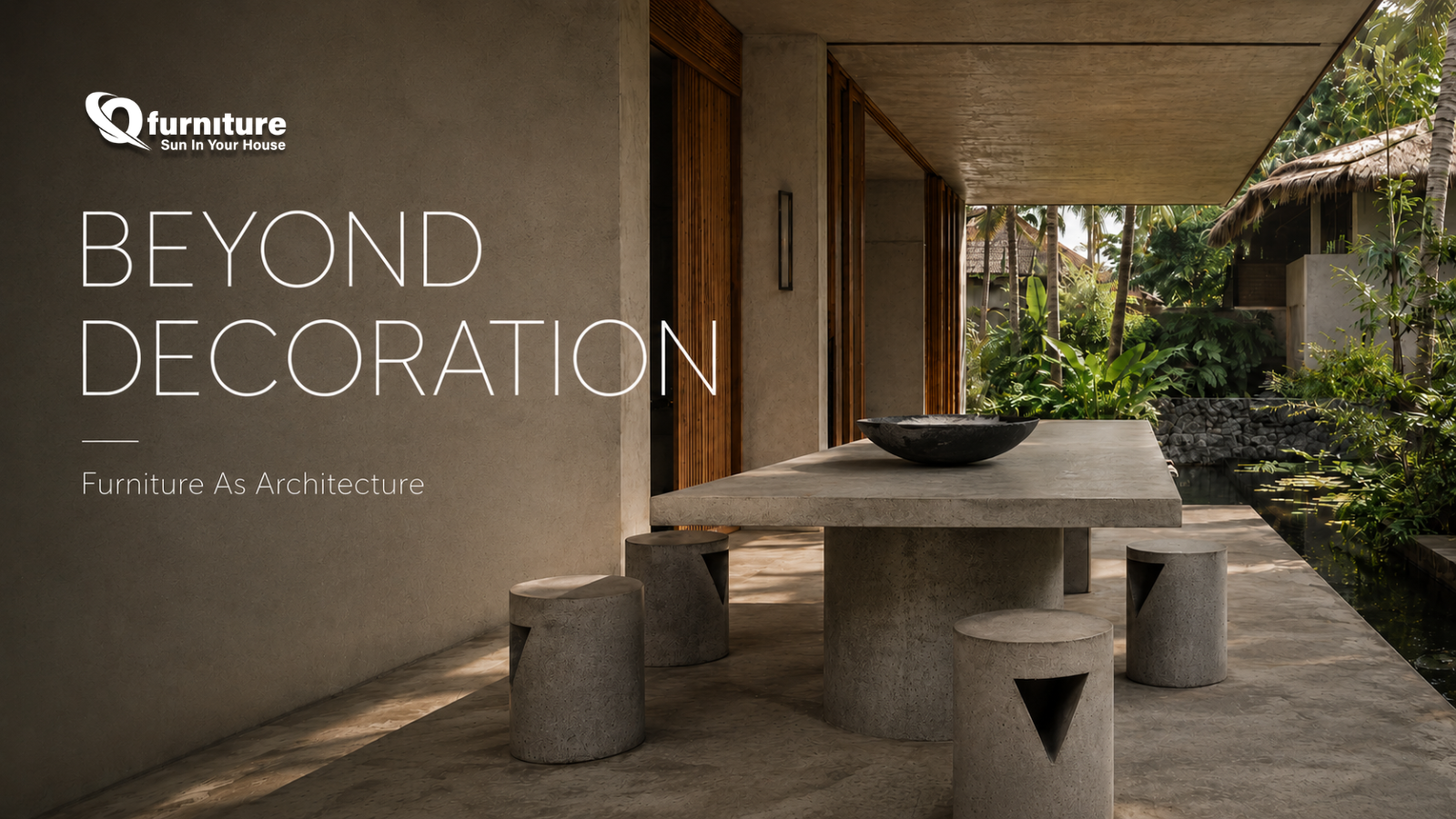
Architectural concrete furniture aligns with 2026 design values because it carries three qualities that the market increasingly wants: permanence, authenticity, and architectural presence.
Concrete has visual gravity. It naturally communicates stability, strength, and calm. In interiors, it pairs well with wood, stone, glass, metal, linen, greenery, and warm lighting. Outdoors, it feels connected to landscape architecture, paving, planting, water features, and built structures.
This gives concrete furniture a valuable role in both residential and commercial settings. It can support minimalist spaces without making them feel sterile. It can add texture to luxury interiors without relying on ornament. It can create a grounded atmosphere in hospitality projects where furniture needs to feel integrated with the architecture.
For B2B buyers, the category is especially attractive because it is not limited to one product type. Q-Furniture’s concrete furniture collection includes categories such as concrete coffee tables, side tables, dining tables, console tables, stools, and basins. This gives importers and design-led brands room to build coordinated collections instead of sourcing isolated products.
Concrete also supports customization. Shape, scale, finish, color, edge profile, and surface treatment can all influence the final product. For furniture brands, this is important because private-label differentiation is harder to achieve in crowded wood, plastic, and metal categories. Concrete offers a more distinctive design language.
In 2026, the value of concrete furniture is not only aesthetic. It is strategic. It helps buyers respond to demand for timeless interiors, sustainable furniture design, hospitality furniture trends, outdoor concrete furniture, and statement furniture that feels built into the project rather than added at the end.
🏨 2026 Hospitality Specifier Matrix: Material Selection by Zone
| Resort Zone | Recommended Material Finish | Key Engineering Advantage |
|---|---|---|
| Poolside & Beachfront | Hydrophobic Nano-Coated GFRC | 100% Salt-spray & chlorine resistant; no rust or warping |
| Rooftop Sky Lounges | Ultra-Lightweight GFRC (Cored) | Wind-resistant stability without exceeding rooftop floor loads |
| Fine Dining Terraces | Polished Marble-Chip Terrazzo | Stain-resistant barrier against red wine, olive oil, and hot plates |
Trend #1: Meaningful Design And Furniture With A Story
Meaningful design is one of the strongest signals shaping interior design trends 2026. People are moving away from spaces that look assembled by algorithm. They want interiors that feel personal, layered, and grounded in material reality.
For hospitality buyers, this matters because guests increasingly respond to spaces that feel memorable. A resort, boutique hotel, restaurant, or lifestyle retail space must create atmosphere. Furniture is no longer a background element. It is part of the story.
Concrete furniture naturally supports design storytelling because the material itself has character. Its texture, weight, mineral tone, and surface variation give each piece a physical presence that is difficult to imitate. Unlike high-gloss synthetic finishes or lightweight decorative furniture, concrete communicates honesty. It looks and feels like a real material.
This is especially relevant for interior designers and resort developers looking to create spaces with a stronger sense of place. A concrete coffee table in a lounge, a sculptural stool in a spa, or a monolithic dining table in an outdoor restaurant can become part of the property’s design identity.
For importers and furniture brands, the opportunity is to position concrete not merely as furniture, but as a story-led category. Collections can be framed around natural textures, architectural forms, indoor-outdoor living, and long-term use. This makes the product easier to market to design-conscious retailers, hospitality groups, and project buyers.
Q-Furniture’s article on concrete furniture manufacturing for B2B export is highly relevant here because it frames concrete furniture for importers, wholesalers, distributors, hotel and resort buyers, architecture studios, landscape contractors, retailers, and procurement teams. That audience is exactly where meaningful, material-led furniture has the strongest commercial potential.
The lesson for B2B buyers is simple. When the market wants story, the product must have substance. Concrete furniture gives brands a material story that is visible, tactile, and commercially useful.
Trend #2: Slow Decorating And Long-Term Furniture Investment

Slow decorating is not only a residential trend. It is also becoming a commercial procurement mindset.
In homes, slow decorating means buying fewer pieces over time and choosing items with lasting relevance. In hospitality and commercial projects, the same idea appears as lifecycle-based purchasing. Buyers are looking beyond the initial unit price and asking more serious questions: How long will this furniture last? How will it age? How often will it need to be replaced? Will it still match the design direction of the property five years from now?
This is where architectural concrete furniture becomes a stronger investment category.
Outdoor furniture, in particular, is often judged too narrowly by upfront cost. For hotels, resorts, cafés, rooftop bars, and restaurants, a low-cost table can become expensive if it fades, warps, rusts, breaks, or needs frequent replacement. The real cost includes removal, reordering, shipping, installation, downtime, and damage to the guest experience.
Concrete furniture offers a different value proposition. When properly designed and finished, it can provide a stable, grounded, long-lasting presence in high-use environments. It works especially well in fixed layouts such as resort gardens, outdoor lounges, pool decks, terraces, courtyards, and commercial hospitality zones.
For buyers evaluating long-term investment, Q-Furniture’s article on the real cost of concrete outdoor furniture is a useful internal resource. It supports the idea that outdoor furniture should be evaluated through performance, replacement cost, maintenance, visual consistency, and long-term project value rather than unit price alone.
Slow decorating also supports timeless interiors. Concrete does not depend heavily on seasonal styling. Its appeal comes from proportion, form, texture, and material authenticity. This gives it a longer design life than furniture built around short-lived decorative trends.
For importers, this is commercially important. Retailers and project buyers want products they can sell with confidence. A durable concrete dining table, coffee table, stool, or bench can be positioned as a long-term investment rather than a temporary trend purchase.
Trend #3: Sustainable Design Beyond Marketing Claims
Sustainable furniture design is becoming more demanding. Buyers no longer accept sustainability as a decorative sentence in a catalogue. They want practical evidence of value: longer use cycles, responsible material choices, efficient manufacturing, repairability, suitability for the environment, and fewer replacements over time.
This changes how outdoor concrete furniture should be discussed.
Concrete is sometimes misunderstood in sustainability conversations because traditional construction concrete is associated with high embodied carbon. But furniture is a more specific category. The sustainability question is not only about material origin. It is also about product lifespan, replacement frequency, manufacturing control, transport planning, surface protection, and whether the furniture is suitable for the conditions where it will be used.
A lightweight outdoor chair that fails after two seasons may not be sustainable in practice, even if it appears efficient at the point of purchase. A stronger piece that remains functional and visually consistent for years may support a more responsible lifecycle.
This is why sustainable living and commercial durability are becoming connected. In hospitality projects, durability is not just an operational benefit. It is part of sustainable decision-making. Fewer replacements mean fewer shipments, less waste, fewer disruptions, and more consistent design quality.
Q-Furniture’s article on premium outdoor furniture trends and sustainable materials 2026–2036 fits naturally into this discussion. It addresses how outdoor spaces are becoming more valuable in residential, hospitality, F&B, and commercial environments, and why buyers are looking for better design, stronger material performance, longer service life, and a more convincing sustainability story.
For B2B buyers, the key is to avoid shallow sustainability claims. Instead, concrete furniture should be positioned around measurable commercial value: durability, long-term use, material performance, timeless design, and suitability for demanding indoor and outdoor spaces.
This is also where OEM and ODM development becomes important. Brands can work with manufacturers to refine dimensions, finishes, weights, packaging, and product applications for different markets. Sustainability improves when products are designed correctly from the beginning.
Trend #4: Material Authenticity Is Becoming A Luxury
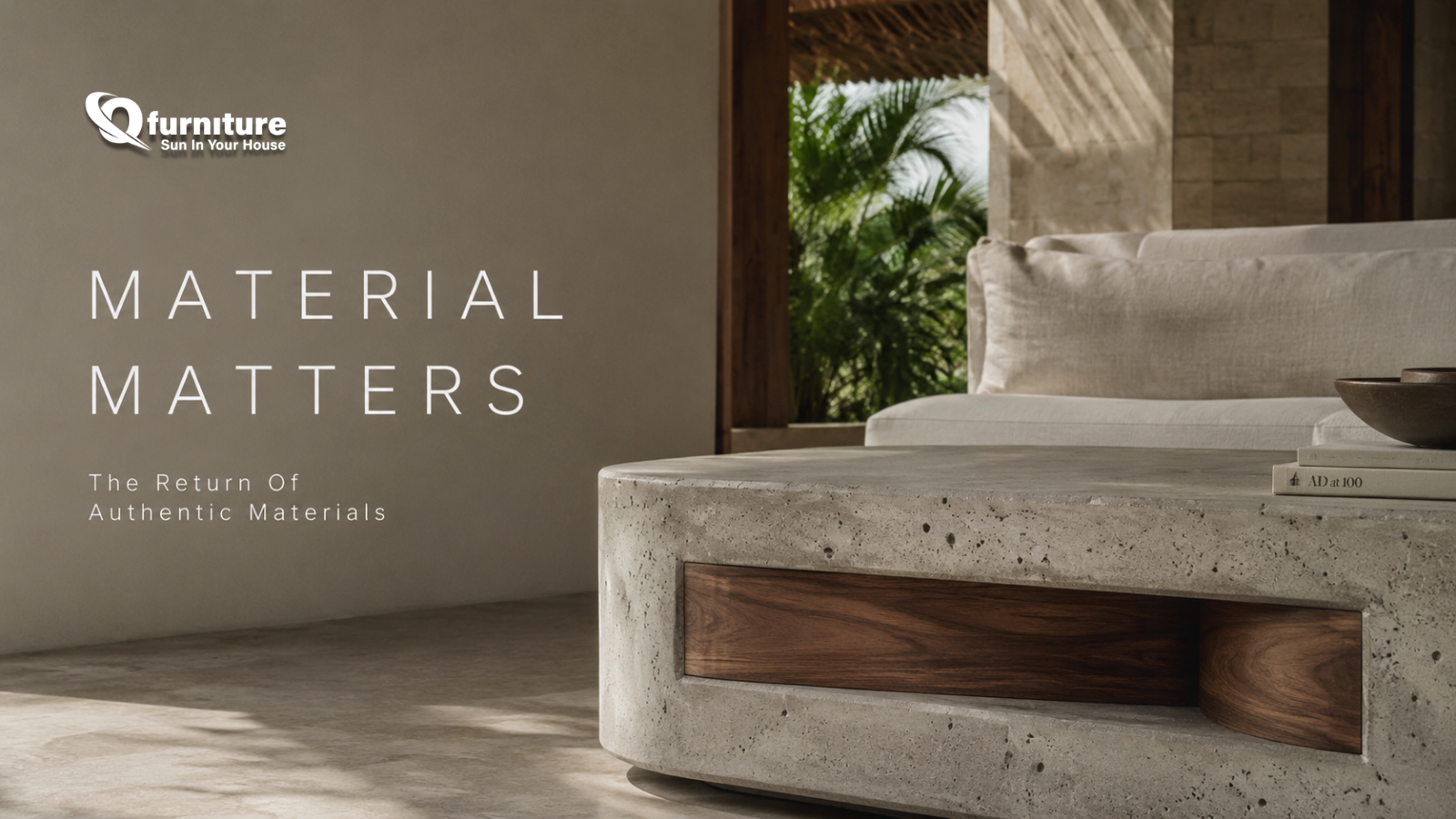
Luxury interiors are changing. They are becoming less dependent on obvious decoration and more dependent on material quality.
In 2026, material authenticity is becoming a luxury signal. Designers are using natural textures, mineral surfaces, visible grain, matte finishes, handmade details, and tactile contrast to create interiors that feel grounded. This does not mean every space is rustic or raw. It means materials must feel believable.
Concrete fits this direction because it has an honest visual language. It does not need to pretend to be something else. Its surface can be smooth, honed, textured, pigmented, refined, or sculptural, but it still carries the identity of the material.
For hospitality furniture trends, this is especially important. Hotels and resorts need materials that photograph well, perform well, and create atmosphere in person. Guests may first encounter a space online, but they judge it physically when they arrive. A concrete table or stool gives visual and tactile feedback that lightweight imitation materials often cannot provide.
Concrete also pairs well with other authentic materials. It can soften when combined with wood. It can become more refined next to brass or black metal. It can feel warm when placed near textured upholstery, woven elements, plants, and ambient lighting. It can feel architectural when paired with stone, glass, or water.
For interior designers, this flexibility is valuable. Concrete can support brutalist, minimalist, tropical, Mediterranean, Japanese-inspired, industrial, and contemporary resort aesthetics. It can be used indoors or outdoors. It can be understated or highly sculptural.
For furniture importers, material authenticity creates a stronger selling story. Instead of competing only on price, brands can compete on mood, design value, and product identity. Concrete furniture gives a catalogue a category that feels different from standard mass-market furniture.
The opportunity is not to present concrete as cold or heavy. The opportunity is to present it as crafted, architectural, durable, and emotionally grounded.
Trend #5: Statement Furniture As Architectural Elements
Statement furniture in 2026 is not about loud decoration. It is about pieces that define space.
A statement piece can be quiet and still powerful. A large concrete dining table can anchor an outdoor restaurant. A sculptural coffee table can define a hotel lounge. A concrete stool can function as seating, side table, or visual marker. A bench can shape circulation in a garden, courtyard, spa, or resort walkway.
This is why architectural concrete furniture is so relevant to current design direction. It does not behave like ordinary movable furniture. It often feels connected to the building, landscape, and spatial plan.
For project buyers, this has practical value. Furniture that feels architectural can reduce the need for excessive decoration. It can make a space look more intentional with fewer elements. It can support brand identity while still serving a functional role.
Concrete stools are a good example. They are compact, flexible, and sculptural. They can work in hotel lobbies, outdoor cafés, poolside lounges, retail spaces, villas, restaurants, gardens, and terraces. Q-Furniture’s concrete stools category shows how this product type can support both seating and architectural styling.
Concrete dining tables are another important category. In hospitality and outdoor dining environments, the dining table is not just a surface. It influences guest comfort, layout planning, perceived quality, and the overall mood of the space. A concrete dining table can create a strong focal point while supporting a long-term commercial furniture strategy. Q-Furniture’s concrete dining tables category is therefore relevant for buyers building outdoor dining, resort, and commercial hospitality collections.
For importers and brands, statement furniture creates a premium selling angle. Instead of presenting concrete as a basic outdoor material, it can be positioned as architectural furniture for design-led projects.
How Furniture Importers Can Benefit From These Trends
Furniture importers are often under pressure to identify categories before they become saturated. Architectural concrete furniture offers a useful opportunity because it sits at the intersection of several market needs: outdoor living, hospitality development, sustainable furniture design, material authenticity, and long-term value.
The first opportunity is category differentiation. Many furniture catalogues are crowded with similar wood, metal, rattan, plastic, and upholstered products. Concrete gives importers a more distinctive material category. It can help brands stand out in retail showrooms, B2B catalogues, hospitality presentations, and project proposals.
The second opportunity is private-label development. Concrete furniture can be customized through shape, color, finish, size, and mixed-material combinations. This allows importers to build collections that feel proprietary instead of generic.
The third opportunity is hospitality and commercial specification. Hotels, resorts, restaurants, cafés, rooftop bars, villas, and landscape projects often need products that combine durability with visual identity. Concrete furniture can serve these environments well when the design, sealing, weight, and logistics are correctly planned.
The fourth opportunity is outdoor expansion. Outdoor spaces are becoming more important for lifestyle, revenue, guest experience, and brand image. Importers that offer outdoor concrete furniture can serve buyers who are upgrading terraces, pool decks, gardens, courtyards, balconies, and open-air dining zones.
The fifth opportunity is better storytelling. In a market where buyers are tired of generic product claims, concrete furniture gives brands stronger language: timeless interiors, natural textures, material authenticity, well-crafted furniture, statement furniture, and design storytelling.
To benefit from these trends, importers should not treat concrete as a one-off novelty product. They should build a focused assortment. A strong starter collection might include concrete coffee tables, side tables, stools, dining tables, benches, planters, basins, and selected custom project items. This gives retailers and hospitality buyers enough range to specify complete spaces.
Why Q-Furniture Is Positioned For The Next Generation Of Design Trends
Q-Furniture is well positioned for the next generation of design trends because its business model aligns with what B2B buyers increasingly need: specialized material expertise, OEM and ODM flexibility, export readiness, and product categories suited to indoor and outdoor projects.
The company focuses on concrete and wood furniture for global wholesale buyers, with products such as concrete tables, stools, and basins. This makes the brand relevant to importers, retailers, interior brands, hospitality buyers, and project-based customers looking for material-driven furniture rather than generic supply.
Its concrete furniture category provides a foundation for collection building. Importers can explore product families across coffee tables, side tables, dining tables, stools, console tables, and basins. This supports both residential retail programmes and commercial hospitality specifications.
Q-Furniture’s positioning is also aligned with 2026 design language. The market is moving toward architectural forms, natural textures, durability, meaningful design, and sustainable living. Concrete furniture speaks directly to these values. It feels permanent, tactile, and intentional.
For hospitality and resort projects, Q-Furniture’s focus is especially relevant. Outdoor areas are no longer secondary spaces. They are revenue-generating, guest-facing, brand-defining environments. Furniture in these zones must be durable, photogenic, comfortable, and consistent with the architecture. Concrete furniture can help create that sense of permanence and quality.
For brands and importers, Q-Furniture’s OEM and ODM model is also important. The ability to adjust dimensions, finishes, colours, and branding gives buyers more control over market positioning. This is essential in a design market where differentiation matters.
The next decade of furniture sourcing will reward buyers who combine design intelligence with manufacturing discipline. Q-Furniture sits in a category where both are needed.
Conclusion: Concrete Furniture Is Moving From Trend To Strategy
Interior design trends in 2026 point toward a more thoughtful market. The strongest signals are not about temporary decoration. They are about meaning, longevity, material authenticity, sustainability, and architectural presence.
That is why architectural concrete furniture is gaining momentum.
For interior designers, it offers a way to create grounded, expressive, timeless interiors. For hospitality buyers and resort developers, it supports outdoor spaces that feel permanent, premium, and operationally durable. For furniture importers and brands, it creates a differentiated category with strong storytelling and long-term commercial potential.
Concrete furniture is not right for every project, and it should never be specified without considering weight, finish, sealing, logistics, and intended use. But when designed and sourced correctly, it answers many of the questions shaping the future of furniture: How can a piece last longer? How can it feel more meaningful? How can it support sustainable design beyond marketing language? How can it become part of the architecture rather than just another object in the room?
For B2B buyers ready to build collections around durability, material authenticity, and design storytelling, architectural concrete furniture is no longer a niche idea. It is becoming a strategic category.
To explore OEM and ODM concrete furniture for wholesale, hospitality, and project-based sourcing, visit Q-Furniture’s concrete furniture collection and start building a product range that matches the next generation of design demand.
FAQ Section
1. What is architectural concrete furniture?
Architectural concrete furniture refers to concrete-based furniture designed with architectural form, material presence, durability, and spatial impact in mind. It includes products such as concrete coffee tables, dining tables, stools, benches, basins, planters, and custom pieces for indoor and outdoor environments.
2. Why is concrete furniture becoming popular in 2026?
Concrete furniture is becoming popular because 2026 design trends favor meaningful design, slow decorating, timeless interiors, natural textures, sustainable furniture design, and statement furniture. Concrete supports these values through durability, authenticity, and sculptural presence.
3. Is concrete furniture suitable for hospitality projects?
Yes. When properly designed, sealed, and specified, concrete furniture can be suitable for hotels, resorts, cafés, restaurants, rooftop bars, pool areas, terraces, courtyards, and landscape projects. It is especially useful where durability and architectural appearance are important.
4. How can importers sell concrete furniture successfully?
Importers can sell concrete furniture successfully by positioning it as a premium, durable, architectural category. Instead of competing only on price, they should emphasize long-term value, material authenticity, outdoor performance, customization, and design storytelling.
5. What should buyers consider before sourcing concrete furniture?
Buyers should consider product weight, surface finish, sealing method, packaging, shipping, intended use, climate exposure, maintenance requirements, MOQ, customization options, and supplier experience with export production.
📚 In-Depth Guides in This Silo 3 Pillar:
Learn about direct manufacturing capabilities in our concrete furniture manufacturer B2B export guide.
📩 Request a Commercial B2B Project Catalog & Price List (FOB / CIF)
Partner directly with Q-Furniture Vietnam for your hospitality, commercial landscape, and export wholesale container orders. Custom CAD drawings, material testing reports, and volume tiered discounts available.








