


The concrete furniture market is moving beyond a niche associated mainly with sculptural statement pieces. Concrete tables, benches, stools, planters, and other architectural furnishings are increasingly specified for homes, hotels, resorts, restaurants, offices, and public spaces. Buyers are drawn to the material because it can combine visual weight, durability, low-maintenance performance, and a distinctive architectural character.
At the same time, the industry is changing behind the scenes. Better reinforcement systems, improved surface protection, lighter construction methods, more precise molds, and repeatable production processes are making concrete furniture easier to scale. For manufacturers and procurement teams, the opportunity through 2030 is therefore not only about design interest, but also about delivering consistent quality, manageable logistics, customization, and long-term performance.

Concrete Furniture Market Overview and Growth Outlook
The concrete furniture market is supported by demand from several end-use environments rather than a single customer group. Residential buyers use concrete for indoor and outdoor tables, coffee tables, stools, and planters, while hospitality and commercial projects create demand for larger runs with consistent finishes. Public-space applications add another layer because benches, planters, and urban furniture often need to withstand heavy use and long exposure periods.
Growth is especially visible where architecture favors simple forms, textured materials, and neutral palettes. Concrete fits naturally into contemporary, minimalist, industrial, and resort-oriented design concepts. It can also be paired with wood, metal, upholstery, and natural stone, allowing designers to create mixed-material collections instead of treating concrete as a standalone aesthetic.
Outdoor applications are an important part of this shift. Hotels, restaurants, resorts, rooftop lounges, pool areas, and landscaped commercial developments increasingly need furniture that can remain visually stable while being used repeatedly. This demand has helped bring modern concrete outdoor furniture into a broader range of projects, particularly where designers want a clean architectural appearance without relying on lightweight-looking materials.
What Is Driving Growth in the Concrete Furniture Market?
Several forces are pushing this category forward. The first is the continued expansion of hospitality, residential, and mixed-use developments that use outdoor and semi-outdoor areas as functional extensions of the main space. Terraces, courtyards, pool decks, lobbies, and public zones are expected to look designed rather than temporary, which creates more room for durable statement furniture.
The second driver is the shift toward longer service life. Commercial buyers increasingly consider how furniture performs under frequent use, cleaning, weather exposure, and movement. Poor durability can lead to higher maintenance and replacement costs over time. Buyers can also explore the durability challenges in commercial outdoor furniture to better understand how materials, finishes, exposure, and maintenance influence long-term performance.
A third driver is manufacturing progress. Concrete furniture no longer depends only on hand casting and artisanal finishing. Manufacturers can use CNC-produced molds, controlled casting methods, standardized curing procedures, fiber reinforcement, and more consistent sealing systems. These improvements make repeat orders more predictable and allow producers to balance customization with scale.
Key Concrete Furniture Market Trends Through 2030
One of the strongest concrete furniture market trends is the move toward lighter-looking and lighter-weight products. Traditional concrete can create transport and handling challenges, especially for export projects or upper-floor installations. Manufacturers are responding with thinner profiles, optimized reinforcement, hollow sections, lightweight aggregates, and hybrid structures that preserve the concrete appearance while reducing unnecessary mass.
Another trend is greater attention to surface consistency. Commercial buyers often need multiple pieces to look related across one project. Concrete naturally contains some variation, but better mold preparation, pigment control, curing, polishing, and sealing can reduce unnecessary differences.
Customization is also becoming more structured. Experienced producers can use repeatable molds, controlled dimensions, finish samples, and clear approval procedures. This helps hospitality brands, importers, and retailers develop their own sizes, colors, textures, or branded collections while maintaining consistency across larger orders.
Digital production is likely to play a larger role as well. CNC tooling can shorten mold-development time and improve geometric accuracy, while 3D printing has potential for complex forms and smaller customized runs. These technologies will not replace conventional casting across the entire industry, but they can expand what manufacturers are able to prototype and produce efficiently.
How Concrete Furniture Manufacturing Is Changing
Manufacturing quality is one of the most important factors separating a visually attractive sample from a reliable commercial product. The industry increasingly rewards manufacturers that can control the full process from mix preparation and reinforcement to mold quality, curing, finishing, sealing, packaging, and final inspection.
The mix must be selected for the intended product rather than treated as a universal formula. A large outdoor dining table, a thin coffee table, and a public bench face different stresses and handling conditions. Reinforcement, wall thickness, edge design, connection points, and surface protection should therefore be planned around the final use environment.
Mold quality affects dimensions, edges, texture, and repeatability. Hand-built molds can work well for special pieces, while CNC-assisted mold production can improve accuracy for repeated SKUs. Controlled casting and curing then help reduce defects such as excessive voids, inconsistent surfaces, or premature cracking.
Finishing is the stage buyers notice first. Polished, smooth, textured, pigmented, and natural concrete finishes can all work, but each requires a clear reference standard. For outdoor products, the sealing system should be selected with exposure and maintenance in mind rather than applied only for appearance.
Sustainability in the Concrete Furniture Industry
Sustainability is becoming an important consideration for the concrete furniture market because concrete combines two different lifecycle characteristics. Cement production carries an embodied-carbon burden, yet well-designed concrete furniture can remain in service for many years, resist frequent replacement, and require relatively limited maintenance compared with products that deteriorate quickly in demanding environments.
Manufacturers can improve this balance by reducing unnecessary material, optimizing product weight, incorporating suitable supplementary materials where technically appropriate, using recycled content when quality can be maintained, and designing products for longer service life. Modular construction can also make repair or part replacement more practical instead of requiring an entire product to be discarded.
For buyers, sustainability should be assessed across the full product lifecycle. A low-cost piece that requires frequent replacement may not be the better environmental choice. Durability, transport distance, packaging, repairability, maintenance requirements, and end-of-life options all contribute to the overall impact.
Regional Market Dynamics and the Role of Vietnam
Regional conditions influence how the concrete furniture market develops. North American and European buyers often focus on finish quality and design differentiation. They also pay close attention to durability documentation and sustainability requirements.
Asia-Pacific combines growing local demand with strong manufacturing capacity. Southeast Asia is especially important for international sourcing because of its established furniture production and export network.
Vietnam is well positioned within this environment. The country has long participated in global furniture supply chains. This has helped manufacturers gain experience in export packaging, container loading, product development, and communication with overseas buyers.
For concrete furniture, competitiveness depends on more than labor cost. Factories also need strong control over molds, concrete mixes, finishes, quality checks, and logistics for heavy products.
For importers and project buyers, working with a direct manufacturer can make customization easier. Dimensions, finishes, sample approval, packaging, and production schedules can be discussed earlier in the development process. Q-Furniture works with indoor and outdoor concrete furniture and can support buyers seeking manufacturing and customization in Vietnam.
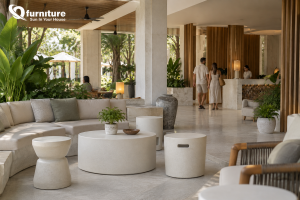
What Buyers Should Look for in a Concrete Furniture Manufacturer
As competition increases, supplier selection should go beyond product photos. Buyers should confirm whether a manufacturer can reproduce approved finishes and control product dimensions. They should also review reinforcement, curing, and packaging methods. Heavy concrete products need suitable protection for the intended shipping route. A reliable supplier should be able to repeat the approved result across a full commercial order.
Project requirements should also be defined before production begins. Buyers should consider placement, climate exposure, expected use, and product dimensions. Finish preferences, packaging limits, access restrictions, and installation conditions may also affect the final specification. For outdoor projects, drainage, sealing, edge protection, and maintenance instructions should receive particular attention.
Buyers who are comparing product types and finishes can explore Q-Furniture’s concrete furniture collection to review available tables, seating, stools, and other concrete pieces. These references can also be used as a starting point for size, finish, or project-specific customization.

Working With a Concrete Furniture Manufacturer in Vietnam
For international buyers, sourcing from Vietnam can be most effective when product development and logistics are planned together. Heavy furniture requires realistic packaging dimensions, handling methods, container planning, and site-access considerations. Addressing these issues early can reduce avoidable changes after a design has already been approved.
A manufacturer should also be able to explain how samples are approved and how production pieces are checked against that reference. Clear communication around natural concrete variation is particularly important because buyers need to understand which differences are acceptable material character and which indicate inconsistent production.
If you are planning a hospitality, retail, residential, or outdoor furniture project, you can contact Q-Furniture to discuss specifications, quantities, finishes, customization, packaging, and export requirements before requesting a quotation.
Frequently Asked Questions
Is the concrete furniture market expected to keep growing?
Demand is expected to remain relevant through 2030 as designers and buyers continue to value durable, architectural furniture for residential, hospitality, commercial, and public applications. Growth will depend on how effectively manufacturers address weight, logistics, surface consistency, and sustainability requirements.
What products are commonly included in the concrete furniture category?
Common products include dining tables, coffee tables, side tables, stools, benches, planters, consoles, countertops, basins, and urban furniture. Concrete is also frequently combined with wood, metal, or upholstery in mixed-material designs.
Why is concrete furniture suitable for commercial and hospitality projects?
Concrete can provide visual stability, durability, and a premium architectural appearance. When the mix, reinforcement, finish, and sealer are selected correctly, it can perform well in high-use spaces while requiring relatively straightforward maintenance.
Why do buyers source concrete furniture from Vietnam?
Vietnam offers an established furniture manufacturing and export ecosystem. For concrete furniture, buyers should still assess each supplier’s mold capability, finish control, QA process, customization experience, packaging, and ability to manage the logistics of heavy products.
What should buyers provide when requesting a quotation?
A useful quotation brief should include product references or drawings, dimensions, quantities, intended use, preferred finishes, destination, packaging expectations, and any customization requirements. More complete specifications help the manufacturer evaluate production methods and provide a more accurate quotation.








