


Outdoor spaces used to be treated as an added benefit.
A few tables outside a café. A poolside lounge at a resort. A garden corner for hotel guests. A rooftop terrace for good weather.
But in a hotter and less predictable climate, outdoor spaces are becoming something more important: part of a business risk conversation.
Recent heat events across different markets have shown how quickly extreme weather can affect daily life, infrastructure and commercial operations. In England, a record-breaking hot and dry period contributed to water pressure problems and temporary disruption for households and businesses. In parts of South and Southeast Asia, rising temperatures are making outdoor work more exhausting and reducing the ability of people to recover from heat.
For hospitality, food service, retail and public space projects, this shift matters.

The question is no longer only:
“Does this outdoor space look good?”
The better question is:
“Can this outdoor space continue to perform under heat, humidity, heavy use and long-term exposure?”
That is where furniture and material choice begin to play a bigger role.
For hotels, resorts, cafés and restaurants, commercial outdoor furniture is no longer just a visual addition. It is part of how a space performs, how guests experience the property and how operators manage long-term maintenance.
Outdoor Space Is No Longer Just Decoration
For hotels, resorts, cafés and restaurants, outdoor areas are often some of the most visible parts of the property. They appear in guest photos, booking images, social media posts and first impressions.
A terrace can become a breakfast area.
A courtyard can become a quiet lounge.
A poolside deck can become a premium hospitality experience.
A café frontage can become part of the street identity.
But when outdoor furniture is selected mainly for short-term appearance, problems often appear after months of real commercial use.
Lightweight pieces move too easily.
Low-grade finishes fade.
Materials crack, warp or stain.
Furniture that looked premium at installation starts to look tired before the project has recovered its investment.
For residential buyers, replacing furniture may be an inconvenience. For commercial operators, it can become an operational cost.
Outdoor furniture in a hospitality or F&B environment is not simply décor. It is equipment for guest experience.
This is why many project buyers are paying closer attention to outdoor concrete furniture as a long-term option for terraces, courtyards, poolside areas and commercial outdoor environments.
Heat Changes the Way People Use Outdoor Environments
As cities become hotter, the way people use outdoor space changes.
Guests may avoid exposed seating during the hottest hours. Staff may need to rearrange furniture more often to follow shade. Restaurants may depend more on covered areas, evening dining and shaded terraces. Hotels may need to design calmer outdoor zones where guests can rest without feeling overexposed.
This does not mean outdoor spaces become less important. In many cases, they become more important.
People still want fresh air, greenery, open views and a connection to nature. Travelers increasingly look for places that feel restorative, quiet and human. Restaurants and cafés still benefit from outdoor seating when it is comfortable and well designed. Resorts still rely on outdoor areas to create a sense of escape.
But the standard for these spaces is rising.
A successful commercial outdoor space now needs to combine beauty with endurance. It needs to feel premium, but also practical. It needs to support the guest experience without creating constant maintenance pressure for the operator.
Climate-Responsive Design Is Not Only About Buildings
When people discuss climate-responsive design, they often focus on buildings: roofs, ventilation, windows, insulation, shading systems and passive cooling.
Those elements are important. But the experience of a space is also shaped by what people touch, sit on, move around and interact with every day.
Furniture is part of climate-responsive design.
In shaded courtyards, covered walkways, verandas, rooftop gardens and poolside areas, furniture helps define how people actually use the space. A well-designed outdoor layout can encourage guests to slow down, stay longer and feel more comfortable. A poorly selected furniture package can make the same space feel temporary, unstable or difficult to maintain.
This is especially relevant for projects in warm, humid or coastal markets such as Vietnam, Singapore, India, parts of China, the southern United States and resort destinations across Southeast Asia.
In these environments, outdoor furniture must deal with more than sunlight. It may face humidity, rain, salt air, cleaning chemicals, high guest turnover and frequent rearrangement.
That makes material selection a business decision, not only a design decision.
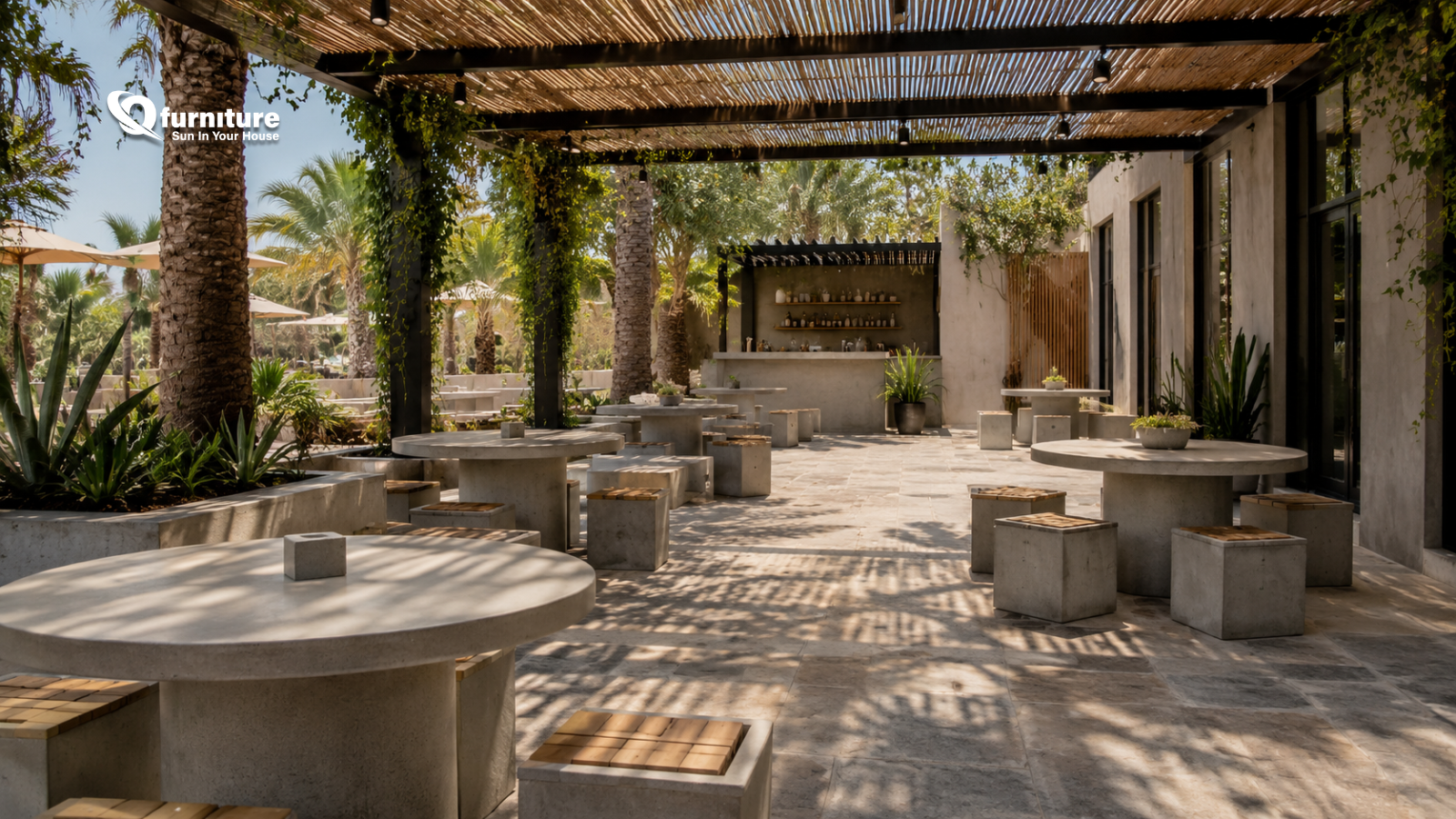
For projects that need both durability and warmth, outdoor concrete and wood furniture can create a practical balance: concrete brings stability and architectural presence, while wood details soften the experience and make the space feel more welcoming.
Why Durable Materials Matter More in Commercial Outdoor Spaces
For B2B buyers, outdoor furniture should be evaluated differently from residential patio furniture.
A hotel does not buy furniture for occasional weekend use.
A café does not buy tables for light seasonal decoration.
A resort does not furnish a poolside area simply to fill empty space.
These businesses need furniture that can support repeated use, maintain visual quality and reduce the need for replacement.
This is where durable materials such as GFRC concrete become relevant.
GFRC, or glass fiber reinforced concrete, offers a different value proposition from many lightweight outdoor furniture materials. It has a strong architectural presence. It feels stable. It works well in permanent or semi-permanent outdoor layouts. When designed properly, it can bring a sense of weight, calmness and long-term value to commercial spaces.
The benefit is not only that concrete furniture is “strong.” That is too simple.
The real benefit is that concrete furniture can help a space feel intentional.
A concrete dining table on a resort terrace does not feel temporary.
A GFRC bench in a landscaped courtyard does not feel like seasonal decoration.
A concrete and teak outdoor setting can create a balance between durability and warmth.
For hotels, cafés, restaurants and project developers, that sense of permanence matters. It supports the visual identity of the space and reduces the feeling that the outdoor area is an afterthought.
From Cost Per Piece to Cost Per Season

Many furniture decisions begin with unit price.
That is understandable. Budgets matter. Importers, distributors, project buyers and hotel owners all need to control cost.
But in commercial outdoor spaces, the cheapest option is not always the lowest-cost option.
A better way to think about outdoor furniture is not only cost per piece, but cost per season.
How many seasons can the furniture perform?
How much maintenance does it require?
How often does it need to be replaced?
Does it still look premium after months of sun, rain and daily use?
Does it support the brand image of the property?
When furniture fails early, the cost is not only the replacement product. There is also time, logistics, installation, disruption, waste and visual inconsistency.
For importers and distributors, this also affects customer trust. A product that looks good in a showroom but performs poorly in real outdoor conditions can create claims, complaints and damaged relationships.
For project developers and hospitality operators, furniture failure can weaken the overall guest experience.
Durability, therefore, is not just a technical feature. It is part of the business case.
This is why B2B buyers should consider the real cost of concrete outdoor furniture across multiple seasons, rather than judging the value of a product only by its initial price.
What B2B Buyers Should Ask Before Choosing Outdoor Furniture
As climate pressure increases and outdoor hospitality becomes more important, buyers may need to ask more practical questions before selecting furniture.
Is the furniture suitable for the local climate?
Can it handle heat, humidity, rain or coastal exposure?
Is it stable enough for high-traffic commercial areas?
Will the material still look appropriate after long outdoor use?
Does the design match the architecture and landscape?
Is the supplier able to deliver consistent quality across multiple pieces or projects?
Can the product support long-term value rather than short-term visual impact?
These questions are especially important for importers, distributors, hotel developers, architects and landscape designers working across international markets.
Outdoor furniture is not only about filling space. It is about helping a commercial environment perform over time.
A More Practical Future for Outdoor Design
The future of outdoor commercial design will not be defined by appearance alone.
It will be shaped by climate, maintenance, guest behavior, operational cost and long-term brand value.
Hotels will continue to invest in terraces, courtyards and poolside areas. Cafés and restaurants will continue to use outdoor seating as part of their identity. Resorts will continue to create open-air experiences that connect guests with nature.
But the materials used in these spaces will need to work harder.
For B2B buyers, this is the moment to rethink outdoor furniture as part of a broader performance strategy. Not just “What looks good in the catalog?” but “What still performs after years of real use?”
GFRC concrete outdoor furniture fits naturally into this conversation. With the right design, finish and production quality, it can offer the durability, stability and premium presence that commercial outdoor spaces increasingly require.
In a hotter and more demanding world, outdoor furniture should not only be beautiful on day one.
It should be built for the seasons ahead.
For importers, distributors, hotel developers and design professionals, working with a concrete furniture manufacturer for B2B export can help connect design intent with production capability, material performance and project-ready supply.
Conclusion
Extreme heat is changing how businesses think about outdoor environments. For hotels, resorts, cafés, restaurants and commercial projects, outdoor spaces are no longer only lifestyle features. They are part of guest experience, operational planning and long-term brand value.
This means outdoor furniture needs to be evaluated with a more practical lens. It must look appropriate for premium spaces, but it also needs to perform under heat, humidity, heavy use and seasonal exposure.
GFRC concrete furniture fits naturally into this new conversation because it offers durability, stability, low maintenance and architectural presence. For B2B buyers, the real value is not only how the furniture looks on the first day, but how well it supports the space over many seasons of use.









