


Why Quality Control Matters More for Hybrid Materials
For commercial project developers and international importers, explore our specialized capabilities as a concrete furniture manufacturer for B2B export.
When sourcing wood-concrete furniture from Vietnam, buyers face a fundamental challenge: two materials with opposing behaviors bonded into one product. Wood expands with moisture; concrete cracks under stress. A single weak joint can fail a 500-unit shipment.
This isn’t about general “good manufacturing practices.” You’re reading this because you’ve either:
- Received a container with 15% defect rates on concrete tabletops
- Been burned by inconsistent wood moisture content causing joint failure post-delivery
- Need documented QC protocols to justify Vietnam sourcing to your stakeholders
The question isn’t if your Vietnamese OEM has quality control—it’s whether their process catches hybrid material failures before they reach your warehouse.

The 7-Step QC Framework for Wood-Concrete OEM
Discover our latest collection of export-grade commercial concrete dining and outdoor tables engineered with lightweight GFRC.
Step 1: Raw Material Certification & Incoming Inspection
What happens: Materials undergo lab testing within 24 hours of factory arrival.
Critical checkpoints:
| Material | Test | Acceptance Criteria | Red Flag |
|---|---|---|---|
| Hardwood (acacia, oak) | Moisture content | 8–12% (kiln-dried) | >14% (warping risk) |
| Concrete mix | Compressive strength | ≥40 MPa at 28 days | <35 MPa (cracking) |
| Steel reinforcement | Tensile strength | Grade 60 (414 MPa) | Unlabeled rebar |
| Adhesives | Bond shear strength | ≥2.5 MPa | <2.0 MPa (joint failure) |
Buyer verification: Request material test certificates (MTCs) from suppliers. ISO 17025-accredited labs (e.g., SGS Vietnam, Intertek) provide third-party validation. Reject batches without traceability codes.
Common failure: Suppliers mixing old wood stock (>18 months kiln storage) with fresh lumber, creating moisture inconsistency across a production run.
Step 2: Pre-Production Sample Approval (Golden Sample Protocol)
What happens: Factory produces 3–5 units matching your specs before mass production begins.
Inspection focus:
- Joint alignment tolerance: ±0.5mm for wood-to-concrete interfaces (use digital calipers)
- Finish consistency: Color matching across wood grain and concrete texture
- Weight distribution: Center of gravity tests for tables/benches (tilt >30° without tipping)
Process:
- Supplier submits photos + dimensional reports
- You approve or reject with specific correction notes
- Approved sample becomes the “golden standard” for production QC
Expert insight: “We caught a supplier using different concrete aggregate sizes between samples and production. The sample had smooth river stones; production used crushed granite—completely different aesthetic. Always verify material sourcing consistency.” — Procurement Manager, US Hospitality Importer
Step 3: In-Process Monitoring (Critical Control Points)
What happens: QC checkpoints embedded into the production line, not just end-of-line inspection.
Key stages:
Stage A: Wood Machining (Day 1–2)
- CNC routing precision: ±0.3mm on joint surfaces
- Sanding grit progression: 80 → 120 → 180 (no skip-grits)
- Knot/crack rejection: Zero tolerance on stress points (table legs, bench supports)
Stage B: Concrete Casting (Day 3–5)
- Mold release application (prevents surface pitting)
- Vibration time: 90–120 seconds (eliminates air pockets)
- Curing chamber humidity: 90–95% RH for 7 days
Stage C: Wood-Concrete Assembly (Day 8–10)
- Adhesive curing pressure: 0.3–0.5 MPa for 24 hours
- Bolt torque specs: Hand-torque wrenches set to manufacturer values
- Real-time joint gap measurement (<0.2mm acceptable)
Practical tip: Request production floor photos timestamped at each stage. Video walkthroughs reveal rushed processes (e.g., workers skipping vibration steps to meet deadlines).
Step 4: Destructive & Non-Destructive Testing (Sampling Protocol)
What happens: Random units from each batch undergo stress tests; others get non-invasive checks.
Destructive tests (1–2% of batch):
- Load capacity: Apply 3x rated weight until failure (tables: 300kg → test to 900kg)
- Joint pull-apart force: Hydraulic testing on wood-concrete bonds
- Impact resistance: Drop test from 0.5m onto concrete floor
Non-destructive tests (100% of batch):
- Ultrasonic testing: Detect internal voids in concrete sections
- Moisture meter scans: Verify wood hasn’t absorbed humidity during assembly
- Visual grading: Surface finish, color matching, hardware alignment
Industry benchmark: Top Vietnam OEM suppliers maintain <2% defect rate. Anything above 5% signals systemic issues (untrained workers, equipment calibration failure).
Step 5: Final Inspection Protocol (Pre-Packaging Checklist)
What happens: Every finished unit undergoes a 12-point inspection before packaging approval.
Checklist (auditable documentation required):
- [ ] Dimensions match approved drawings (±2mm tolerance)
- [ ] Weight within spec range (±3% variance)
- [ ] Finish quality: No scratches >5mm, no concrete spalling
- [ ] Hardware secure: All bolts tightened, no missing components
- [ ] Stability test: 4-point rock test on flat surface (<1mm wobble)
- [ ] Labeling: SKU, batch number, production date visible
- [ ] Edge sealing: Wood edges sealed against moisture (marine-grade sealant)
- [ ] Concrete surface: Sealed with penetrating silicate (prevents dusting)
- [ ] Compliance marks: CARB P2, TSCA Title VI labels affixed
- [ ] Photography: 3 angles per unit for traceability
- [ ] Packaging materials: Foam corners, cardboard edge protectors present
- [ ] Final sign-off: QC inspector ID and timestamp
Red flag scenario: Supplier rushes final inspection during the last 48 hours before container loading. Quality drops sharply when timelines compress.
Step 6: Third-Party Audit Options (Independent Verification)
What happens: External auditors inspect random samples from your production batch.
When to use:
- First-time supplier relationship
- Orders >$50,000 value
- High-risk items (outdoor furniture, heavy concrete elements)
- Post-defect corrective action verification
Vietnam-based audit firms:
| Firm | Service | Cost (2026) | Turnaround |
|---|---|---|---|
| SGS Vietnam | Pre-shipment inspection (PSI) | $350–600/visit | 3–5 days |
| Bureau Veritas | Factory audit + PSI | $800–1,200 | 7 days |
| Intertek | Loading supervision | $400–700 | Same-day |
| QIMA (formerly AsiaInspection) | On-demand QC | $280–500 | 48 hours |
What they check:
- Sample selection (random pull from pallets)
- AQL (Acceptable Quality Limit) testing per ANSI/ASQ Z1.4 standards
- Packaging integrity
- Compliance documentation review
Buyer tip: Specify AQL levels in your purchase order (e.g., AQL 2.5 for critical defects, AQL 4.0 for minor defects). This removes subjectivity from pass/fail decisions.
Step 7: Defect Documentation & Corrective Action (Continuous Improvement)
What happens: Failed units trigger root cause analysis and process adjustments.
Defect categorization:
Critical (shipment rejection):
- Structural failure (cracked concrete, broken joints)
- Safety hazards (sharp edges, unstable base)
- Wrong materials used
Major (partial acceptance with discount):
- Finish defects affecting >10% surface area
- Dimensional variance >5mm
- Missing hardware (if replaceable)
Minor (acceptable with note):
- Small scratches <3mm
- Color variation within tolerance
- Packaging cosmetic damage
Corrective action loop:
- Supplier photographs defect + measures affected quantity
- Root cause identified (material, process, or human error)
- Corrective action plan (CAP) submitted within 48 hours
- Re-inspection before shipment release
- Follow-up audit on next production run
Data-driven insight: Suppliers tracking defect rates by category (material vs. process) reduce repeat failures by 60% within 3 months. Ask for monthly QC reports showing trend analysis.
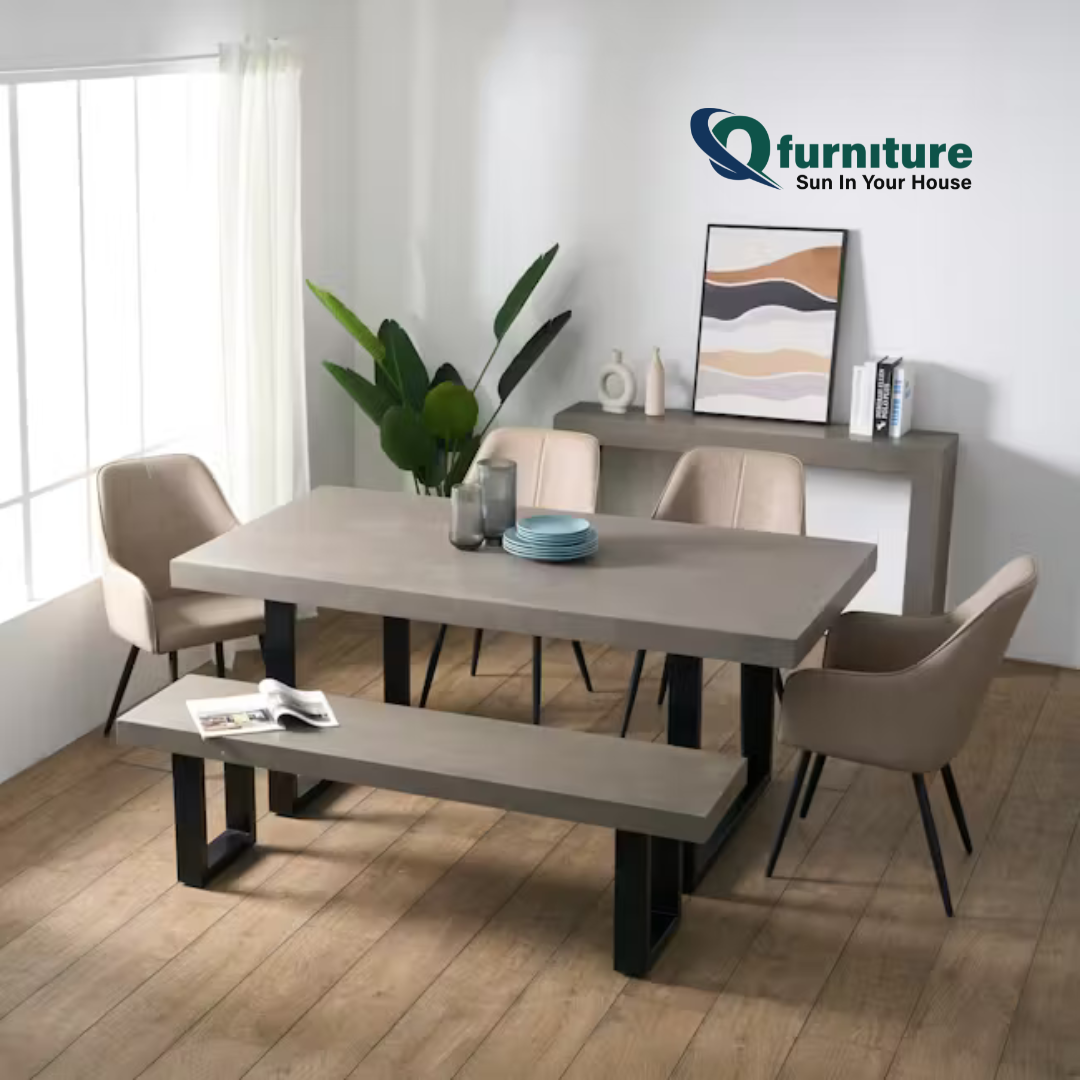 Q-Furniture Vietnam Factory” width=”1080″ height=”1080″ />
Common QC Failures & How to Avoid Them
Failure #1: “Phantom QC” (Documentation Without Actual Testing)
Scenario: Supplier sends perfect QC reports, but your container arrives with 20% defects.
Root cause: Fabricated data or spot-checking only 5% of production.
Prevention:
- Require timestamped photos of testing equipment in use
- Cross-reference batch numbers on QC reports with unit labels
- Conduct surprise audits (don’t announce inspection dates)
Failure #2: Concrete Curing Shortcuts
Scenario: Tables develop hairline cracks 2–3 months post-delivery.
Root cause: Factory reduced curing time from 28 days to 14 days to meet deadlines.
Prevention:
- Contract clause: “Concrete elements must cure minimum 21 days before assembly”
- Request curing chamber logs (temperature + humidity records)
- Specify compressive strength testing at 28 days, not 7 days
Failure #3: Inconsistent Joint Adhesive Application
Scenario: Some units have strong wood-concrete bonds; others separate during shipping.
Root cause: Workers apply adhesive manually without measured dispensers.
Prevention:
- Require pneumatic adhesive guns with calibrated output
- Photographic evidence of adhesive coverage (100% surface area)
- Pull-test random samples before final assembly
Best Practices from Vietnam OEM Leaders
Practice #1: QC Handover Meetings
Hold a 30-minute call with the factory QC manager before production starts. Walk through your specific concerns (e.g., “We had issues with concrete chipping on edges last time”). Document agreed checkpoints in writing.
Practice #2: Tiered Inspection Schedule
- 10% batch completion: First-article inspection
- 50% completion: Mid-production audit
- 100% completion: Final random sampling
This catches systemic issues early (cheaper to fix 100 units than 1,000).
Practice #3: Shared Defect Photo Library
Create a Google Drive folder with photos of acceptable vs. unacceptable quality. Removes language barriers and interpretation gaps.
Mini FAQ: Quality Control Decision Points
Q: Should I pay for third-party inspection on every order?
A: Not necessarily. Use audits for:
- First 3 orders with a new supplier
- Any order after a previous defect issue
- Orders where unit cost >$200 (audit cost becomes negligible)
For established suppliers with <1% defect history, spot-check every 4th–5th order.
Q: What’s a reasonable defect rate to negotiate into contracts?
A: Industry standard for furniture OEM:
- Critical defects: 0% (zero tolerance)
- Major defects: <2.5% (AQL 2.5)
- Minor defects: <4.0% (AQL 4.0)
Anything above this, and you’re absorbing the supplier’s QC failures.
Q: How do I verify a factory’s QC equipment is calibrated?
A: Request calibration certificates for:
- Moisture meters (annual calibration)
- Compression testers (6-month calibration)
- Calipers/micrometers (annual calibration)
Certificates should reference ISO 17025 standards.
Q: Can I reject a shipment at port if defects exceed AQL?
A: Yes, if your purchase order specified AQL limits and a pre-shipment inspection was conducted. Without documented QC agreements, rejection becomes a legal dispute.
Q: What’s the cost difference between in-house QC vs. third-party audits?
A: In-house QC is built into unit pricing (typically 2–4% of FOB cost). Third-party audits are separate ($280–1,200 per visit). Total landed cost difference: ~1–2% when using audits selectively.
How This QC Framework Fits into the Bigger Supplier Evaluation Picture
Related deep-dive: For technical details on wood-concrete joint durability that QC processes protect, see Joint Technology Standards in Wood-Concrete Hybrid Furniture
Compliance context: QC inspections must verify adherence to US/EU material regulations—review CARB P2 & TSCA Compliance for Vietnam Furniture Exports
Broader framework: This QC process fits within the overall supplier evaluation methodology covered in the Ultimate Guide to Vietnam Wood-Concrete Furniture OEM Suppliers (Pillar Page, Section: “Manufacturing Standards”).
Anchor text suggestion for pillar link: “Our 7-step quality control framework ensures the manufacturing standards detailed in the main supplier selection guide translate into consistent production outcomes.”
Final takeaway: Quality control for wood-concrete furniture isn’t a one-time gate check—it’s a continuous verification system across material intake, production stages, and final inspection. Buyers who treat QC as negotiable end up managing defects instead of preventing them. The suppliers who survive long-term OEM relationships are those who document, test, and improve at every stage.
For complementary supply chain insights, read our evaluation on Vietnam vs China furniture sourcing for importers.
📩 Request a Direct Factory B2B Sourcing Proposal (FOB / CIF)
Are you evaluating furniture manufacturing partners in Vietnam or planning full container load (FCL) orders? Connect directly with Q-Furniture’s export engineering team to discuss CAD design specs, material finishes, and wholesale pricing.








