


For furniture importers, wholesalers, distributors, hotel project buyers, and procurement teams, choosing between Vietnam and China is not only a question of unit price. The real decision depends on landed cost, minimum order quantity, material capability, customization flexibility, export documentation, packaging, lead time, and long-term supplier reliability.
China remains one of the world’s largest furniture manufacturing and export bases. In 2025, China’s home furnishing export volume was reported at around USD 64 billion, supported by a large industrial base, automation, and mature export networks. Vietnam, meanwhile, has become a major furniture export hub, especially for wooden, outdoor, mixed-material, and project-based furniture. In 2024, Vietnam exported USD 10.3 billion of “other furniture,” ranking second globally in that category according to OEC data.
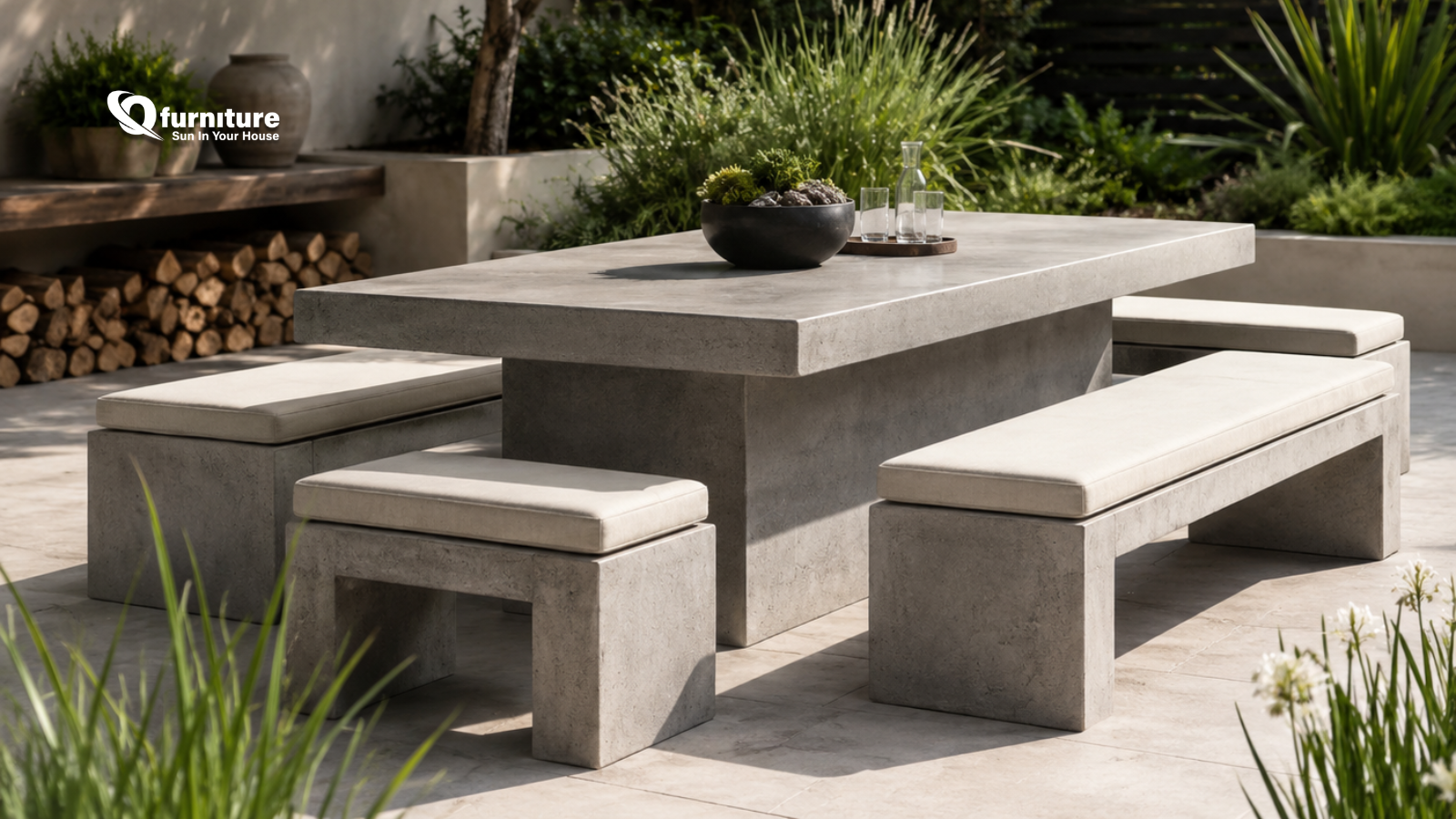
For buyers evaluating concrete furniture, the comparison becomes more specific. Q-Furniture is positioned as a B2B concrete furniture manufacturer and exporter, not as a wooden furniture brand. This matters because concrete furniture follows a different sourcing logic from mass-market wooden furniture. Importers should evaluate mold accuracy, surface finishing, curing control, outdoor durability, protective packaging, and container loading methods, not only catalog price.
Vietnam vs China at a Glance
For commercial project developers and international importers, explore our specialized capabilities as a concrete furniture manufacturer for B2B export.
| Factor | Vietnam | China |
|---|---|---|
| Best fit | OEM/ODM, outdoor furniture, mixed materials, concrete furniture, project-based orders | Large-scale catalog furniture, wide supplier base, fast component sourcing |
| Price advantage | Competitive for labor-intensive, customized, outdoor, and project furniture | Strong for mass production, standardized SKUs, hardware, accessories, and high-volume runs |
| MOQ style | Often container-based or SKU-based, depending on factory | Can be low through trading markets, but custom factory orders may require higher MOQ |
| Customization | Strong for B2B export projects and design-led buyers | Very broad capabilities, especially when volume is large |
| Export maturity | Strong in furniture exports, especially to the US, Europe, Japan, Australia | Extremely mature global export infrastructure |
| Risk focus | Supplier capacity, material sourcing, compliance documentation | Trade duties, supplier verification, product consistency across complex supply chains |
Export Profile: Scale vs Specialization
Discover our latest collection of export-grade commercial concrete dining and outdoor tables engineered with lightweight GFRC.
China offers unmatched scale. Its furniture ecosystem includes raw materials, hardware, fittings, packaging suppliers, machinery, logistics providers, trading companies, and large factory clusters. For importers buying high volumes of standardized furniture, China often provides broader supplier choice and faster sample comparison.
Vietnam has developed a different profile. It is highly relevant for importers looking for export-ready production, outdoor furniture, wooden furniture, mixed-material furniture, and project-based manufacturing. World Bank WITS data shows that in 2024, top importers of Vietnamese wooden furniture included the United States, the European Union, the United Kingdom, Japan, Canada, Australia, France, and Germany.
For concrete furniture buyers, Vietnam can be attractive because many B2B buyers are no longer sourcing only traditional indoor wooden furniture. Hospitality projects, outdoor restaurants, resorts, landscape contractors, and architecture studios increasingly look for durable, architectural materials that can perform in outdoor and semi-outdoor environments.
This is where Q-Furniture’s concrete furniture focus becomes relevant. Instead of competing as another wooden furniture supplier, Q-Furniture can serve buyers who need concrete tables, concrete benches, concrete planters, concrete sinks, outdoor concrete furniture, and custom concrete pieces for commercial or hospitality projects.
Price Comparison: Unit Price Is Not the Final Cost
China is often competitive when the product is standardized, the quantity is large, and the buyer can work with existing catalog designs. A factory that already produces a dining chair, cabinet, or table in large volumes can spread mold, setup, labor, and material costs across many units. That can reduce unit price.
Vietnam can be competitive when the order requires more manual finishing, outdoor material handling, customized production, or smaller project batches. For concrete furniture, price should not be evaluated like lightweight indoor flat-pack furniture. Importers should compare the total landed cost, including:
- product weight;
- packaging structure;
- pallet or crate requirements;
- container utilization;
- damage rate risk;
- surface finishing requirements;
- replacement cost;
- inspection cost;
- import duties and tariff exposure.
For US-bound importers, tariff policy has become especially important. In 2025, Reuters reported new US duties on imported timber, lumber, kitchen cabinets, bathroom vanities, and upholstered furniture, with higher rates affecting certain wooden product categories. Importers should therefore calculate landed cost by HS code, not by supplier quote alone.
For concrete furniture, the key pricing question is not simply “Vietnam or China: which is cheaper?” A better question is: “Which supplier can deliver the required design, durability, packaging safety, and defect control at the most reliable landed cost?”
MOQ Comparison: Container Logic Matters
MOQ is one of the biggest differences between retail sourcing and B2B furniture manufacturing.
In China, MOQs vary widely. Some sourcing agents report typical ranges of 10–50 pieces per model for standard furniture, 20–100 pieces per design for custom or upholstered furniture, and 50–200 pieces or more for complex specialized items. This makes China flexible at the market and trading-company level, especially when buyers source existing designs.
In Vietnam, many export furniture factories work on container-based logic. Public exhibitor data from HawaExpo 2026 shows examples such as MOQ by 20-foot container, 1–2 containers per month, 1 x 40’HQ container, 50 pieces per SKU, 100 pieces, or 750 pieces per product depending on the factory and category. Another Vietnamese OEM furniture manufacturer lists a standard MOQ of 20 pieces per item based on a full mixed 20-foot container.
For importers, this means MOQ should be negotiated around container planning, not only SKU count.
For concrete furniture, MOQ depends heavily on product size, mold complexity, finishing process, and container loading. A concrete coffee table, concrete planter, concrete dining table, and concrete sink may not share the same production economics. If custom molds are required, buyers should expect higher setup costs or agreed repeat-order commitments.

Customization: Where Vietnam Can Be Strong
China has a very deep customization ecosystem. For large-volume orders, Chinese factories can support design changes, hardware options, finishes, upholstery, packaging, and private labeling. The advantage is strongest when buyers have mature specifications and predictable order volume.
Vietnam is increasingly strong in OEM and ODM furniture for export buyers. For importers who need design adaptation, project-based production, and communication around finishing details, Vietnam can be a practical option. This is especially true for outdoor furniture, hospitality furniture, mixed-material furniture, and architectural products.
For Q-Furniture, customization should focus on the strengths of concrete furniture:
- custom dimensions;
- custom molds;
- color tone variation;
- smooth, textured, or stone-like surfaces;
- indoor and outdoor finishes;
- drainage options for planters;
- sink and basin formats;
- logo or project-specific packaging;
- wholesale and project-based packing plans.
Concrete furniture is not mass-customized in the same way as flat-pack wood furniture. A serious importer should ask about mold development, sample approval, curing time, edge detail, color tolerance, surface protection, and packaging tests before confirming a production order.
Why Concrete Furniture Requires a Different Supplier Evaluation
Wooden furniture sourcing often focuses on timber species, moisture content, joinery, veneer quality, coating, and structural stability. Concrete furniture requires another set of controls.
GFRC, or glass fiber reinforced concrete, is commonly used in architectural and furniture applications because it can support thinner, lighter, and more design-flexible concrete forms compared with traditional heavy concrete. Architectural precast sources describe GFRC as useful for thin-wall applications and projects where weight limitations matter.
For importers, this affects both product design and logistics. A well-made concrete table or planter must balance strength, weight, edge durability, finish consistency, and safe handling. Poor curing, weak reinforcement, insufficient sealing, or inadequate packaging can cause cracks, chips, staining, or shipment damage.
This is why Q-Furniture’s positioning as a concrete furniture manufacturer should be clear. The brand should not be evaluated against Vietnam’s wooden furniture exporters only. It should be evaluated as a specialized supplier for architectural concrete furniture, outdoor concrete furniture, concrete planters, concrete sinks, and custom project furniture.
Q-Furniture’s Focus: Concrete Furniture, Not Wooden Furniture
Q-Furniture is not positioned as a general wooden furniture manufacturer. Its value is in concrete furniture manufacturing for B2B export projects.
This distinction helps importers make a better sourcing decision. Buyers looking for low-cost wooden chairs or standard indoor cabinets may compare China, Vietnam, Malaysia, Indonesia, and Eastern Europe using a traditional wooden furniture framework. Buyers looking for concrete tables, concrete benches, concrete planters, or outdoor architectural furniture need a supplier with material-specific knowledge.
Concrete furniture is suitable for projects where durability, visual weight, outdoor performance, and architectural identity matter. Hotels, resorts, restaurants, landscape projects, commercial courtyards, villas, and modern residential developments often need furniture that does more than fill a room. They need pieces that support the design language of the space.
Q-Furniture’s role is to support that type of buyer with manufacturing, customization, quality control, export packaging, and project communication.
Concrete Furniture Products Q-Furniture Can Manufacture
Concrete Tables
Concrete tables are suitable for cafes, resorts, outdoor dining areas, patios, courtyards, and commercial spaces. Importers may request coffee tables, dining tables, side tables, console tables, and custom table formats.
For B2B buyers, the key details include tabletop thickness, base design, surface finish, edge profile, sealing, weight, and packaging method.
Concrete Benches and Stools
Concrete benches and stools are often used in gardens, hotels, public areas, landscape projects, and outdoor restaurants. They provide a strong architectural look and can be designed as standalone pieces or as part of a coordinated outdoor collection.
Concrete Planters
Concrete planters are highly relevant for landscape contractors, garden centers, hospitality projects, and commercial developments. Importers should confirm drainage holes, internal coating, frost or heat exposure requirements, size tolerance, and palletization.
Concrete Sinks and Basins
Concrete sinks and basins serve hotels, villas, restaurants, and architectural interiors. These products require careful mold control, water resistance, sealing, drainage accuracy, and surface finishing.
Outdoor Concrete Furniture
Outdoor concrete furniture is suitable for weather-exposed areas when properly designed, fabricated, sealed, and maintained. Buyers should specify the destination climate, use case, expected maintenance level, and packaging requirements.
Custom Concrete Furniture for Projects
Custom concrete furniture is often needed for hospitality, commercial, and architectural projects. Q-Furniture can position this capability around project drawings, size adjustments, color matching, mold development, and export-ready production planning.
Quality Control and Export-Ready Production
For concrete furniture importers, quality control should be built into every production stage.

Material selection matters because cement, aggregates, fibers, pigments, admixtures, and sealers affect both appearance and durability. Mold accuracy affects dimensions, edge quality, and repeatability. Surface finishing determines the final visual quality of each piece.
The curing process is also important. Concrete products require controlled curing to reduce cracking risk and improve durability. Rushing production may create hidden defects that appear later during shipping or use.
A strong export-ready process should include:
- material batch control;
- mold inspection;
- dimensional checking;
- surface finishing review;
- curing control;
- strength and durability checking where applicable;
- edge and corner inspection;
- sealing and protection;
- carton, foam, pallet, or crate design;
- container loading support;
- pre-shipment inspection.
For heavy or fragile-surface products such as concrete tables and sinks, packaging is not a minor detail. It is part of the product engineering.
Vietnam or China: Which Should Importers Choose?
Importers should choose China when they need broad supplier choice, very high-volume production, standardized catalog furniture, fast hardware sourcing, and large-scale cost optimization.
Importers should choose Vietnam when they need export-ready production, strong outdoor furniture capability, project-based manufacturing, and a supplier base that is increasingly familiar with US, European, Australian, Japanese, and international buyer requirements.
For concrete furniture, Vietnam can be a strong option when the supplier has the right material expertise. The decision should not be based only on country comparison. It should be based on factory fit.
A practical sourcing framework is:
- Define the product category: wooden, metal, upholstery, concrete, GFRC, mixed material.
- Confirm the buyer type: wholesaler, distributor, project buyer, retailer, hotel group, landscape contractor.
- Compare landed cost, not only FOB price.
- Check MOQ by SKU, mold, container, and repeat order.
- Review customization capability.
- Request samples or prototypes.
- Confirm packaging and container loading method.
- Verify export documentation and inspection process.
- Start with a controlled first order before scaling.
For importers seeking concrete furniture, Q-Furniture should be evaluated as a specialized manufacturing partner rather than a general furniture supplier.
Why B2B Buyers Choose Q-Furniture
- Focus on concrete furniture manufacturing for export projects.
- Suitable product categories for hotels, resorts, outdoor spaces, commercial areas, and residential developments.
- Ability to support custom concrete furniture based on project needs.
- Product direction aligned with architectural, outdoor, and modern furniture trends.
- Manufacturing mindset suited to B2B buyers, importers, distributors, and procurement teams.
- Attention to mold accuracy, surface finish, curing, packaging, and shipment preparation.
- Clear positioning outside the crowded wooden furniture supplier category.
Frequently Asked Questions
Is Vietnam better than China for furniture sourcing?
Vietnam can be better for certain B2B furniture categories, especially outdoor furniture, project-based production, and custom manufacturing. China is often stronger for very large-scale standardized production and broad supplier selection. The better choice depends on product type, MOQ, customization, landed cost, and compliance requirements.
Is Q-Furniture a concrete furniture manufacturer?
Yes. Q-Furniture is positioned as a concrete furniture manufacturer and exporter for B2B buyers, including importers, wholesalers, distributors, hotel and resort buyers, architecture studios, landscape contractors, and procurement teams.
Does Q-Furniture produce wooden furniture?
Q-Furniture is not positioned as a wooden furniture manufacturer. Its focus is concrete furniture, including concrete tables, concrete benches, concrete planters, concrete sinks, outdoor concrete furniture, and custom concrete furniture.
Can Q-Furniture make custom concrete furniture?
Q-Furniture can be positioned for custom concrete furniture projects, including customized dimensions, forms, colors, surface finishes, and packaging requirements. For project orders, buyers should provide drawings, target use, quantity, and destination market requirements.
Is concrete furniture suitable for outdoor use?
Concrete furniture can be suitable for outdoor use when it is properly designed, fabricated, sealed, packaged, installed, and maintained. Outdoor use should be discussed early because climate, drainage, surface protection, and exposure conditions affect product specifications.
What types of concrete furniture are suitable for hotels and resorts?
Hotels and resorts often use concrete dining tables, coffee tables, benches, stools, planters, sinks, basins, and outdoor lounge furniture. These products work well in courtyards, pool areas, gardens, restaurants, villas, and public spaces.
How should importers compare MOQ between Vietnam and China?
Importers should compare MOQ by SKU, mold, container, and repeat-order plan. China may offer low MOQs for existing catalog products, while Vietnam export factories often work around container-based orders. For concrete furniture, MOQ may also depend on mold cost and product size.
For complementary supply chain insights, read our evaluation on Custom & OEM furniture manufacturing solutions from Vietnam.
Conclusion
Vietnam and China both have strong advantages for furniture importers. China offers scale, supplier variety, and mature mass-production systems. Vietnam offers strong export capability, growing B2B furniture specialization, and good potential for customized, outdoor, and project-based furniture.
For concrete furniture buyers, the best sourcing decision is not simply Vietnam versus China. It is whether the supplier understands the material, the project requirements, the export process, and the risks of shipping heavy architectural furniture.
Q-Furniture is positioned for importers who need a reliable concrete furniture manufacturer for wholesale orders, OEM/ODM projects, hotel and resort furniture, outdoor concrete furniture, and custom export inquiries.
📩 Request a Direct Factory B2B Sourcing Proposal (FOB / CIF)
Are you evaluating furniture manufacturing partners in Vietnam or planning full container load (FCL) orders? Connect directly with Q-Furniture’s export engineering team to discuss CAD design specs, material finishes, and wholesale pricing.








