


Vietnam Furniture Manufacturers – Finding Reliable Suppliers
Most buyers who come to Vietnam for the first time have a similar experience: the prices look competitive, the suppliers seem capable, and then the first shipment arrives with problems that were never properly discussed at the beginning.
The issue is not Vietnam’s manufacturing potential. Vietnam furniture manufacturers have built a strong export base over the years, and many suppliers are capable of handling international orders. The real challenge is that the supplier landscape is fragmented in ways that are not always obvious until production is already underway. That is especially true when you are sourcing from Vietnam concrete furniture manufacturers, where technical execution matters just as much as production capacity.
A lot of buyers enter the market expecting flexible production and attractive pricing. What they do not always expect is how uneven the supplier base can be. Not every Vietnam furniture factory is export-ready. Not every “manufacturer” is actually running its own production. And not every supplier has real experience with concrete furniture manufacturing.
If you are trying to get a clearer picture of how Vietnam furniture manufacturers operate in the concrete furniture segment, this guide will help you avoid the common sourcing mistakes many buyers make early on.

Why Choose Vietnamese Furniture Manufacturers
For commercial project developers and international importers, explore our specialized capabilities as a concrete furniture manufacturer for B2B export.
The shift away from China may have accelerated buyer interest, but Vietnam furniture manufacturers have held their position for reasons beyond cost alone.
Vietnam has an established furniture export ecosystem, and that matters even when working with concrete furniture manufacturers in Vietnam. In the right supplier network, buyers can find factories with experience in mold development, casting, reinforcement handling, curing control, surface finishing, sealing, and export packaging for heavy products. Materials and production inputs — including cement-based mixes, pigments, reinforcement elements, metal frames, and finishing systems — are also relatively accessible.
On pricing, Vietnam furniture manufacturers do not always compete on the absolute lowest cost. What they tend to do better is offer workable mid-range production with a reasonable level of consistency. For many importers, that balance is more valuable than simply chasing the lowest quote.
If you are new to this market, it helps to start with a broader understanding through this overview of Vietnam’s furniture manufacturing landscape before moving into direct supplier outreach.
Types of Furniture Manufacturers in Vietnam
Discover our latest collection of export-grade commercial concrete dining and outdoor tables engineered with lightweight GFRC.
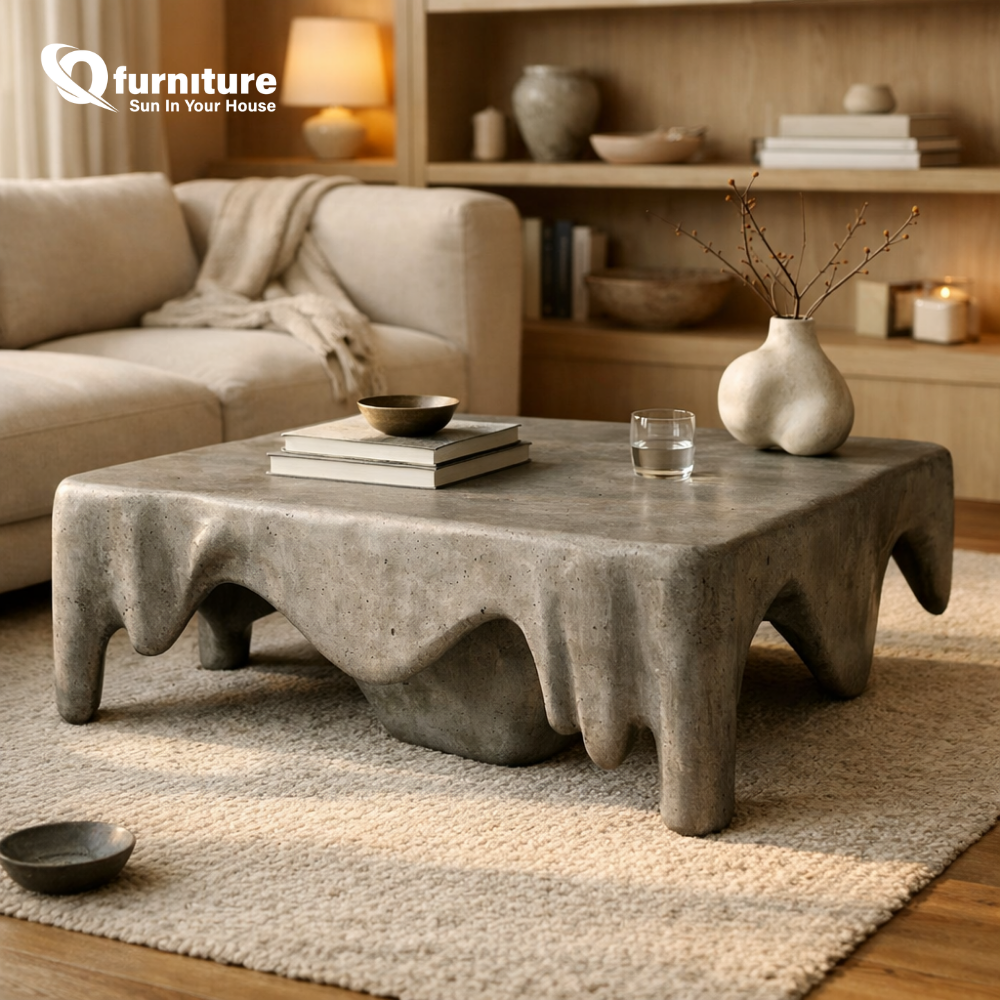
Not all Vietnam furniture manufacturers are built the same. This is where many sourcing problems begin.
OEM vs. Standard Production
This is usually the first distinction buyers notice.
OEM factories work based on your design. You send drawings, specifications, dimensions, finish references, and technical requirements, and they produce accordingly. In theory that sounds simple. In practice, success depends heavily on whether the supplier has real experience as a concrete furniture manufacturer.
Some Vietnam furniture manufacturers say yes to everything, then struggle with mold accuracy, tonal consistency, crack prevention, surface finish, or packaging requirements.
Standard production factories, on the other hand, sell what they already make. Their business is usually catalog-based. Faster, easier, and with fewer surprises — but with limited customization.
If you are still defining your sourcing approach, it is worth understanding how to source furniture effectively from Vietnam before deciding between OEM production and standard models.
A practical note from experience: if your product has tight design requirements or strong brand positioning, OEM is usually the better route. But when working with Vietnam concrete furniture manufacturers, expect more back-and-forth during development, especially around samples, edge details, finish quality, and reinforcement structure.
Handmade vs. Factory-Made Furniture
Vietnam still has a strong handcrafted segment, and that applies to concrete furniture as well. Many concrete furniture suppliers in Vietnam produce smaller-batch decorative tables, stools, benches, planters, and custom architectural pieces using more manual casting and finishing methods.
Handmade does not mean low quality — but it does mean variation.
You may see slight differences between batches in tone, cast texture, pinholes, edge sharpness, or surface character. In some markets, that variation is part of the product appeal. In others, it becomes a quality issue.
Factory-made furniture is more standardized. A Vietnam furniture factory with better mold systems, more repeatable casting methods, and more consistent finishing processes will usually be better suited for larger orders and repeatable SKUs.
Where buyers often get caught off guard is when they mix expectations. They order a handmade concrete product but expect factory-level uniformity in every unit.
That mismatch leads to disputes.
How to Verify a Supplier in Vietnam

This is where most sourcing failures happen — not during negotiation, but during verification.
A polished website does not mean much. Neither does a quick response time.
Certifications and Compliance
At a minimum, export-focused Vietnam furniture manufacturers should have basic certifications or process controls depending on your market and product type.
That may include:
- social compliance standards such as BSCI or SEDEX
- ISO or similar process-control systems
- product-related testing or declarations for coatings, sealers, or packaging requirements where relevant
But the reality is simple:
Certificates can be outdated, borrowed, or not directly relevant to the products you are buying.
Always ask for:
- the latest audit reports
- product-specific compliance or testing documents, not just factory-level paperwork
And do not just collect files. Make sure you understand what they actually cover.
When evaluating Vietnam concrete furniture manufacturers, paperwork alone is not enough. You also need to understand whether the supplier can control the factors that matter most in concrete furniture production: mix consistency, reinforcement methods, curing discipline, dimensional tolerance, sealing quality, and safe packaging for heavy items.
Factory Visits and Quality Checks
If you are serious about long-term sourcing, visiting the factory changes the conversation completely.
You will quickly see:
- whether the supplier is actually producing in-house
- how organized the casting, curing, finishing, and packing areas are
- how they handle molds, raw materials, reinforcement, and finished goods
Some Vietnam furniture manufacturers are in fact trading companies coordinating outsourced production. That is not always a problem — but you need to know whether the supplier is a real manufacturer or just acting as an intermediary.
If you cannot visit, third-party inspections are essential. Pre-production and pre-shipment checks should be standard practice when working with a new Vietnam furniture factory.
Buyers who skip this step often pay for it later through delays, defects, rework, or customer claims.
For concrete furniture, inspections should not focus only on visual appearance. They should also assess dimensional tolerances, surface consistency, edge durability, curing quality, sealing performance, and packaging readiness.
Export Capabilities of Vietnam Manufacturers
Even if a supplier can manufacture well, exporting adds another layer of complexity.
Lead Times and Minimum Order Quantities (MOQ)
Lead times in Vietnam are usually workable, but they depend heavily on:
- mold preparation or mold modification
- casting and curing time
- sealing and finishing requirements
- order volume
Typical ranges are often:
- 30–45 days for standard items
- 45–75 days for OEM projects or more complex builds
MOQ is where things often become less straightforward.
Some Vietnam furniture manufacturers appear flexible on paper, but in reality:
- small orders get pushed back in the schedule
- pricing becomes unstable
- finish consistency becomes harder to maintain across inefficient production runs
It is usually better to align your MOQ with the supplier’s natural production flow rather than force quantities that do not fit how the factory actually runs.
If you are preparing your first order, reviewing this step-by-step guide to importing furniture from Vietnam can help reduce early sourcing and logistics mistakes.
Shipping and Logistics Options
Most exports from Vietnam furniture manufacturers move through:
- Ho Chi Minh / Cat Lai Port
- Hai Phong Port
Shipping options are standard:
- FCL (Full Container Load) for larger orders
- LCL (Less than Container Load) for smaller shipments
But with concrete furniture suppliers in Vietnam, logistics issues often come less from the shipping route itself and more from packaging and load handling.
Common problems include:
- weak internal protection leading to chipped edges or cracked corners
- poor pallet construction leading to movement, breakage, or higher handling costs
- incorrect labeling or load details causing customs or warehouse issues
A reliable Vietnam furniture factory should address packaging standards early, especially when dealing with heavy and fragile concrete products. If the supplier does not raise that issue on their own, that is a warning sign.
Before sending your first RFQ, it is worth testing how a supplier responds to three simple questions:
“Can you share the latest audit report or quality control documents relevant to this product category?”
Serious Vietnam furniture manufacturers can usually provide something current. Those who cannot — or who send old or irrelevant paperwork — are already telling you something.
“What is your typical lead time if I order [X units] with [Y finish/specification]?”
A vague answer often means they have not actually mapped the process. A specific answer, even if still approximate, shows that the supplier understands mold planning, casting capacity, curing time, and finishing workflow.
“Who handles packaging specifications for my market, especially for heavy concrete products?”
If they hesitate — or push the full responsibility back to you — that usually means they are still learning how to manage export-grade packaging. That does not always make them unusable, but it does affect your timeline and risk level.
None of these questions are difficult. But the quality of the answers will often tell you more than any factory profile.
For complementary supply chain insights, read our evaluation on Ultimate furniture factory audit checklist for importers.
📩 Request a Direct Factory B2B Sourcing Proposal (FOB / CIF)
Are you evaluating furniture manufacturing partners in Vietnam or planning full container load (FCL) orders? Connect directly with Q-Furniture’s export engineering team to discuss CAD design specs, material finishes, and wholesale pricing.








