
Import Furniture From Vietnam – Furniture Sourcing & Manufacturing
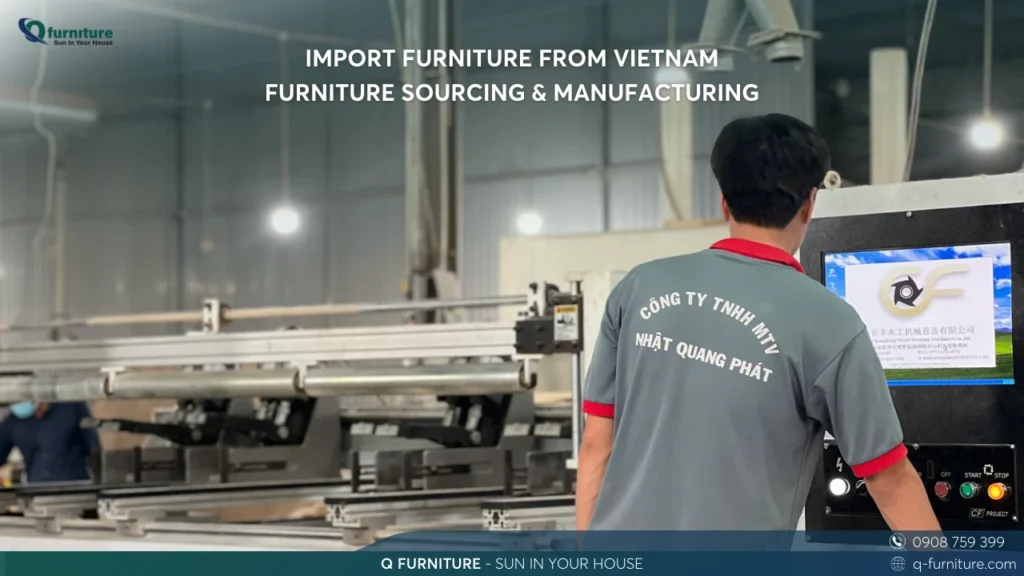

For commercial project developers and international importers, explore our specialized capabilities as a concrete furniture manufacturer for B2B export.
Import Furniture From Vietnam: What Buyers Actually Need to Know
Discover our latest collection of export-grade commercial concrete dining and outdoor tables engineered with lightweight GFRC.
Most guides on this topic read like a trade report. This one doesn’t.
What follows is based on what we’ve seen working directly with importers from the US, EU, Canada, and India — the questions they ask before their first order, and the problems that come up after.
Vietnam’s Furniture Industry: Why It Actually Matters Now
If you’re still sourcing furniture from China only, you’re already exposed to risk — cost volatility, tariffs, and lead times that shift every time policy does.
Vietnam has quietly become one of the most reliable alternatives — not because it’s cheaper, but because it’s built for export from day one. Over 90% of furniture produced here goes straight to international buyers. That changes everything about how factories operate: how they quote, how they handle documentation, and how seriously they treat your production slot.
The shift wasn’t gradual either. Vietnam went from 13th to 6th in global furniture production in under a decade. It now ranks in the top 3 exporters worldwide. Upholstered furniture alone has grown to 25% of total output — so if your range goes beyond wooden case goods, Vietnam can still deliver.
The buyers getting the best results here aren’t chasing the lowest FOB price. They’re the ones who came in with clear specs, treated factory vetting seriously, and approached this as a long-term sourcing relationship. That mindset difference shows up — in pricing, in lead times, and in how factories prioritize your orders when production is tight.
What You Can Actually Source Here — And Where Vietnam Falls Short
Most factories here focus on indoor furniture. But not all categories are equal.
Vietnam is genuinely strong in solid wood bedroom sets (acacia, rubberwood, teak-veneer), upholstered sofas built for mid-to-high retail price points, dining sets at mid-range to high-volume runs, rattan and outdoor furniture, and office furniture for commercial and hospitality projects.
Where does it fall short? Flat-pack and ultra-low-cost SKUs. That still belongs to China — the automation infrastructure and supply chain density there are purpose-built for that margin. If your business model runs on €39 bookshelves, Vietnam is not your market.
But if you’re building a brand around solid wood, natural materials, or private-label upholstery — you’re in the right place. If you’re still mapping out where Vietnam sits relative to other major production hubs, our breakdown of how global furniture manufacturing is structured by region and category gives useful context before you finalize a sourcing decision.
Wood in Vietnam: What’s Available, What Isn’t, and What to Watch For

Southeast Asia runs on tropical hardwoods. The climate shapes what’s commercially viable here — and understanding that before you brief a factory saves a lot of back-and-forth.
What you can source consistently:
Acacia — Vietnam’s most commercially mature species. Plantation-grown, which means stable supply and predictable pricing. Dense enough for structural pieces, takes stain well, naturally resistant to termites. Works well for modern or Scandinavian-influenced designs.
The grain is subtle — a limitation if you’re selling on “natural wood character,” but an advantage when finish consistency matters across a large run. One thing buyers consistently miss: acacia board quality varies significantly between suppliers. Same species, very different results. Ask to see the lumber source and kiln-drying process — not just the finished sample.
Rubberwood — Harvested at the end of a rubber tree’s productive life, so genuinely sustainable — not just marketed that way. Tight-grained, moisture-resistant, stable. One of the better choices for painted furniture because the surface stays consistent. It’s not a statement wood, though. If your product story depends on visible grain and natural warmth, acacia or teak will serve you better.
Plywood & engineered wood — Standard for cabinet carcasses, drawer boxes, panel furniture. Quality varies considerably. Always specify grade in your PO — we’ve seen factories substitute lower-grade plywood on bulk runs when specs weren’t locked down in writing.
Bamboo — Good for the sustainability story and for specific applications: shelving, flooring, accent pieces. Still has real vulnerability to humidity swings. Better suited for decorative or secondary structural roles than primary frames.
Woods that are harder to source:
If your design calls for oak, beech, walnut, ash, or large-volume teak — be upfront with your factory before you send specs.
Vietnam doesn’t have significant oak or beech forests. Walnut is imported. Teak is grown domestically but not at export scale. Pine comes primarily from Northern Europe and the US.
The mistake we see repeatedly: a buyer sends a brief calling for “solid oak” or “American walnut” without checking whether the factory has a reliable supply channel for that species. The factory says yes — because they want the business. Then lead times stretch, costs spike, and quality becomes harder to control because they’re sourcing through a third party they’ve never worked with before.
If your designs depend on European hardwoods, build that raw material cost in from day one. Or work with a factory that has established import channels — and ask to see documentation proving it.
OEM and Custom Production: What “Custom” Actually Means Here
Most Vietnamese factories will say yes to custom orders. The real question is whether they have the capability to execute — or whether they’re saying yes because they want the business and will figure it out later.
Vietnam is not a low-cost shortcut for complex custom production. If fast and cheap is your brief, don’t come here expecting both.
The factories worth working with on OEM can show you three things without hesitation: past tech pack documentation, a sample room with previous client approvals, and a clear timeline for your sampling rounds. If a factory can’t produce any of those, “custom production” probably means “we’ll try our best.” For buyers who want to go deeper on how OEM production actually works in Vietnam — including how to read a factory’s sample room and what a realistic production timeline looks like — our guide on custom and tailored furniture manufacturing in Vietnam covers the full process.
When it works — and with the right partner, it usually does — the process looks roughly like this:
- Submit specs, reference samples, or CAD files
- Factory quotes and produces prototypes — around 2–3 weeks for most pieces, longer for complex upholstery
- Sample review and revision rounds — budget for at least two, sometimes three
- Final sample sign-off — in writing, with photos, measurements, and finish references
- Bulk production: around 60 days in most cases, longer for complex pieces or during peak season
- Pre-shipment inspection before the container is sealed
- Export documentation and shipping
Plan for 10–12 weeks total from deposit to container departure. If someone promises you 6 weeks on a custom order, ask them exactly what’s being compressed — because something always is.
One of the most common — and expensive — mistakes we see: approving samples over WhatsApp.
The sample looks good enough on camera. Production starts. Then when the container is ready, the finish is slightly off, dimensions are inconsistent, or materials were quietly substituted somewhere in the run.
At that point, you’re no longer negotiating quality. You’re negotiating damage control.
One EU buyer we worked with ran into exactly this. Verbal approval on a photo, no written spec confirmation. The factory proceeded. The bulk finish didn’t match. By the time the container was at the port, the options were: accept a discount, delay shipment for rework, or eat the cost. None of them were good.
A proper sample approval — signed specs, measurements, finish reference swatches confirmed by both parties — adds maybe a day or two upfront. It can save an entire container from being discounted later.
The Key Players in Your Import Chain
A clean import depends on five parties working in sequence. If any one of them drops the ball, the others feel it.
You (the importer) — Define specs, manage POs, handle destination-country compliance. The more clearly you brief, the fewer surprises downstream.
Vietnamese factory — Produces goods, manages export documentation. A good factory handles this without you prompting them. A less experienced one may need hand-holding on paperwork — that’s something to assess during vetting, not after your first order is placed. Our guide to finding and verifying Vietnam furniture suppliers walks through the methodology in full.
Vietnamese Customs — Manages the export side: customs declaration, phytosanitary certificates for wood products, CITES compliance where applicable.
Freight forwarder — Handles FCL or LCL booking, transit routing, and port coordination. Worth investing in one who specializes in Vietnam-origin shipments. The Lacey Act, EUDR requirements, and phytosanitary paperwork are not areas to navigate with a generalist.
Destination customs — US CBP, Canadian CBSA, EU customs, India DGFT. Each has different documentation requirements. Non-compliance means delays, fines, or seizure — and those costs fall on you, not your factory.
Export Compliance: What Your Factory Should Handle
Most buyers don’t need to manage Vietnamese export procedures directly. But you should know what your factory is responsible for — and be able to recognize if they’re not on top of it.
Customs declaration — Standard export documentation. Should be handled without you asking. If a factory needs guidance here, that’s a flag.
Phytosanitary certificate — Required for solid wood products entering the US, EU, Canada, and most other markets. Confirms the wood is pest-free. If your factory looks uncertain when you raise this, take note.
FSC / PEFC certification — Increasingly required by EU buyers and major US retailers. This needs to be confirmed before you commit to an order. Getting certified mid-production isn’t possible.
CARB P2 compliance — Non-negotiable if you’re selling into California or to retailers with CARB requirements (which covers most major US chains). Ask for actual test reports — not just a verbal confirmation.
Export taxes — Generally zero for furniture. VAT refund mechanisms apply for factories exporting the majority of their output.
Import Duties by Market: The Practical Version
United States — No FTA with Vietnam, but most wooden furniture enters at low MFN rates — typically 0% to 5.3% depending on HS code. Anti-dumping history on some bedroom furniture categories is worth a quick check with a customs broker before you commit to a category.
European Union — EVFTA delivers real tariff benefits. Most wooden dining, bedroom, and living room furniture enters at 0% preferential rate with valid EUR.1 proof of origin. EUDR compliance is no longer optional for EU buyers — your factory needs auditable wood sourcing documentation before you place an order.
Canada — Standard MFN rates, generally low for wooden furniture. CBSA documentation (B3 form, Certificate of Origin) needs to be prepared carefully — errors here are a reliable way to cause border delays.
India — No comprehensive FTA currently in effect. Basic customs duty applies. Importers need an IEC code. The India-Vietnam trade relationship is developing — but budget for standard duty rates for now.
Shipping: FCL, LCL, and What to Actually Expect

Sea freight is the only realistic option for furniture volume. Air freight makes sense for samples and urgent small replenishments — nothing else.
FCL (Full Container Load) — For orders filling a 20ft or 40ft container. Most cost-efficient per CBM. Standard for buyers with regular volume.
LCL (Less than Container Load) — For smaller test orders or mixed-product shipments. Higher per-CBM cost, but lower upfront commitment. Usually the right call for a first order with a new factory. Buyers working toward wholesale volume — especially those consolidating multiple SKUs in a single shipment — should also read through how bulk sourcing logistics work for Vietnam-origin furniture, since LCL consolidation works differently when you’re mixing product categories.
Main export ports:
- Ho Chi Minh City (Cat Lai) — southern factory clusters, Binh Duong, Dong Nai
- Hai Phong — northern production areas
Realistic transit times:
- Vietnam → US West Coast: 18–22 days
- Vietnam → US East Coast: 25–30 days
- Vietnam → Europe: 22–28 days
- Vietnam → India: 8–12 days
On packaging: this is consistently underfunded by first-time importers. Furniture damaged in transit is expensive in every direction — replacement cost, customer complaints, resolution time. Specify export-grade packaging in your PO. Inspect it before the container is sealed.
Cargo insurance: always take it. The cost against the risk is not a close call.
Documentation Checklist
For all markets:
- Commercial Invoice
- Packing List
- Bill of Lading
- Certificate of Origin (required for FTA tariff benefits)
- Phytosanitary Certificate (solid wood products)
Additional by destination:
US: CBP Entry (Form 3461), Customs Bond, Arrival Notice, Lacey Act declaration (wood species and country of harvest)
Canada: Canada Customs Invoice, Import Declaration (B3), Import Permit where applicable
EU: EUR.1 certificate for EVFTA preference; EUDR due diligence documentation on wood sourcing
India: IEC code, Bill of Entry, BIS compliance where required
FAQ
What’s the minimum order quantity when importing from Vietnam?
For stock or semi-custom products: sometimes 20–50 units is workable. For fully custom OEM: 100–200 units per SKU is more realistic. That number is negotiable — particularly during slower production periods, typically Q1. One underused lever: timing your order placement around factory production cycles can meaningfully affect both MOQ flexibility and pricing. Our piece on seasonal patterns and timing strategy for furniture buying covers how this plays out in practice.
How long from order to delivery?
Custom production runs around 60 days in most cases, sometimes longer for complex upholstery or during peak season. Add 20–30 days ocean freight to the US or EU. Budget 10–12 weeks total from deposit to warehouse arrival. If someone quotes you 6 weeks on a custom order, ask exactly where they’re compressing — because it’s somewhere.
Is Vietnamese furniture cheaper than Chinese?
Not always — and that’s the wrong frame. Vietnam is competitive on solid wood, rattan, and upholstered goods. For flat-pack or highly automated production, China’s infrastructure still wins on cost. The real case for Vietnam is quality consistency on wood products and lower trade risk exposure. How to weigh that trade-off is something our source furniture supply chain overview addresses directly — particularly useful for buyers building a multi-origin sourcing strategy.
How do I verify a factory is legitimate?
At minimum: business registration certificate, export license, bank references, and examples of past export documentation. Better: commission an audit through SGS, Bureau Veritas, or QIMA before committing to a significant order. A polished showroom at HawaExpo is not a substitute. The full checklist — what to ask, what to inspect, what certifications actually mean — is in our Vietnam manufacturers sourcing guide.
What certifications should I look for?
FSC (sustainable wood sourcing), CARB P2 (formaldehyde compliance — non-negotiable for US market), ISO 9001 (quality management), BSCI (social compliance). For EU buyers, EUDR documentation is increasingly required before order placement. Ask for copies, not claims.
Can I buy furniture direct from Vietnam without a sourcing agent?
Yes — plenty of factories work directly with foreign buyers. For buyers new to the market, having someone on the ground for factory vetting and pre-shipment inspection is worth the cost. Remote sourcing based on factory-provided photos has a poor track record on first orders. Before you contact any factory, it’s worth working through how to structure your furniture sourcing approach — particularly the sections on supplier qualification and supply chain mapping.
Conclusion: Vietnam Works Best If You Come Prepared
Vietnam isn’t a shortcut. It’s a serious sourcing market with real advantages — and real requirements.
The factories here are capable. The export infrastructure is mature. The tariff environment, particularly for EU and US buyers, is favorable. But the buyers who struggle are almost always the ones who treated the first order like a spot purchase: vague specs, skipped inspections, casual sample approvals.
If your goal is the lowest possible price at any cost, Vietnam probably isn’t your answer. But if you’re building something with staying power — a private label, a long-term supplier relationship, a brand built on quality materials — this market will deliver.
Come in with clear tech packs. Vet your factory properly. Lock down sample approvals in writing. Budget realistic lead times. Do those things, and Vietnam consistently delivers. Skip them, and you’ll spend the next quarter dealing with the fallout.
QFurniture has over 11 years of manufacturing and export experience — working with buyers across the US, EU, Canada, and India on solid wood furniture, OEM production, and private-label programs.
Request a Quote → | Browse the Product Catalogue → | Pricing and MOQ →
For complementary supply chain insights, read our evaluation on Vietnam vs China furniture sourcing for importers.
📩 Request a Direct Factory B2B Sourcing Proposal (FOB / CIF)
Are you evaluating furniture manufacturing partners in Vietnam or planning full container load (FCL) orders? Connect directly with Q-Furniture’s export engineering team to discuss CAD design specs, material finishes, and wholesale pricing.


