


In 2026, global furniture buyers are no longer looking only for the lowest production cost. They are looking for manufacturing partners that can support supply chain resilience, stable quality, export compliance, flexible product development and transparent sourcing.
This is one reason why Vietnam continues to attract importers, wholesalers, retailers, hospitality buyers and furniture brands that want to diversify production in Asia. The shift is not simply about moving away from one country. It is about building a more balanced sourcing strategy with factories that can handle OEM/ODM, custom furniture, wood furniture, concrete furniture and mixed-material production for international markets.
As of 2026, the latest complete annual data shows that Vietnam’s timber and wood product exports reached about US$17.2 billion in 2025, increasing nearly 6% compared with 2024. Vietnam Customs preliminary data also showed wood and wooden product exports of about US$3.99 billion in Q1 2026, while year-to-date exports had reached about US$4.71 billion by the first half of April 2026. These are not full-year 2026 results, but they provide an early view of the market’s direction.
Vietnam’s furniture export position entering 2026
For commercial project developers and international importers, explore our specialized capabilities as a concrete furniture manufacturer for B2B export.
Vietnam entered 2026 as one of Asia’s most important furniture manufacturing and wood product export hubs. The country has built a strong ecosystem around timber processing, furniture production, export packaging, logistics, subcontracting, hardware supply and international buyer service.

The 2025 export milestone matters because it shows that Vietnam’s furniture-related manufacturing base has reached significant scale. According to Vietnam Customs data cited by Vietnam News, exports of timber and wood products reached nearly US$1.7 billion in December 2025 alone, bringing total 2025 export value to US$17.2 billion.
For buyers, this means Vietnam is not an experimental sourcing market. It is already a proven export base with established production capacity, experienced factories and long-term relationships with key markets such as the United States, Japan, China, South Korea, Canada, Australia and Europe.
The United States remained the largest market for Vietnam’s wood and wood products in 2025, with exports of about US$9.46 billion and around 55% of the industry’s export turnover, showing both the strength and the concentration of Vietnam’s export demand.
What the 2025 export milestone means for 2026 buyers
Discover our latest collection of export-grade commercial concrete dining and outdoor tables engineered with lightweight GFRC.
For international buyers evaluating a Vietnam furniture manufacturer in 2026, the US$17.2 billion figure is more than a headline. It reflects several practical sourcing advantages.
First, Vietnam has a mature export-ready manufacturing base. Many factories are familiar with buyer specifications, container loading requirements, export documentation, quality control processes and packaging standards.
Second, Vietnam has developed strong capabilities in wood furniture, indoor furniture, outdoor furniture, hospitality furniture and custom-made products. This is especially important for buyers who need more than catalog production. In 2026, many brands want suppliers that can help refine designs, adjust materials, create samples and scale production after approval.
Third, the 2025 milestone gives buyers more confidence that Vietnam can support both volume orders and specialized production. A mature ecosystem helps reduce the risk of relying on a single supplier or a single manufacturing country.
However, the early 2026 numbers also suggest that buyers should take a realistic view. Q1 2026 wood and wood product exports reached nearly US$3.99 billion, up only 1.4% year on year, according to preliminary Customs-based figures reported by AsemconnectVietnam. This points to steady but cautious growth rather than a simple boom market.
Why global buyers are choosing Vietnam in 2026
Global buyers are choosing furniture manufacturing in Vietnam for several connected reasons.
The first is supply chain diversification. Many buyers continue to follow a China+1 or multi-country sourcing strategy to reduce exposure to disruption, tariffs, capacity pressure or overdependence on one production base.
The second is cost competitiveness. Vietnam may not always be the cheapest option, but it offers a strong balance between labor capability, export experience, material access and production quality. For B2B buyers, this balance is often more valuable than chasing the lowest unit price.
The third is manufacturing flexibility. Vietnam is well suited for brands that need OEM furniture Vietnam services, ODM support, private-label production or custom furniture manufacturer Vietnam capabilities. Many buyers want factories that can produce according to drawings, technical packs, mood boards, reference samples or project specifications.
The fourth is material diversity. Vietnam’s furniture industry is not limited to standard wood production. Buyers can source wood furniture, concrete furniture, mixed-material furniture, metal-and-wood combinations, stone-look finishes and indoor/outdoor collections. This is valuable for hospitality projects, lifestyle brands and retailers seeking differentiated products.
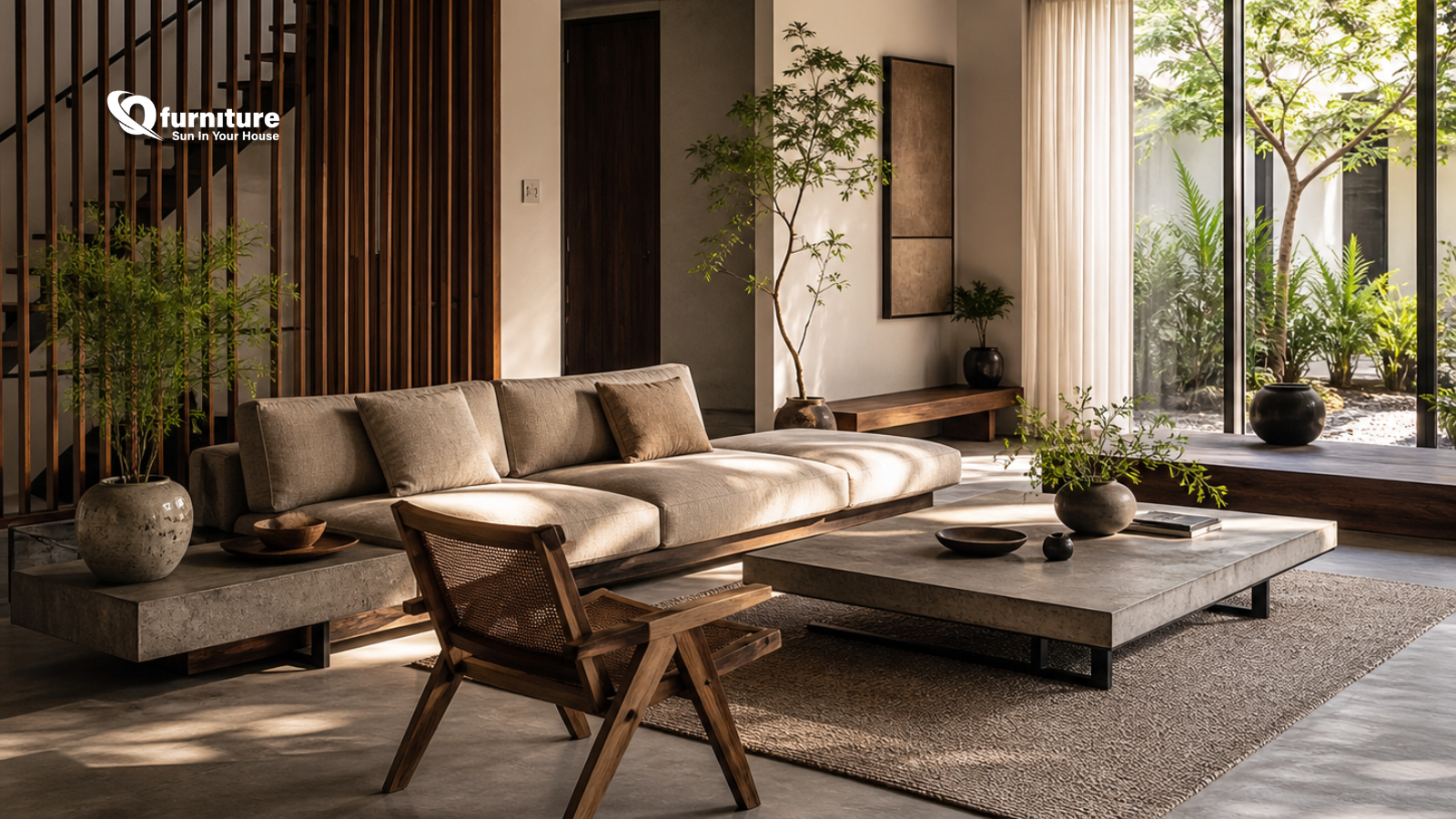 Q-Furniture Vietnam Factory” width=”1600″ height=”900″ />
The fifth is export familiarity. A Vietnam furniture factory that already works with international buyers is more likely to understand tolerances, finishing expectations, packaging requirements, carton markings, inspection procedures and shipping documentation.
Key advantages of furniture manufacturing in Vietnam
Vietnam’s key advantage in 2026 is not one single factor. It is the combination of production skill, export experience and increasing attention to compliance.
Vietnamese manufacturers are known for woodworking capability, finishing skills and adaptability in custom production. This matters for buyers developing collections that require specific dimensions, finishes, textures or mixed materials.
The country also benefits from an established supplier network. A buyer sourcing from Vietnam can often find support for timber processing, upholstery, hardware, packaging, finishing, concrete casting and export logistics within the same industrial ecosystem.
Another advantage is the ability to serve different buyer types. Retailers may need repeatable SKUs and stable QC. Wholesalers may need competitive pricing and container optimization. Hospitality projects may require custom dimensions, project-based finishes and timeline coordination. Furniture brands may need OEM/ODM support from concept to sample to production.
Vietnam is also moving toward higher-value production. Industry reports in 2026 noted that Vietnam’s wood processing sector is investing more in technology, green production, product design and market diversification to strengthen competitiveness.
For buyers, this means Vietnam is becoming more than a low-cost manufacturing location. It is increasingly a sourcing base for design-sensitive, export-ready and compliance-aware furniture production.
Challenges buyers should consider in 2026
Vietnam offers strong opportunities, but buyers should understand the risks before selecting a supplier.
Raw material price volatility remains a concern, especially for wood-based production. Buyers should clarify whether quotations are fixed, how long prices are valid and what material alternatives are available.
Legal timber and traceability are also becoming more important. For buyers selling into Europe, the EU Deforestation Regulation is especially relevant. The European Commission states that the EUDR requires covered products, including wood and certain wood-derived products, to be deforestation-free, with requirements applying from 30 December 2026 for relevant operators and traders.
Trade compliance is another major issue. In recent years, tariff and anti-transshipment scrutiny has increased in global trade, including Vietnam-related exports. Reuters reported that Vietnam had been preparing stricter penalties against illegal transshipment and trade fraud following US-Vietnam tariff developments.
This means buyers should not choose a factory based only on price. They should verify production capability, material origin, documentation, actual factory operations and export experience.
Lead time can also become a risk if the factory lacks planning discipline or relies too heavily on subcontractors. For project furniture, hospitality furniture and custom collections, sample approval, finish matching and packaging development should be planned early.
Quality control is another area where buyers must be careful. A low quotation can become expensive if dimensions, finishing, moisture content, packaging or assembly details are not controlled correctly.
How to choose the right Vietnam furniture manufacturer
When selecting a Vietnam furniture manufacturer 2026 buyers should evaluate both capability and reliability.
Start with export experience. A strong manufacturer should understand international documentation, product specifications, inspection standards and container loading requirements.
Next, review OEM/ODM capability. The factory should be able to work from drawings, reference images, samples or technical specifications. For custom furniture, buyers should ask how the factory manages prototyping, sample revisions, material testing and finish approval.
Quality control should be clearly documented. Ask about incoming material checks, in-line inspection, final inspection, packaging checks and how defects are handled before shipment.
Material transparency is equally important. Buyers should understand where the wood comes from, whether FSC or other certification is available when required, and how the factory manages alternative materials if costs change.
For buyers serving the US, Canada, Australia or the EU, it is important to confirm that the manufacturer understands market-specific expectations for structure, safety, labeling, packaging and compliance.
Finally, evaluate communication. A reliable supplier should be clear about MOQ, lead time, pricing assumptions, packaging, sample cost, production schedule and potential risks. In B2B furniture sourcing, transparency is often as important as production capacity.
How Q-Furniture supports international buyers
Q-Furniture is positioned as a Vietnam-based furniture manufacturer supporting international buyers with custom furniture, OEM/ODM production, wood furniture, concrete furniture and direct factory export solutions.
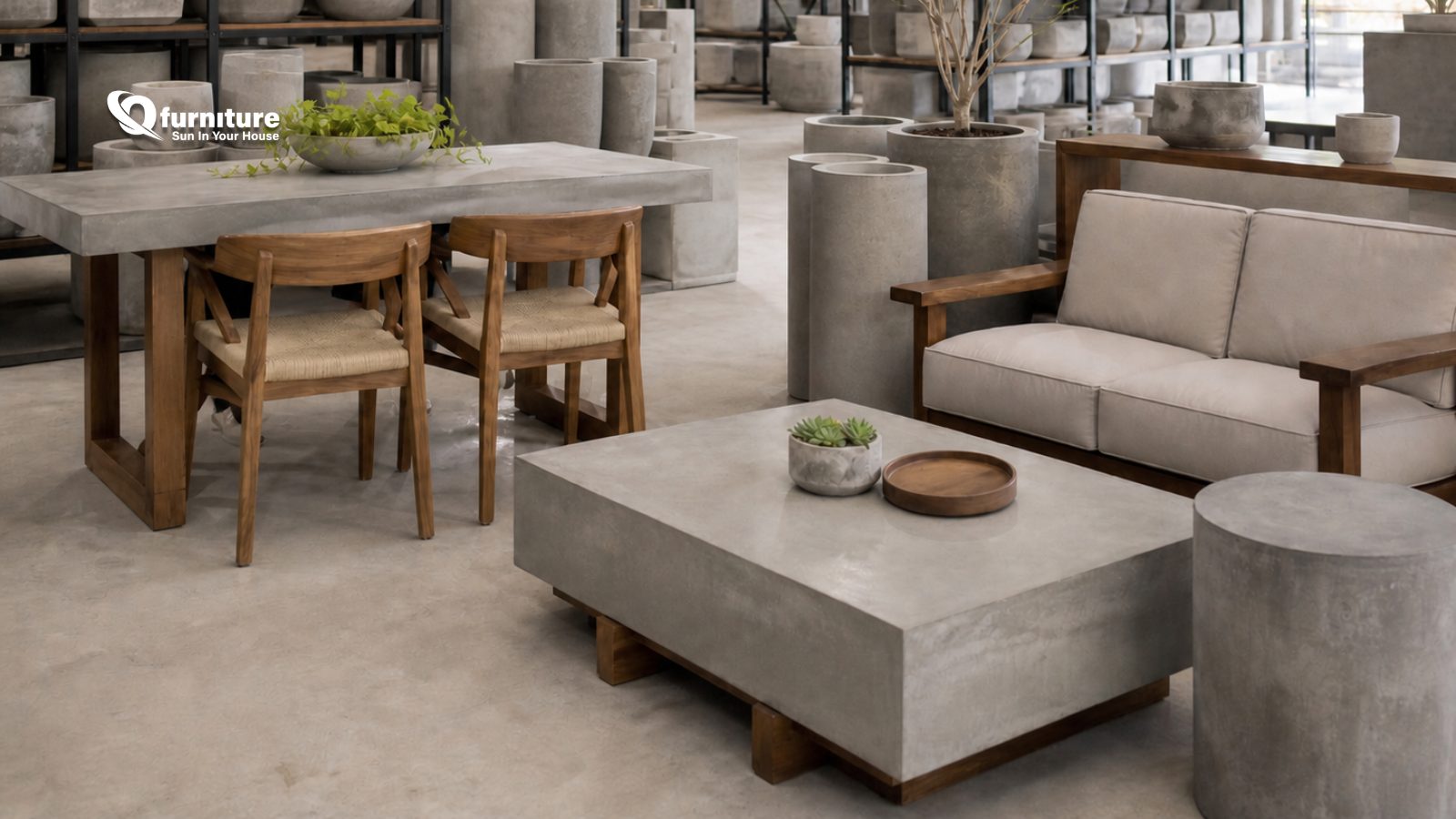
For buyers looking to develop new products in Vietnam, Q-Furniture can support the process from material consultation and sample development to production planning and quality control. This is especially useful for brands, retailers, wholesalers and hospitality buyers that need furniture made to their own design, size, finish or project requirement.
Instead of offering only standard products, Q-Furniture can work with buyers that need custom manufacturing support. This includes helping evaluate suitable materials, optimizing production methods, developing samples, adjusting specifications and preparing products for export.
For buyers comparing Vietnam furniture factory options in 2026, Q-Furniture offers a practical solution for those who want a manufacturing partner that understands both product development and international sourcing expectations.
For complementary supply chain insights, read our evaluation on CARB P2, TSCA & EU REACH compliance guide for Vietnam exporters.
Conclusion
Global buyers are shifting furniture manufacturing to Vietnam in 2026 because the country offers a strong combination of scale, skill, flexibility and export experience. The 2025 export milestone of about US$17.2 billion confirms Vietnam’s position as a major wood and furniture production base, while early 2026 data shows continued export activity rather than a completed full-year result.
For buyers, the opportunity is clear: Vietnam can support custom furniture, OEM/ODM production, wood furniture, concrete furniture and mixed-material collections for international markets. But the right factory choice matters. Compliance, material transparency, quality control, lead time management and communication should all be reviewed carefully.
Looking for a reliable furniture manufacturing partner in Vietnam in 2026? Contact Q-Furniture to discuss your custom furniture, OEM/ODM, wood and concrete furniture production needs.
📩 Request a Direct Factory B2B Sourcing Proposal (FOB / CIF)
Are you evaluating furniture manufacturing partners in Vietnam or planning full container load (FCL) orders? Connect directly with Q-Furniture’s export engineering team to discuss CAD design specs, material finishes, and wholesale pricing.








