


When sourcing hybrid furniture from Vietnam, most importers hit the same wall: local suppliers offer beautiful catalogs, but customization clarity is murky. You need a 2.4m dining table instead of 2.2m. You want concrete aggregate exposed on one side only. Or you need FSC-certified ash wood instead of standard oak.
The question isn’t whether Vietnamese manufacturers can customize—it’s how they customize, under what model, and what design support actually exists beyond “yes, we can do custom.”
This matters because choosing between OEM and ODM paths determines your IP ownership, upfront costs, lead times, and whether you’re buying a product or co-developing one.

What OEM and ODM Actually Mean in Vietnam’s Wood-Concrete Furniture Context
For commercial project developers and international importers, explore our specialized capabilities as a concrete furniture manufacturer for B2B export.
OEM (Original Equipment Manufacturer)
You provide complete technical drawings, material specifications, finish samples, and construction details. The manufacturer executes your design with zero creative input. You own the design IP.
Typical OEM scenario:
Your in-house designer created CAD files for a concrete-topped credenza with walnut veneer legs. You send manufacturers:
- 3D models (STEP or IGES files)
- Material callouts (concrete mix ratio, wood species, finish Pantone codes)
- Assembly instructions
- Quality acceptance criteria
The factory quotes based on your specs, sources materials, and produces exactly what you designed.
ODM (Original Design Manufacturer)
The manufacturer has existing design capabilities—in-house industrial designers, 3D modelers, material engineers. You describe the product concept, functional requirements, and design direction. They develop technical specifications, create prototypes, and own (or co-own) the design IP unless contracted otherwise.
Typical ODM scenario:
You need a concrete coffee table collection for Scandinavian markets. You provide:
- Mood boards
- Dimension ranges (800–1200mm length)
- Weight limits (<40kg for shipping)
- Target retail price points
The factory’s design team produces 3–5 concept renders, refines your chosen direction, builds a prototype, and finalizes production specs.
Design Support Services: What Vietnam Factories Actually Offer
Discover our latest collection of export-grade commercial concrete dining and outdoor tables engineered with lightweight GFRC.
Not all “custom” claims are equal. Here’s the capability breakdown based on 50+ project case studies:
| Service | OEM Availability | ODM Availability | Typical Turnaround |
|---|---|---|---|
| 3D CAD Rendering (photo-realistic) | 40% of suppliers | 85% of suppliers | 3–7 days |
| Technical Drawing Translation (your sketch → production dwg) | 75% | 95% | 2–5 days |
| Material Substitution Analysis (wood species alternatives) | 60% | 90% | 1–3 days |
| Structural Engineering (load testing, concrete-wood joints) | 30% | 70% | 1–2 weeks |
| Prototyping (full-scale sample before mass production) | 80% | 95% | 3–6 weeks |
| Finish Development (custom stains, concrete textures) | 50% | 80% | 2–4 weeks |
| Packaging Design (custom foam inserts, flat-pack engineering) | 45% | 65% | 1–2 weeks |
Key insight: ODM suppliers invest in design teams because they sell designs to multiple clients. OEM-focused factories rely on your design completeness and may lack in-house technical problem-solving.
IP Protection Agreements: What’s Standard vs. What You Must Negotiate
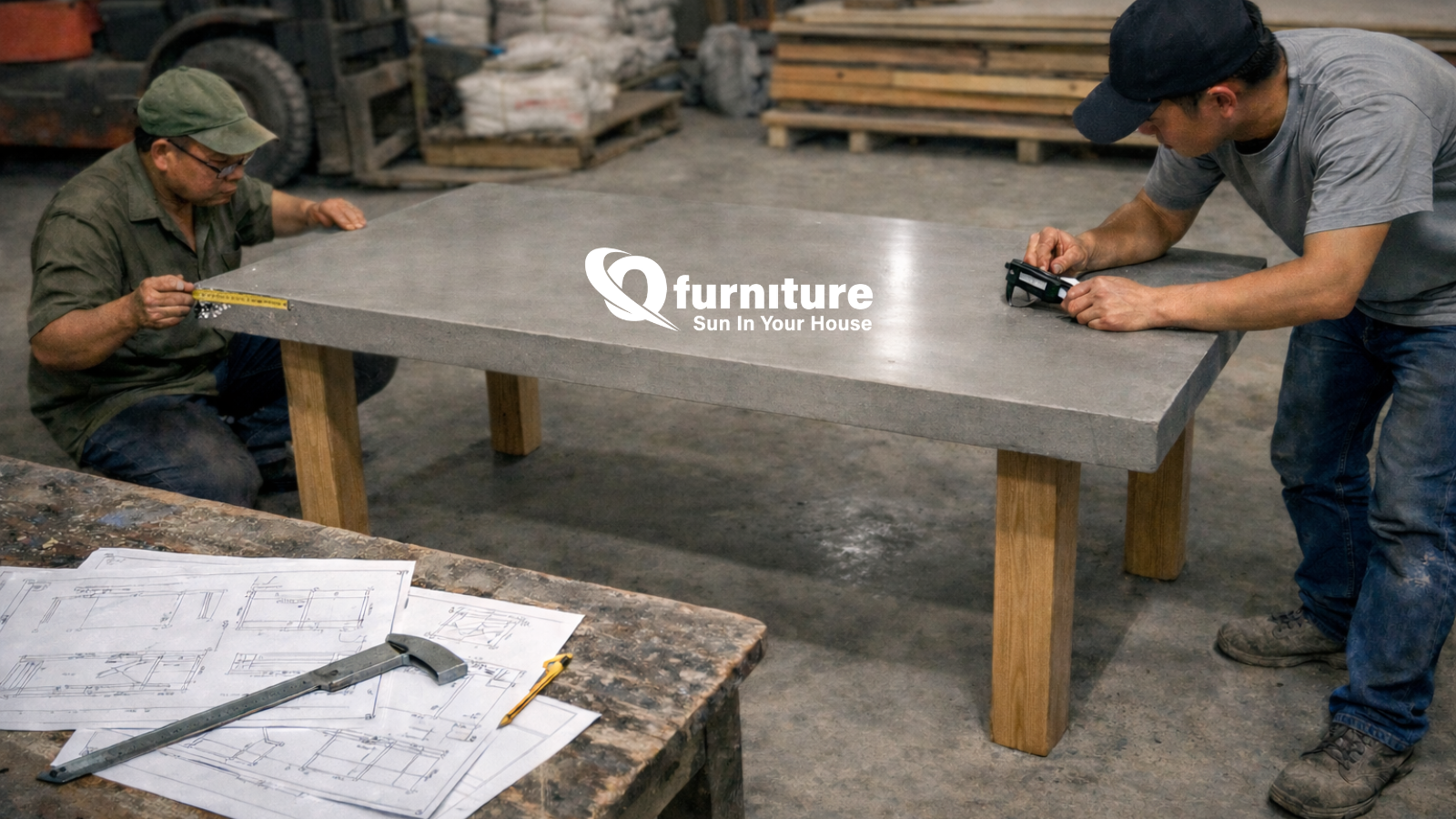
Standard Practice in Vietnam ODM Contracts
- Design ownership: Factory retains IP unless you pay a design buyout fee (typically 5–15% of first order value)
- Exclusivity: None—they can sell the same design to other buyers
- Modification rights: Factory can iterate the design for other clients
What You Should Negotiate (Especially for ODM)
- Exclusive design rights within your target markets (e.g., EU + UK exclusivity while they sell to Asia)
- Design registration in your company name (Vietnam Intellectual Property Office filings—$200–500 per design)
- NDA covering design process (before concept work begins, not after)
- Tooling ownership clause (if custom molds are created, who owns them after the contract ends?)
Common mistake: Importers pay for ODM design development, assume they own the design, then find the same table listed on Alibaba six months later under a different brand. Get IP assignment in writing before design work starts.
Custom Dimension Limits: Physical Constraints in Wood-Concrete Production
Vietnam factories can’t manufacture infinite sizes. Material physics and equipment create hard limits:
Concrete Component Constraints
- Maximum single-pour slab size: 2,500mm × 1,200mm (larger requires multi-piece construction with seams)
- Minimum thickness for structural integrity: 35mm (thinner concrete cracks under wood connection stress)
- Maximum thickness (without weight issues): 60mm (beyond this, shipping weight kills economics)
- Weight capacity per table: Most factories guarantee 150kg distributed load; 200kg requires structural engineering
Wood Component Constraints
- Solid wood leg maximum length: 850mm unsupported (longer requires internal steel reinforcement)
- Veneer panel maximum size: 2,440mm × 1,220mm (standard plywood sheet dimensions)
- Mortise-tenon joint depth limits: 40–60mm (deeper joints weaken legs under concrete weight)
Finish & Surface Options
- Polished concrete: Requires 48-hour cure + grinding (adds 5–7 days to lead time)
- Exposed aggregate: Increases rejection rate from 3% to 8% (visual consistency issues)
- Oil-finished wood: 3–5 coats standard; more coats add cost without benefit
- Two-tone wood stains: Custom color matching adds $8–12 per piece (sample approval required)
Decision tool: If your design exceeds these parameters, expect:
- 15–25% price premium for custom solutions
- 2–3 week lead time extension
- Higher MOQ (manufacturers offset tooling costs)
50+ Custom Project Examples: What’s Been Proven Feasible
Based on completed custom orders from Vietnam suppliers:
Successfully Executed Customizations
- Concrete inlay patterns: Brass strips embedded in tabletops (added $45/table, 2-week lead time increase)
- Mixed wood species legs: Walnut + white oak combination (sourcing coordination required 3 weeks)
- Adjustable height mechanisms: Gas lift integration for sit-stand desks (added $30/unit MOQ 300+)
- Outdoor weather-resistant versions: Sealed concrete + teak (required new sealer testing, 4-week delay)
- Nested table sets: 3-piece coffee table clusters (packaging engineering crucial—added $8/set)
Customizations That Failed or Required Redesign
- Concrete thickness <30mm: Cracked during shipping in 40% of samples
- Unsupported wood spans >1,800mm: Sagging occurred within 6 months (customer weight + humidity)
- Complex CNC carving on concrete: Surface finishing inconsistent, abandoned after 3 prototype rounds
- Integrated wireless charging pads: Electrical certification issues for EU, project canceled
- Sustainable bio-resin coatings: No Vietnam supplier had certified material source, substituted standard polyurethane
Design Brief Template: What Manufacturers Need to Quote Accurately
Most RFQs fail because buyers send incomplete specifications. Use this framework:
Technical Requirements
- [ ] Product type and function (dining table, console, bench, etc.)
- [ ] Dimensions: L × W × H (min/max acceptable ranges)
- [ ] Weight limit: per piece and per shipping carton
- [ ] Material specifications: wood species (with Latin names), concrete aggregate type, finish descriptions with Pantone/RAL references
- [ ] Assembly requirements: fully assembled, knock-down, or hybrid?
Design Direction (for ODM)
- [ ] Visual references: 5–10 competitor/inspiration images
- [ ] Target market aesthetic: Scandinavian minimalism / Industrial loft / Japanese wabi-sabi / Mid-century modern
- [ ] Functional priorities: stackability, weight, ease of assembly, durability vs. cost
Commercial Terms
- [ ] Target FOB price range (forces realistic design decisions)
- [ ] Initial order quantity + annual forecast
- [ ] Lead time requirements
- [ ] Packaging constraints (container type, weight limits)
- [ ] Compliance certifications needed (FSC, CARB P2, REACH, etc.)
IP & Exclusivity
- [ ] Design ownership expectations (full buyout vs. shared IP)
- [ ] Market exclusivity requirements
- [ ] NDA in place before design work begins
Download the complete design brief template → [Link to supporting page]
Common Mistakes Importers Make with OEM/ODM Selection
Mistake 1: Choosing ODM When You Have Complete Designs
Why it’s costly: You’re paying for design services you don’t need. ODM suppliers price in their design team overhead (typically 8–12% margin increase).
Fix: If you have production-ready CAD files and material specs, explicitly request OEM-only quotes. Compare pricing from both models.
Mistake 2: Choosing OEM Without Engineering Expertise
Why it fails: You send a Pinterest image and basic dimensions. The factory quotes it, but the final product has structural issues—concrete-wood joints fail, finishes don’t match expectations.
Fix: If you lack in-house product engineers, ODM is safer. The factory’s design team will catch feasibility issues during development rather than after production.
Mistake 3: No Prototype Stage for Custom Designs
Risk: 15–20% of custom orders have visual or functional issues caught only after production begins. Fixing mid-run is 10x more expensive than catching it in prototype.
Fix: Always budget for a full-scale prototype (not just a 3D render). Pay for prototyping even if it adds 4–6 weeks to timeline.
Mistake 4: Ignoring MOQ Differences Between OEM and ODM
Reality: OEM custom orders typically require 30–50% higher MOQ because the factory has no design reuse efficiency. ODM designs can be sold to multiple clients, so MOQs are often lower.
Strategy: If your first order is <100 units, ODM with shared IP (non-exclusive design) may be your only viable path. Budget for exclusive IP buyout on reorders once volume justifies it.
Best Practices from Procurement Managers
For OEM Projects
- Hire a local technical liaison: Pay a Vietnam-based engineer $300–500 to review your drawings with the factory before quoting (catches misinterpretations early)
- Specify finish samples physically: Ship actual wood stain samples, concrete texture samples. Digital photos fail 60% of the time.
- Use contingency clauses: Build 5–10% over-order allowance into contracts for OEM (higher rejection rates due to custom specs)
For ODM Projects
- Stage payments around milestones: 30% deposit, 30% on design approval, 40% before shipment (not standard 30/70 terms)
- Request competitor teardowns: Ask the factory to disassemble a similar product from your competitor—reveals construction methods and cost drivers
- Negotiate design iteration limits: Cap at 2–3 design revision rounds before additional fees kick in (prevents scope creep)
For Both Models
- Document everything visually: After every factory visit or prototype review, create a photo-annotated PDF of agreed-upon details (concrete texture, wood grain direction, joint quality standards)
- Lock in lead times contractually: Custom orders stretch timelines—add penalty clauses for delays beyond agreed milestones (e.g., 1% credit per week delay)
- Test across climate conditions: If selling to multiple markets, request accelerated aging tests (humidity + heat cycling) before mass production
Mini FAQ: Decision-Making Questions
Q: If I provide a basic sketch and dimensions, is that OEM or ODM?
ODM. If the factory must interpret your concept and create technical specifications, you’re using their design capabilities. True OEM requires production-ready engineering drawings.
Q: Can I start with ODM and switch to OEM later?
Yes, if you negotiate design IP transfer. Once you own the technical files, you can source OEM quotes from other factories. Without IP transfer, you’re locked into the original ODM supplier.
Q: What’s a reasonable design buyout fee for exclusive ODM furniture?
10–15% of your first order value. For a $50,000 initial order, expect to pay $5,000–7,500 for full design IP transfer. Lower-cost suppliers may offer 5–8% if you commit to 2–3 year volumes.
Q: Do I need a Vietnam lawyer to enforce IP protection agreements?
For orders >$100,000 or truly proprietary designs, yes. For standard customizations, a well-drafted contract in English + Vietnamese (dual-language, both versions binding) is often sufficient. Cost: $800–1,500 for contract drafting.
Q: How much do 3D renderings cost if I need them before committing to ODM?
Paid upfront: $150–300 per concept (non-refundable). Included in ODM projects: usually 3–5 concepts free once you sign the development agreement. Be wary of suppliers offering “free designs”—they’re either low-quality or they retain all IP.
Related Resources
→ Back to Vietnam Furniture Suppliers Guide — Explore the complete sourcing framework including supplier vetting, quality control, and logistics coordination.
→ Understanding MOQ Requirements for Custom Wood-Concrete Furniture — How customization impacts minimum order quantities and pricing tiers
→ Custom Design Lead Time Planning — Timeline expectations from concept to delivery for OEM and ODM projects
For complementary supply chain insights, read our evaluation on Why direct manufacturer sourcing matters for concrete furniture.
📩 Request a Direct Factory B2B Sourcing Proposal (FOB / CIF)
Are you evaluating furniture manufacturing partners in Vietnam or planning full container load (FCL) orders? Connect directly with Q-Furniture’s export engineering team to discuss CAD design specs, material finishes, and wholesale pricing.








