


Why Material Sourcing Defines Your Vietnam OEM Partnership
For commercial project developers and international importers, explore our specialized capabilities as a concrete furniture manufacturer for B2B export.
When you’re evaluating Vietnam furniture suppliers for wood-concrete hybrid products, material provenance isn’t just a compliance checkbox—it’s your primary risk mitigation lever. The question procurement teams ask isn’t “Can they source FSC acacia?” but rather “How do I verify their supply chain won’t compromise my ESG commitments or introduce mid-production delays when material quality varies?”
This matters because 67% of furniture importers cite inconsistent raw material quality as the #1 cause of production delays in Vietnam OEM contracts (2024 Vietnam Timber Industry Report). For wood-concrete hybrid furniture specifically, material decisions cascade: the wrong acacia grade affects joint tolerance with GRC; non-compliant concrete additives trigger customs holds in EU markets.
This guide focuses on one decision point: selecting and vetting sustainable materials for Vietnam-based OEM production before you issue your RFQ.

The Core Material Decision Framework
Discover our latest collection of export-grade commercial concrete dining and outdoor tables engineered with lightweight GFRC.
Wood Selection: Beyond “FSC-Certified Acacia”
Vietnam furniture manufacturing centers on three primary hardwoods, each with distinct trade-offs for OEM buyers:
| Wood Type | Vietnam Sourcing Availability | Typical MOQ Impact | Durability Grade | ESG Risk Level |
|---|---|---|---|---|
| Acacia (Keo) | 80% domestic supply | Low (readily available) | Medium-High (15-20yr exterior life) | Low (fast-growing, 5yr harvest cycle) |
| Rubberwood | 60% domestic, 40% Thailand/Malaysia | Medium (seasonal variance) | Medium (indoor-only applications) | Medium (plantation deforestation concerns) |
| Reclaimed Teak | 15% domestic, 85% Myanmar/Laos imports | High (limited quantities) | Very High (50+ yr lifespan) | High (illegal logging verification required) |
Decision trigger: If your target market requires CARB P2 or TSCA Title VI compliance, verify that Vietnam suppliers use formaldehyde-free adhesives in laminated acacia components. Standard Vietnamese manufacturing practices often use E1-grade glues, which don’t meet US regulations without modification.
Acacia Sourcing Deep Dive
Acacia mangium and Acacia auriculiformis dominate Vietnam’s plantation forestry (1.2M hectares under cultivation). For OEM buyers, the critical verification points are:
- FSC Chain of Custody (CoC) certification: Only 12% of Vietnamese acacia plantations hold FSC certification as of 2025. Request CoC certificate numbers and verify via FSC database (fsc.org/en/search).
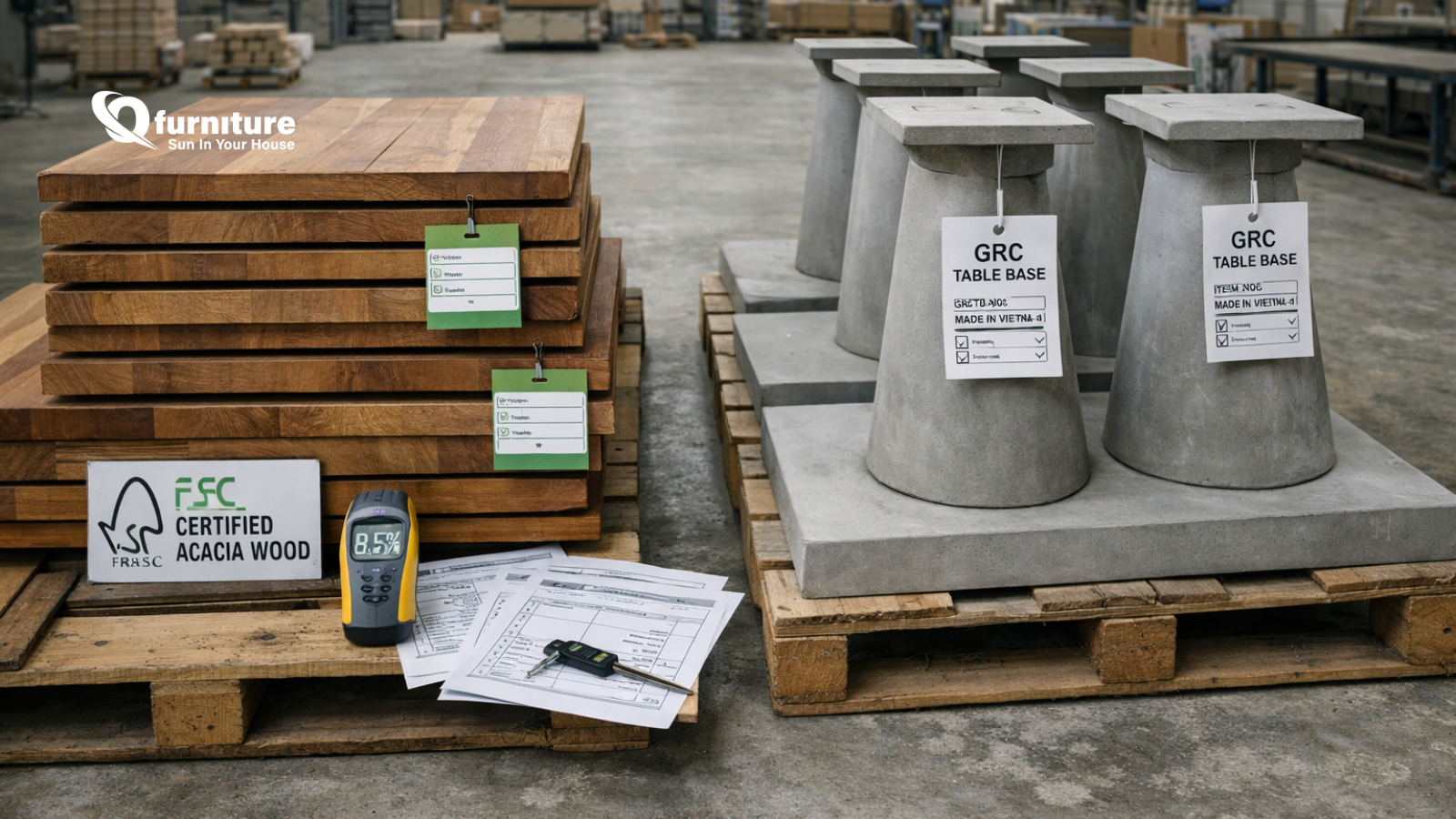
- Moisture content management: Vietnam’s tropical climate requires wood to be kiln-dried to 8-12% MC before fabrication. Ask suppliers for digital moisture meter records per production batch—not just certifications.
- Grade consistency: Specify FAS (Firsts and Seconds) grade minimum for visible surfaces. Vietnam grading standards differ from NHLA (US) standards; request physical samples with grain pattern documentation.
Practical vetting step: Before signing an OEM contract, request a material traceability report showing GPS coordinates of source plantations, harvest dates, and kiln facility locations. Reliable suppliers provide this within 48 hours.
Concrete Material Specifications: GRC vs. Traditional Mixes
For wood-concrete hybrid furniture, concrete composition directly impacts logistics costs and structural integrity.
GRC (Glass-Reinforced Concrete) Advantages
GRC reduces weight by 40-60% versus traditional concrete while maintaining compressive strength above 50 MPa. For Vietnam OEM applications:
- Weight savings translate to shipping cost reductions: A standard 120cm wood-GRC dining table weighs ~45kg vs. 85kg for traditional concrete base. This difference determines whether you fit 280 vs. 180 units per 40ft HC container.
- Curing time: GRC achieves 80% design strength in 7 days vs. 28 days for conventional concrete—shortening production lead times by 15-20 days.
- Fiber sourcing verification: GRC requires alkali-resistant (AR) glass fibers. Vietnam suppliers typically import these from China (Owens Corning) or Turkey (Sisecam). Confirm supplier has direct manufacturer agreements to avoid counterfeit fiber issues that cause delamination after 18-24 months.
Traditional Concrete for High-Durability Applications
When buyers prioritize exterior durability over weight (e.g., hospitality project furniture for coastal climates), traditional concrete with specific additives remains relevant:
- Fly ash substitution: Vietnamese suppliers near HCMC often use 20-30% fly ash replacement for cement (sourced from Pha Lai thermal plant). This reduces carbon footprint by ~25% but requires 28-day minimum curing verification.
- Sealer penetration: For outdoor wood-concrete benches, specify penetrating silane/siloxane sealers applied at <15% concrete moisture content. Vietnam’s humidity makes timing critical—request time-stamped photos of moisture testing before sealing.
Cost reality check: GRC material costs run $12-18/m² vs. $6-9/m² for fly ash concrete in Vietnam (2026 pricing). However, shipping savings often offset the 50-80% material premium for export orders above 10 containers.
Carbon Footprint Comparison: Vietnam vs. China Production
ESG-conscious buyers increasingly request cradle-to-port carbon calculations. Vietnam offers structural advantages:
| Factor | Vietnam Production | China Production | Delta |
|---|---|---|---|
| Grid carbon intensity | 0.52 kg CO₂/kWh | 0.68 kg CO₂/kWh | -24% |
| Acacia plantation carbon sequestration credit | -0.8 tCO₂/m³ wood | N/A (import-dependent) | Significant offset |
| Average distance to major ports (HCMC, Hai Phong) | 85 km | 320 km (avg Southern China) | -73% logistics emissions |
| FSC-certified supply chain availability | Growing (12% → 25% by 2027 projection) | Mature (35% current) | Vietnam catching up |
Actionable insight: When issuing RFQs, request ISO 14067 Product Carbon Footprint (PCF) reports from shortlisted suppliers. Only 8-10 Vietnam furniture OEM manufacturers currently provide these, creating a pre-qualification filter for serious ESG commitments.
Supplier Vetting Process: The 3-Stage Material Audit
Stage 1: Documentation Review (Pre-Visit)
Request these documents during initial supplier screening:
- FSC Chain of Custody certificate (if claiming certified wood)
- Material test reports from last 6 months:
- Wood: Moisture content, formaldehyde emission (ASTM E1333 or EN 717-1)
- Concrete: Compressive strength (ASTM C39), density, absorption rate
- Supplier declarations for all concrete additives (especially plasticizers and accelerators—some contain phthalates banned in EU)
- Plantation/quarry source maps with GPS data
Red flag: If suppliers provide “generic” certificates not matching your production timeline or claim “FSC-certified” without CoC numbers, escalate scrutiny.
Stage 2: Factory Material Inspection
During factory audits, focus on:
- Raw material storage conditions: Acacia should be stored in <60% humidity environments. Check for digital hygrometers in wood storage areas.
- Concrete batching process: Observe whether suppliers use automated batching systems with digital weight scales (±2% accuracy) or manual mixing (±10% variance risk).
- Waste material handling: FSC compliance requires tracking offcut disposal. Verify suppliers maintain waste logs and have partnerships with recycling facilities.
Stage 3: Sample Material Testing (Third-Party)
Before confirming orders above $50K, commission independent lab testing:
- Wood samples: Send to SGS or Bureau Veritas for formaldehyde emission testing ($280-450 per test)
- Concrete cores: Test compressive strength and water absorption at 7, 14, 28 days ($150-200 per batch)
Timeline consideration: Third-party testing adds 2-3 weeks to supplier qualification but reduces defect-related delays by 60-70% based on importer experience data.
Common Material Sourcing Mistakes & Risk Mitigation
Mistake 1: Accepting “FSC-Equivalent” Claims
Some Vietnam suppliers market “sustainable plantation wood” without formal FSC certification, arguing it’s “equivalent quality.”
Risk: Without Chain of Custody documentation, you cannot prove supply chain integrity to sustainability-focused retail buyers (IKEA, Crate & Barrel supplier requirements explicitly reject non-certified claims).
Mitigation: Build 5-8% cost premium into budgets for FSC-certified materials. If budget constraints exist, prioritize FSC for US/EU markets and use verified plantation wood (with GPS traceability) for AU/Middle East markets with less stringent documentation requirements.
Mistake 2: Ignoring Seasonal Acacia Quality Variance
Vietnam’s monsoon season (May-October) affects acacia moisture content management. Wood harvested during rainy months requires extended kiln-drying.
Risk: Suppliers rushing production may use insufficiently dried wood (>15% MC), causing joint failures 4-6 months post-delivery when wood shrinks.
Mitigation: Specify maximum 12% moisture content in OEM contracts with penalty clauses. Request kiln schedules showing drying duration >21 days for monsoon-harvested batches.
Mistake 3: Overlooking Concrete Additive Disclosure
Many Vietnam concrete furniture manufacturers use undisclosed plasticizers to improve workability.
Risk: Some plasticizers contain phthalates (DEHP, DBP) banned under EU REACH regulations, triggering customs rejections.
Mitigation: Require full material safety data sheets (MSDS) for all concrete additives in English. Cross-reference CAS numbers against REACH Candidate List and California Prop 65.
Best Practices from Procurement Leaders
Practice 1: Material Sample Kits Before RFQ
Request comprehensive sample kits including:
- 15cm × 15cm wood samples showing grain variation across 3 boards
- 10cm × 10cm concrete samples with exposed aggregate finish
- Wood-concrete joint samples demonstrating attachment method (epoxy, mechanical fasteners, hybrid)
Cost: $80-150 per kit including DHL shipping. ROI: Eliminates 40% of unsuitable suppliers before investing in detailed RFQs.
Practice 2: Dual-Sourcing Strategy for Critical Materials
For orders >20 containers annually, maintain relationships with two qualified acacia suppliers and two GRC fiber importers.
Rationale: Vietnam experienced 3-month GRC fiber shortages in Q2 2024 when Chinese AR fiber exports faced quota restrictions. Buyers with dual-source agreements maintained production continuity.
Practice 3: Material Escalation Clauses in OEM Contracts
Include contract language allowing material substitutions only with:
- 15-day advance written notice
- Equivalent or superior technical specifications
- No cost increase >5%
- Buyer approval of substitute samples
This prevents suppliers from downgrading materials mid-production when commodity prices spike.
Material Selection FAQ
Q: How do I verify FSC claims when visiting Vietnam factories?
A: Request the supplier’s FSC certificate and check the certificate code on FSC’s online database. Verify the certificate covers “W6.5 – Assembled Furniture” under product scope. During factory visits, look for FSC logos on wood storage areas and ask to see transaction certificates for recent wood purchases.
Q: What’s the typical price difference between GRC and traditional concrete for Vietnam OEM?
A: GRC material costs are 50-80% higher ($12-18/m² vs $6-9/m²), but total landed costs often favor GRC for export orders due to 40-60% weight reduction. Calculate break-even at your shipping volume—typically 8-10 containers for US West Coast routes, 12-15 containers for EU.
Q: Can Vietnam suppliers provide carbon footprint calculations per product?
A: Only ~8-10 established OEM manufacturers currently offer ISO 14067 Product Carbon Footprint reports. If ESG documentation is mandatory for your buyers, this becomes a primary supplier filter. Request sample PCF reports during initial contact—turnaround time of >2 weeks suggests capability gaps.
Q: How do I handle moisture content disputes for delivered wood components?
A: Specify inspection protocols in contracts: digital moisture meter testing (pin-type, calibrated annually) of 10% of components upon arrival. Accept batches at 8-14% MC depending on destination climate. Include contract clause requiring supplier to cover return shipping + replacement costs for batches >15% MC.
Q: Are reclaimed teak claims verifiable for Vietnam suppliers?
A: Verify through documentation: original building demolition permits, transportation records, and ideally third-party verification from organizations like the Forest Stewardship Council. Reclaimed teak from Myanmar/Laos carries high illegal logging risk—request detailed provenance or specify alternative species.
Connecting Material Decisions to Your OEM Strategy
Material sourcing directly determines three outcomes for your Vietnam furniture OEM partnership:
- Compliance velocity: Verified sustainable materials reduce customs clearance time by 40-60% for EU/US shipments
- Production risk buffer: Dual-source arrangements for acacia and GRC maintain schedule integrity during supply disruptions
- ESG differentiation: ISO 14067 carbon footprint documentation converts material choices into marketing assets for sustainability-focused buyers
The suppliers who excel at material transparency—providing GPS-tracked wood sources, third-party concrete testing, and comprehensive MSDS documentation—typically demonstrate operational maturity across production management, QC, and export logistics.
Related resources:
For comprehensive supplier evaluation criteria beyond materials, see the Ultimate Guide to Vietnam Wood-Concrete Furniture OEM Suppliers covering capacity assessment, compliance frameworks, and RFQ best practices.
When you’re ready to validate material claims through factory audits, refer to Quality Control Protocols for Vietnam Furniture OEM for inspection checklists and third-party testing recommendations.
For buyers prioritizing sustainability certifications alongside material sourcing, explore ESG Compliance & Sustainability Certifications for Vietnam Furniture Exports detailing FSC, ISO 14001, and carbon neutrality pathways.
For complementary supply chain insights, read our evaluation on Custom & OEM furniture manufacturing solutions from Vietnam.
📩 Request a Direct Factory B2B Sourcing Proposal (FOB / CIF)
Are you evaluating furniture manufacturing partners in Vietnam or planning full container load (FCL) orders? Connect directly with Q-Furniture’s export engineering team to discuss CAD design specs, material finishes, and wholesale pricing.








