


Why MOQ Matters More for Hybrid Material Furniture
For commercial project developers and international importers, explore our specialized capabilities as a concrete furniture manufacturer for B2B export.
When sourcing wood-concrete furniture from Vietnam, MOQ requirements function differently than conventional wooden furniture orders. The financial stakes are higher: concrete components require specialized molds, wood-concrete joints demand precision tooling, and production setup costs don’t scale linearly. A procurement manager evaluating a 50-unit bench order faces distinct ROI considerations compared to ordering 500 traditional wooden chairs.
The core question isn’t “What’s the MOQ?” but rather “At what order volume does the unit economics justify the setup investment, quality risk, and logistics complexity of hybrid material furniture?”
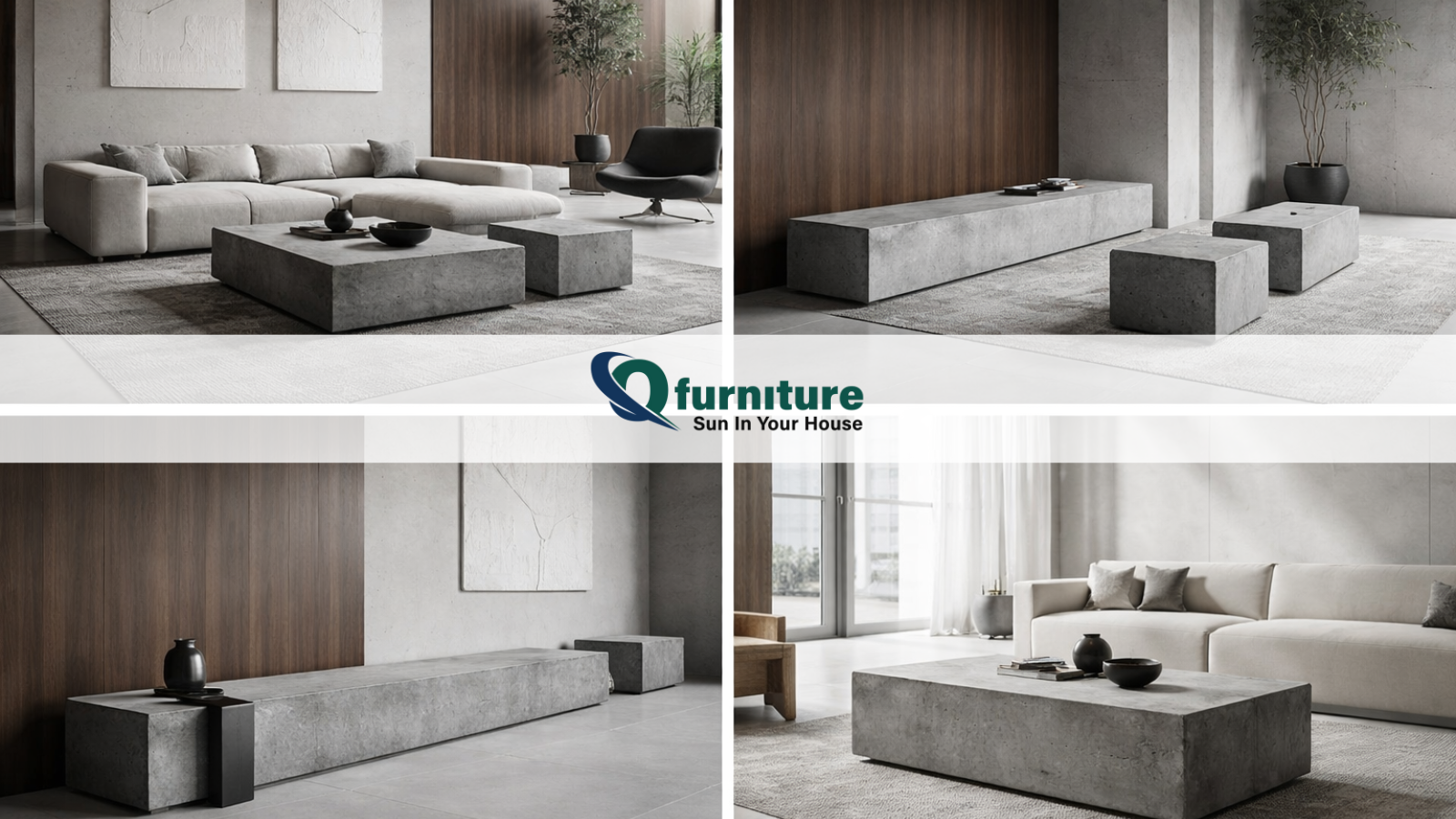
Product-Specific MOQ Benchmarks: Reality Beyond Round Numbers
Discover our latest collection of export-grade commercial concrete dining and outdoor tables engineered with lightweight GFRC.
Tables (Wood Top + Concrete Base)
Standard MOQ: 100–150 units for dining/conference tables with custom concrete base designs.
Why this threshold?
- Concrete mold fabrication costs $800–$1,200 per unique base design
- Wood surface customization (species, finish) runs parallel production lines
- Quality control requires destructive joint strength testing on 2–3% of batch
- Container optimization: 100 units ≈ 1x 40HQ for standard 180cm tables
Negotiation lever: If accepting standard base molds (supplier’s existing designs), MOQ drops to 50–80 units with 12–18% higher unit cost.
Benches & Seating (Primarily Concrete with Wood Accents)
Standard MOQ: 50–100 units for outdoor benches, lower than tables due to:
- Simpler joint mechanics (wood slats on concrete frame vs structural integration)
- Concrete-heavy weight ratio reduces per-unit shipping efficiency, forcing smaller batches
- Standardized designs dominate this category, limiting custom mold requirements
Risk factor: Orders below 50 units typically see 25–30% unit cost premiums due to non-optimal concrete curing batch sizes (minimum economical batch = 40–50 pieces for consistent strength).
Planters & Accessories
Flexible MOQ: 30–50 units, reflecting:
- Lower tooling complexity
- Often bundled with furniture orders to meet total value thresholds
- Used as “test products” for evaluating wood-concrete craftsmanship before larger commitments
The Hidden MOQ: Total Order Value Thresholds
Vietnam OEM suppliers operate on minimum order values (MOV) rather than pure unit counts:
| Supplier Tier | Typical MOV | Implication |
|---|---|---|
| Large-scale exporters (60+ containers/month capacity) | $15,000–$25,000 | Forces multi-SKU orders or higher quantities of single items |
| Mid-tier specialists | $8,000–$12,000 | Allows focused product testing with 80–120 units |
| Emerging manufacturers | $3,000–$5,000 | Accessible for initial trials but limited customization |
Critical insight: A $20,000 MOV allows either 100 premium tables OR 200 standard benches OR a mixed order (60 tables + 80 benches). This flexibility matters more than per-product MOQ when testing market response across SKUs.
Sample Orders: The Prototyping Economics
Most Vietnam wood-concrete OEM suppliers offer pre-production samples under these structures:
Option 1: Full-cost samples (3–5 units)
- Unit price: 2.5–3x production cost
- Lead time: 4–6 weeks (includes mold creation for custom designs)
- Non-refundable, but mold becomes reusable for production orders
Option 2: Refundable deposit samples (10–15 units)
- Unit price: 1.5–2x production cost
- Deposit refunded if production order meets MOQ within 90 days
- Practical for buyers needing showroom inventory while finalizing orders
Decision framework:
- Choose Option 1 if validating completely new designs with uncertain market demand
- Choose Option 2 if design is confirmed but supplier quality/reliability needs vetting
What buyers miss: Sample costs should include shipping simulation. A 5-unit sample order shipped via air freight reveals nothing about the real landed cost of a 100-unit ocean shipment with specialized concrete packaging.

Scalability Proof: From MOQ to Full Production
Vietnam’s wood-concrete furniture capacity typically scales in these tiers:
Tier 1: Initial MOQ phase (50–150 units)
- Production time: 6–8 weeks
- Quality variability risk: Medium (setup standardization still developing)
- Best for: Market testing, retail pilot programs
Tier 2: Repeat order scale (200–500 units)
- Production time: 5–7 weeks (molds/jigs established)
- Unit cost reduction: 8–15% vs initial MOQ pricing
- Quality consistency: High (process documented)
- Best for: Regional rollouts, hospitality projects
Tier 3: Partnership volume (500+ units or 60 containers/year)
- Production time: 4–6 weeks (dedicated production lines)
- Unit cost reduction: 18–25% vs initial MOQ
- Customization flexibility: Maximum (supplier invests in unique tooling)
- Best for: National distribution, contract manufacturing agreements
Evidence requirement: Request documented proof of 60-container/month capacity claims. Verify through:
- Client reference checks with similar volume buyers
- Factory tour showing parallel production lines
- Existing mold inventory (indicates design diversity capability)
Pricing Tiers: The MOQ-to-Cost Curve
Wood-concrete furniture pricing doesn’t follow traditional linear curves due to concrete component economics:
| Order Quantity | Unit Cost Index | Key Cost Drivers |
|---|---|---|
| 50 units (below standard MOQ) | 100 (baseline) | Full setup cost absorption, small-batch concrete mixing inefficiency |
| 100 units (standard MOQ) | 75–82 | Optimized concrete batching, partial jig amortization |
| 250 units | 68–74 | Full setup cost dilution, bulk wood sourcing discounts |
| 500 units | 62–68 | Dedicated production scheduling, negotiated material contracts |
Non-linear factor: Concrete base weight. Orders mixing 50kg benches with 150kg tables face container optimization penalties that can offset volume discounts by 5–8%.
ROI Calculator Framework: MOQ Testing vs Full Production
Scenario A: Conservative MOQ Test (100 tables @ $220/unit)
Initial investment: $22,000 + $3,500 shipping = $25,500
Retail assumption: $550/unit (2.5x markup)
Break-even: 47 units sold
Risk exposure: $12,540 if only 50% sellthrough
Scenario B: Volume Commitment (500 tables @ $165/unit)
Initial investment: $82,500 + $12,000 shipping = $94,500
Retail assumption: $550/unit (3.3x markup)
Break-even: 172 units sold
Risk exposure: $47,250 if only 50% sellthrough
But profit differential at 80% sellthrough:
- Scenario A: $118,000 revenue – $25,500 cost = $92,500 profit (362% ROI)
- Scenario B: $440,000 revenue – $94,500 cost = $345,500 profit (365% ROI)
The calculus: Higher MOQ compounds absolute profit but doesn’t dramatically improve ROI percentage. The real benefit is supply chain control—500-unit buyers secure 4–6 week reorder priority vs 8–10 weeks for small MOQ buyers during peak seasons.
Common MOQ Negotiation Mistakes
Mistake 1: Focusing Only on Per-Unit Price Reduction
Suppliers absorb setup costs across MOQ. Negotiating unit price down by $15 (7%) while keeping MOQ at 100 units saves $1,500. Accepting a 150-unit MOQ for the same $15 reduction generates $2,250 savings but triples inventory risk.
Better approach: Negotiate payment terms (30% deposit vs 50%) or free mold retention (reduces future reorder MOQ to 50 units) rather than squeezing unit margins.
Mistake 2: Mixing Designs Within One PO to Meet MOV
Combining 50 units each of two table designs to reach $20,000 MOV doubles mold costs and extends lead times by 2–3 weeks (sequential vs parallel production).
Better approach: Order 100 units of one proven design, then use learnings to inform second design’s dedicated order in 3–6 months.
Mistake 3: Ignoring Wood-Concrete Joint Warranty Implications
Standard MOQ orders (100–150 units) receive 12-month joint integrity warranties from reputable suppliers. Orders below 80 units often face 6-month warranties or “as-is” terms because low-volume batches may use hand-finishing rather than jig-controlled assembly, increasing long-term failure risk.
Due diligence: Confirm warranty terms scale with order volume, not just unit pricing.
Best Practices from Experienced Importers
Start with Supplier’s Standard Designs (First Order Only)
Importers saving 35–40% on first orders by selecting from existing mold libraries, then using profit from that batch to fund custom design MOQ on second order. This “earn before you customize” approach reduces speculative investment.
Build MOQ Flexibility into Annual Agreements
Instead of committing to 500-unit single POs, structure framework agreements: 500 total units across 3–4 deliveries over 12 months. Suppliers offer near-volume pricing (within 5–8% of 500-unit rates) while buyers maintain demand flexibility.
Require MOQ-Based Contingency Samples
Insist that 3–5 units from the actual MOQ production run (not pre-production samples) be shipped via air freight for QC approval before container release. This catches production drift issues that prototype samples don’t reveal.
Use MOQ Transitions as Supplier Performance Tests
Deliberately escalate from 100 to 250 units on the second order as a capability stress test. Suppliers who maintain quality and meet lead times at 2.5x volume demonstrate genuine scalability vs those where consistency collapses.
Decision Framework: Determining Your Right-Fit MOQ
Order 50–80 units if:
- Testing completely new hybrid material concept in your market
- Budget constraints limit risk capital below $15,000
- Targeting niche hospitality projects (2–3 venues)
- Willing to accept 20–25% higher unit costs for flexibility
Order 100–200 units if:
- Design is validated (sold similar wooden furniture previously)
- Building showroom + initial retail inventory simultaneously
- Supplier relationship is new but product demand is confirmed
- Standard 12-month warranty protection is essential
Order 250+ units if:
- Replacing existing wood-concrete supplier with proven sales velocity
- Launching coordinated multi-location rollout (retail chains, hotel groups)
- Securing container booking priority during Q3–Q4 peak season
- Unit cost reduction directly impacts competitive positioning
Frequently Asked Questions
Can I split one MOQ across two wood species or concrete finishes?
Most suppliers allow one variable split (e.g., 100 tables = 50 walnut/50 oak tops) without MOQ increase, but splitting concrete finishes (polished vs matte) often requires separate 50-unit minimums per finish due to different curing processes.
Do suppliers waive MOQ for repeat customers?
After 3–4 successful orders, established buyers typically see MOQ reductions of 30–40% (e.g., 100 units → 60–70 units) as suppliers retain molds and have proven demand patterns. This is earned trust, not automatic.
How does MOQ affect lead time?
Counter-intuitively, orders at exact MOQ (100 units) often face longer lead times (7–8 weeks) than 150–200 unit orders (6–7 weeks) because suppliers prioritize larger orders in production scheduling. The 20–30% volume premium buys queue-jumping privilege.
What happens if my order is 10–15% below stated MOQ?
Suppliers typically accommodate with 15–20% unit price surcharge OR require prepayment of full MOQ cost (shipping only actual units). The latter protects supplier’s setup cost recovery while giving you lower per-unit pricing.
Are MOQ requirements different for CARB P2 or FSC-certified wood?
Yes. Sourcing certified materials typically adds 2–3 weeks to lead time and often requires 20–30% higher MOQ (e.g., 130 vs 100 units) to justify the cost of separate compliance documentation and material segregation in production.
For complete export compliance requirements, documentation processes, and supplier responsibilities for Vietnam wood–concrete furniture, see our Vietnam Wood–Concrete Furniture Export Compliance Guide (CARB P2, TSCA & EU REACH).
Further buyer guidance:
• Supplier selection: How to evaluate Vietnam OEM/ODM partners beyond MOQ, pricing,
and sample quality → Vietnam Wood–Concrete Furniture Supplier Vetting Guide (2026)
• Logistics planning: How MOQ decisions affect container utilization, lead time,
and landed cost → Lead Time & Container Optimization Strategies for Heavy Furniture
For complementary supply chain insights, read our evaluation on Why direct manufacturer sourcing matters for concrete furniture.
📩 Request a Direct Factory B2B Sourcing Proposal (FOB / CIF)
Are you evaluating furniture manufacturing partners in Vietnam or planning full container load (FCL) orders? Connect directly with Q-Furniture’s export engineering team to discuss CAD design specs, material finishes, and wholesale pricing.








