


Concrete outdoor furniture is increasingly specified for hotels, resorts, restaurants, rooftops, landscaped developments, and other commercial environments where furniture must support both long-term use and a consistent architectural identity. For B2B buyers, however, the decision involves more than choosing a table, bench, or stool. Product dimensions, finish consistency, customization, packaging, logistics, and the manufacturer’s ability to reproduce the same quality across an order can all affect the success of a project.
This guide gives importers, distributors, hospitality procurement teams, designers, and project buyers a practical overview of the category before they move into specific models. It focuses on the main product groups, applications, construction directions, customization needs, and sourcing factors that matter when concrete furniture is being considered for commercial use.
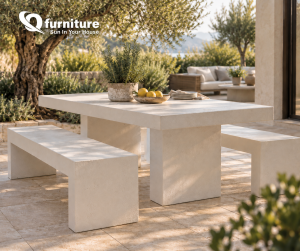
What Is Outdoor Concrete Furniture?
Concrete outdoor furniture refers to exterior furniture in which concrete is used as a primary structural or visual material. The category can include dining and coffee tables, side tables, benches, stools, seating, and complementary pieces designed for outdoor or semi-outdoor spaces.
Terms such as concrete patio furniture and concrete garden furniture usually describe the environment in which the products are used rather than completely separate categories. A patio project may focus on hospitality seating and dining, while a garden or landscape project may place greater emphasis on visual integration with planting, pathways, and surrounding architecture.
Why Outdoor Concrete Furniture Matters in Commercial Projects
In commercial projects, furniture is evaluated differently from products selected mainly for residential styling. Buyers need to consider how the product will perform in repeated use, how its form supports the design concept, and whether the supplier can meet project requirements at the required quantity and quality level.
Concrete is often considered where a grounded, architectural appearance is desired. In hotels and resorts, it can help create a more intentional outdoor atmosphere. In public or mixed-use developments, its visual weight can suit spaces that need a permanent, structured character. For rooftops and terraces, the discussion may shift toward dimensions, handling, construction method, and installation conditions.
For a more design-focused discussion of contemporary forms and commercial applications, see our modern concrete outdoor furniture.

Main Product Groups Within Outdoor Concrete Furniture
A commercial concrete furniture program may combine several product types rather than relying on one hero piece. Buyers can also browse the concrete furniture collection to review available product directions.
Benches
Concrete benches are particularly relevant to hospitality landscapes, public spaces, walkways, amenity zones, and shared outdoor areas. Because benches are often highly visible and repeatedly used, buyers may evaluate both their architectural presence and practical suitability for the site.
For buyers evaluating this product group in more detail, our patio concrete bench for commercial projects provides a more focused next step.
Tables
Concrete tables are commonly specified for outdoor dining, lounge areas, terraces, poolside settings, and communal spaces. Depending on the project, buyers may need dining tables, coffee tables, side tables, or coordinated table families. Important considerations include overall dimensions, top thickness, base proportion, edge profile, finish, and how the table will be packed and handled during installation.
Stools, Seating, and Accent Pieces
Stools and smaller seating or accent pieces can complete a commercial outdoor collection without dominating the space. They may be used beside lounge seating, in waiting areas, on terraces, or as flexible elements within branded hospitality environments. Coordinating finishes and proportions across different product types is important when the buyer is building a complete collection.
Design and Finish Directions
Modern Design Language
Modern concrete outdoor furniture often uses clean silhouettes, simple geometry, softened edges, and restrained surface treatments. This direction works well in projects where furniture is expected to complement contemporary architecture rather than compete with it. For commercial buyers, the key question is not whether a design looks modern in isolation, but whether the whole collection remains consistent with the project’s spatial language.
Surface and Finish
Finish selection affects both appearance and the way a product is perceived in use. Buyers may compare smooth, polished, lightly textured, or more natural-looking surfaces depending on the design concept. For B2B orders, finish consistency should also be discussed before production, especially when multiple pieces will be installed together or reordered later.
Construction Variations to Consider
Not all concrete furniture is produced with the same construction approach. Cast concrete furniture is commonly associated with a solid visual expression and substantial architectural presence. Lightweight concrete furniture, by contrast, may be considered when handling, rooftop access, installation, or logistics require more flexibility.
The appropriate construction direction depends on the product, dimensions, intended use, and site conditions. Rather than assuming that one construction type is suitable for every project, buyers should confirm these details with the manufacturer during product development or quotation.
How B2B Buyers Should Evaluate Concrete Outdoor Furniture
1. Application and Site Conditions
Start with the actual environment in which the furniture will be used. A quiet resort garden, a busy restaurant terrace, and a public amenity area create different expectations. Buyers should consider frequency of use, exposure, available space, circulation, placement, and installation access before selecting dimensions or product types.
2. Dimensions and Design Coordination
Commercial projects often require tighter control of size and proportion than standard retail purchasing. Tables must fit seating plans, stools need the correct relationship to table height, and benches may need to coordinate with pathways or landscape elements. Drawings, reference images, and clear specifications help reduce misunderstandings before production.
3. Customization and OEM/ODM Capability
Custom concrete outdoor furniture makes sense when standard products do not match the project’s dimensions, finish direction, branding, or overall design language. For importers, wholesalers, retailers, and hospitality projects, a manufacturer that can support OEM/ODM development may also help adapt an existing idea into a production-ready product.
4. Quality Consistency
For B2B orders, consistency across multiple units is as important as the appearance of a single sample. Buyers should discuss approved dimensions, finish references, color tolerance, workmanship expectations, and inspection procedures before mass production. This becomes even more important for repeat orders or projects installed in several locations.
5. Export Packaging and Logistics
Concrete furniture can be heavy and bulky, so packaging and shipping should be considered early rather than after the product is finalized. Export packaging, packed dimensions, container efficiency, handling method, and site access can materially affect the practicality and landed cost of an order. A suitable manufacturer should be able to discuss these factors alongside the product itself.
Where Concrete Outdoor Furniture Is Commonly Used
Hospitality Patios and Terraces
Hotels, resorts, restaurants, and rooftop venues often use concrete furniture to create outdoor areas that feel more permanent and integrated with the architecture. Dining tables, coffee tables, side tables, stools, and benches can be combined depending on whether the space is intended for dining, waiting, lounging, or informal gathering.
Garden and Landscape Projects
In landscaped environments, concrete garden furniture can work as part of the wider spatial composition rather than as isolated decoration. Product shape, finish, and scale can be coordinated with planting, stonework, pathways, and surrounding structures to create a more cohesive result.
Public and Shared-Use Spaces
Mixed-use developments, institutional projects, amenity areas, and other shared spaces may require furniture that can support repeated use while maintaining a stable visual character. In these settings, practical dimensions, placement, durability expectations, and ease of site coordination often become as important as styling.

For commercial sourcing, the supplier relationship should extend beyond choosing products from a catalog. Buyers may need support with drawings, dimensions, finish selection, samples, OEM/ODM development, production coordination, quality control, export packaging, and repeat-order consistency. The ability to communicate clearly through these stages can reduce project risk and make product development more efficient.
Q-Furniture focuses on concrete furniture manufacturing for B2B, wholesale, hospitality, and commercial project applications. Buyers can select from existing product directions or share drawings, reference images, and specifications for review.
Choosing the Right Concrete Outdoor Furniture for Your Project
Concrete outdoor furniture is best evaluated as a combination of product suitability and manufacturing capability. Once the buyer understands the application, desired design direction, dimensions, finish, and logistics, it becomes easier to narrow the project into specific tables, benches, stools, or custom developments.
If you are sourcing concrete outdoor furniture for wholesale, hospitality, retail, or commercial projects, contact Q-Furniture to discuss specifications, customization, quantities, samples, and quotation requirements.
FAQ
What is the difference between concrete outdoor furniture and concrete patio furniture?
Concrete outdoor furniture is the broader category. Concrete patio furniture usually refers to products intended for patios, terraces, and similar outdoor hospitality or residential-style settings.
Is concrete outdoor furniture suitable for commercial projects?
Yes. It can be suitable for hospitality, landscape, rooftop, public-space, and shared-use applications. The product design, construction, finish, and dimensions should match the actual project conditions.
When should buyers consider custom concrete outdoor furniture?
Customization is useful when standard products do not meet required dimensions, finish direction, branding, architectural coordination, or other site-specific needs.
What should B2B buyers confirm before placing an order?
Key points include specifications, dimensions, finish references, sample approval, and quantity. Buyers should also confirm production consistency, packaging, logistics, lead time, and any customization or OEM/ODM requirements.








