


International buyers sourcing wood-concrete hybrid furniture from Vietnam face a critical challenge: each target market imposes distinct regulatory frameworks that can delay shipments, trigger customs holds, or disqualify products entirely. A $150,000 container of concrete benches rejected at US ports due to CARB non-compliance represents more than lost revenue—it erodes supplier relationships and project timelines.
This guide addresses the specific compliance, tariff, and market entry requirements for wood-concrete furniture exports to the three largest B2B markets: United States, European Union, and Australia. Buyers evaluating Vietnam suppliers need this framework before issuing RFQs or conducting factory audits.
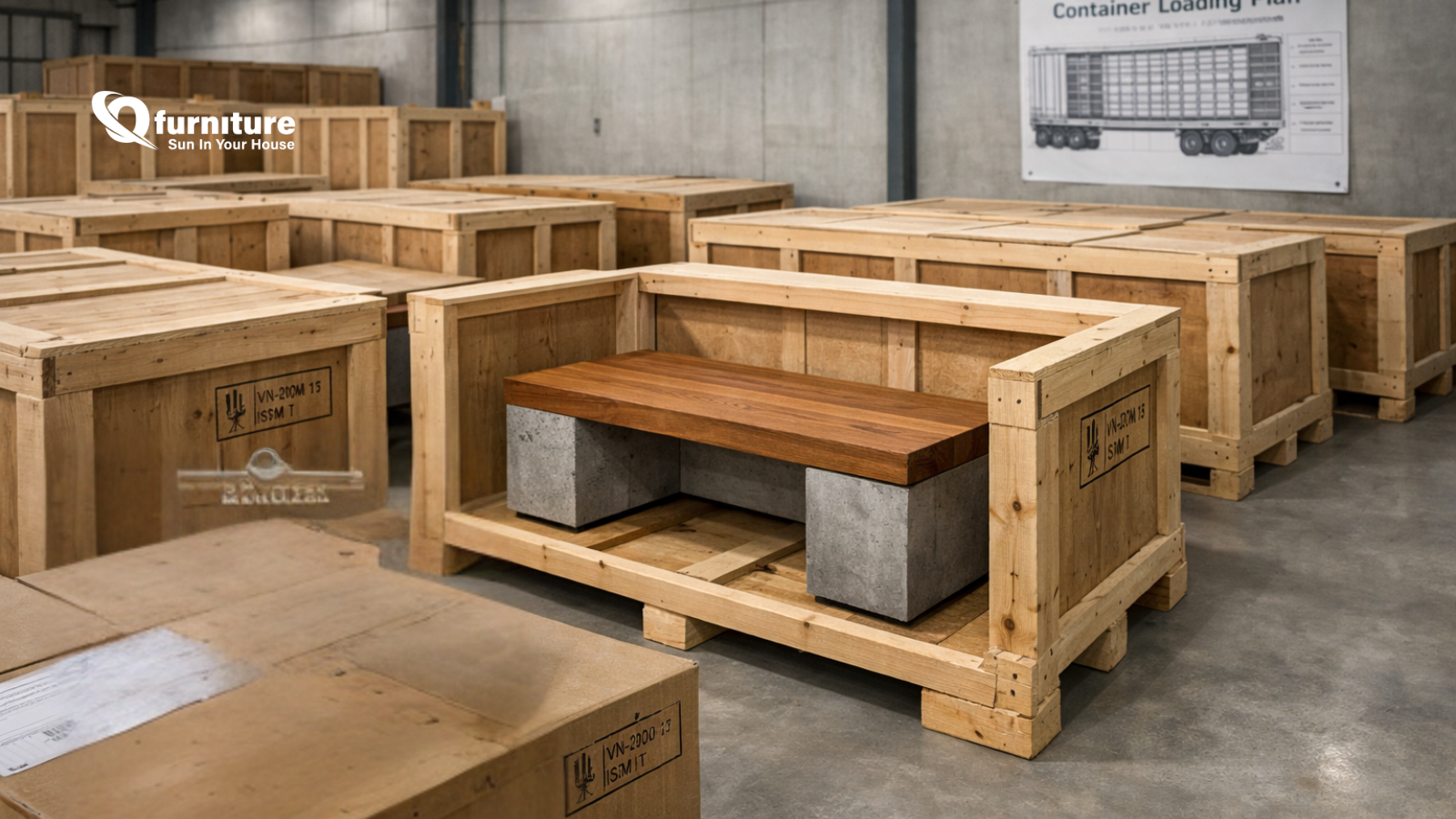
🚢 International Sea Freight & Transit Matrix from Southern Vietnam
| Destination Port | Average Port-to-Port Transit | Key Documentation Required |
|---|---|---|
| US West Coast (LA / Long Beach) | 16 – 20 Days (Direct Service) | ISF 10+2, Lacey Act Declaration, TSCA Title VI, B/L |
| European Union (Rotterdam / Hamburg) | 24 – 30 Days | C/O Form EUR.1 (EVFTA 0% tariff), EUDR Due Diligence, REACH |
| Australia (Sydney / Melbourne) | 14 – 18 Days | AANZFTA Form AANZ, ISPM-15 Fumigation Certificate |
Why Market-Specific Requirements Matter for Wood-Concrete Furniture
For commercial project developers and international importers, explore our specialized capabilities as a concrete furniture manufacturer for B2B export.
Unlike traditional wood-only exports, wood-concrete hybrids trigger dual material scrutiny:
- Wood components: Formaldehyde emissions, pest treatment, species legality
- Concrete elements: Chemical composition (REACH registration), weight-based flammability testing, curing agent disclosures
Vietnam manufacturers compliant for wood exports to one region may lack certifications for concrete additives in another. Procurement managers must verify cross-material compliance during supplier vetting, not post-production.
United States Market: Compliance Deep Dive
Discover our latest collection of export-grade commercial concrete dining and outdoor tables engineered with lightweight GFRC.
CARB Phase 2 (Formaldehyde Emissions)
Scope: All composite wood products (plywood, MDF, particleboard) in furniture sold/distributed in California—effectively nationwide due to supply chain logistics.
Wood-Concrete Application:
If wood tabletops use laminated substrates or edge banding adhesives, CARB P2 limits apply:
- Plywood: ≤0.05 ppm formaldehyde
- MDF/Particleboard: ≤0.09 ppm
Verification Requirements:
- EPA TSCA Title VI certification from Vietnam manufacturer or US importer
- Third-party lab testing (not self-certification)
- Chain-of-custody documentation if wood sourced outside factory
Common Gap: Vietnamese concrete furniture specialists may subcontract wood components to uncertified workshops. Buyers must audit the entire supply chain, not just final assembly.
Flammability Standards (California TB117-2013)
Trigger: Upholstered furniture or products with >50% fabric/foam content for residential use.
Relevance to Wood-Concrete:
Limited for solid wood-concrete pieces, but applies if:
- Benches include cushioned seating components
- Outdoor chairs use fabric slings with concrete bases
Testing Protocol:
- Smolder test for upholstery materials
- Open flame test (12-second exposure)
Importer Action: Clarify with supplier if any cushion/textile component requires separate TB117 compliance—concrete weight does not exempt fabric elements.
Lacey Act (Wood Legality)
Risk Factor: Vietnam sources teak, acacia, rubberwood from regional suppliers. Illegal logging in neighboring countries can contaminate supply chains.
Due Diligence Requirements:
- Plant declaration (species, country of harvest, quantity)
- FSC or PEFC certification preferred but not mandatory
- Supplier must prove legal harvest via documentation
Penalty: Up to $500,000 fine + shipment forfeiture for non-compliance.
Best Practice: Request annual third-party forest audits from Vietnam suppliers, especially for teak-concrete combinations popular in US hospitality projects.
Tariff Considerations
| Product Classification | HTS Code | Standard Rate | GSP Eligibility |
|---|---|---|---|
| Wood tables with concrete base | 9403.60.80 | 0% | N/A (already zero) |
| Concrete benches with wood seat | 9403.89.60 | 0% | N/A |
| Mixed-material chairs | 9403.80.40 | 0% | N/A |
Key Insight: Most wood-concrete furniture enters duty-free under existing US tariff schedules. However, Section 301 tariffs (China-origin materials) may apply if Vietnam manufacturer uses Chinese-sourced concrete additives or hardware. Verify country of origin for all components exceeding 25% of product value.
European Union Market: REACH & CE Compliance

REACH Registration (Chemical Safety)
Core Requirement: Any chemical substance manufactured/imported >1 tonne/year must be registered with ECHA (European Chemicals Agency).
Wood-Concrete Application:
Concrete curing agents, sealers, and surface treatments often contain:
- Chromium VI compounds (in cement)
- Phthalates (in coatings)
- Volatile organic compounds (in adhesives)
Supplier Obligations:
- Provide Safety Data Sheets (SDS) for all chemical components
- Confirm REACH pre-registration or exemption status
- Disclose Substances of Very High Concern (SVHC) if concentration >0.1%
Importer Liability: EU buyers become the “importer of record” for REACH compliance. If Vietnam supplier cannot provide REACH documentation, the buyer must:
- Hire an Only Representative (OR) in EU
- Register substances independently (cost: €10,000–€50,000 per substance)
Common Failure Point: Small Vietnam manufacturers lack REACH expertise. Request pre-shipment SVHC testing from SGS/Bureau Veritas labs in Vietnam to avoid customs delays.
CE Marking (Commercial Furniture)
When Required: Furniture for public/commercial spaces (offices, hotels, restaurants) must meet EN standards for:
- Structural safety (EN 1728 for seating)
- Flame retardancy (EN 1021 for upholstered pieces)
- Durability (EN 15372 for outdoor furniture)
Wood-Concrete Testing:
- Concrete base must withstand 150 kg static load (EN 1728) without cracking
- Wood-concrete joints tested for separation resistance under cyclical stress
Documentation:
- Declaration of Conformity (DoC) signed by manufacturer
- Test reports from EU-notified body (TÜV, BSI, SGS)
Procurement Tip: Request DoC during RFQ stage. Vietnamese suppliers experienced with EU exports (e.g., Q-Furniture, Aurora Craft) maintain ongoing EN compliance; newer exporters may require 4–6 months for initial testing.
EU-Vietnam FTA (EVFTA) Tariff Benefits
Duty Elimination Timeline:
- Year 1 (2020): 71% of tariff lines at 0%
- Year 10 (2030): 99% of tariffs eliminated
Current Rates (2026):
| Product Type | Pre-FTA Rate | Current FTA Rate |
|---|---|---|
| Wooden furniture (9403.50) | 0% | 0% |
| Concrete furniture (9403.89) | 4.7% | 0% (phased out 2023) |
Rules of Origin: Minimum 40% value-added in Vietnam to qualify. Wood imported from Laos then assembled in Vietnam may not meet threshold—verify with supplier’s Movement Certificate EUR.1.
Australia/New Zealand Market: AS/NZS Standards
Formaldehyde Limits (AS/NZS 1859.4)
Requirement: Similar to CARB but with regional testing protocols.
- E1 emission standard: ≤1.5 mg/L (lower than CARB P2)
- Testing must be conducted by NATA-accredited labs (Australia) or IANZ labs (New Zealand)
Importer Action: US CARB P2 certificates are not automatically accepted. Request separate AS/NZS testing or confirm supplier holds dual certification.
Biosecurity (Wood Treatment)
Mandatory Treatment: All solid wood must be:
- Heat-treated (56°C for 30 min) OR
- Methyl bromide fumigated
ISPM 15 Marking: Required on wood components and packaging (pallets, crates).
Concrete Furniture Exception: If wood is fully sealed/coated (no exposed surfaces), biosecurity risk is reduced but treatment still recommended to avoid quarantine inspections.
Tariff Structure
Australia-Vietnam FTA (AVFTA):
- Furniture tariff: 0% (eliminated 2020)
- No GST at border (applied at retail level)
New Zealand:
- Most furniture: 0% (MFN rate already eliminated)
- Wood-concrete hybrids: No special classification hurdles
Best-Selling Product Types:
- Outdoor benches (concrete base + hardwood slats): High demand for coastal hospitality projects
- Communal tables (polished concrete with timber inlays): Popular in Melbourne/Sydney cafés
Common Mistakes & Risk Mitigation
Mistake #1: Assuming Supplier’s “Export Experience” Covers All Markets
Reality: A Vietnam factory exporting wood furniture to Australia for 10 years may have zero REACH compliance for EU. Each market requires distinct certifications.
Solution: During supplier vetting, request:
- Market-specific test reports (last 12 months)
- Client references from target region
- Compliance documentation for identical product categories
Mistake #2: Overlooking Component-Level Compliance
Scenario: Wood tabletop passes CARB testing, but metal brackets (connecting wood to concrete) contain lead-based coatings banned under EU RoHS.
Solution: Request Bill of Materials (BoM) with compliance status for every component >1% of product weight. Third-party audits should test assembled products, not just materials.
Mistake #3: Ignoring Packaging Regulations
Issue: Concrete furniture’s weight (50–300 kg per unit) requires reinforced crating. If crates use non-heat-treated wood, Australia/NZ biosecurity will quarantine entire shipment.
Solution: Specify ISPM 15 compliance for all packaging in purchase contracts. Vietnam suppliers near HCMC port (e.g., Smart Concrete Design) typically use certified packaging vendors.
Market Entry Checklist by Destination
United States
- [ ] EPA TSCA Title VI certificate (CARB P2)
- [ ] Lacey Act plant declaration
- [ ] TB117-2013 test report (if upholstered)
- [ ] HTS classification confirmation
- [ ] Section 301 tariff assessment (Chinese components)
European Union
- [ ] REACH SDS + SVHC disclosure
- [ ] CE marking + DoC (commercial furniture)
- [ ] EN test reports from notified body
- [ ] EVFTA Certificate of Origin (EUR.1)
- [ ] Importer of Record contact (REACH)
Australia/New Zealand
- [ ] AS/NZS 1859.4 test report (formaldehyde)
- [ ] ISPM 15 heat treatment certificates
- [ ] Biosecurity import permit (if required)
- [ ] AVFTA Certificate of Origin
Frequently Asked Questions
Q: Can a single test report satisfy US, EU, and Australia formaldehyde standards?
No. While test methods overlap, each region requires lab accreditation from local authorities (EPA, ECHA, NATA). Budget for 3 separate testing cycles or work with suppliers holding multi-market certifications.
Q: How do I verify a Vietnam supplier’s REACH compliance?
Request their REACH registration number or confirmation from their EU-based Only Representative. Cross-check against ECHA’s public database. If supplier cannot provide, assume non-compliance.
Q: What’s the typical lead time for obtaining market-specific certifications?
- CARB P2: 6–8 weeks (if supplier uses certified materials)
- REACH registration: 4–6 months (first-time registration)
- CE marking: 8–12 weeks (testing + documentation)
- AS/NZS testing: 4–6 weeks
Plan certification into production timelines—don’t treat as afterthought.
Q: Do tariffs apply differently if concrete exceeds 50% of product weight?
HTS classification prioritizes “essential character.” If concrete provides structural function (e.g., table base), classify as 9403.89 (other furniture). If wood dominates aesthetic/functional role, classify as 9403.60 (wood furniture). Consult customs broker for binding rulings.
Expert Insight: Multi-Market Strategy
Procurement managers targeting multiple regions should prioritize Vietnam suppliers with established compliance infrastructure rather than lowest MOQ. A manufacturer investing in REACH registration, CARB-certified adhesives, and EN testing demonstrates export maturity—reducing your due diligence burden and customs risk.
For comprehensive guidance on selecting compliant Vietnam wood-concrete OEM suppliers across all export markets, see our Ultimate Guide to Vietnam Wood-Concrete Furniture OEM Suppliers.
Related topics:
- Wood-Concrete Joint Durability Testing & Quality Standards
- Export Packaging Solutions for Heavy Hybrid Furniture
For complementary supply chain insights, read our evaluation on Vietnam vs China furniture sourcing for importers.
📚 In-Depth Guides in This Silo 5 Pillar:
Explore factory OEM sourcing in our concrete furniture manufacturer B2B export guide.
📩 Request a Commercial B2B Project Catalog & Price List (FOB / CIF)
Partner directly with Q-Furniture Vietnam for your hospitality, commercial landscape, and export wholesale container orders. Custom CAD drawings, material testing reports, and volume tiered discounts available.








