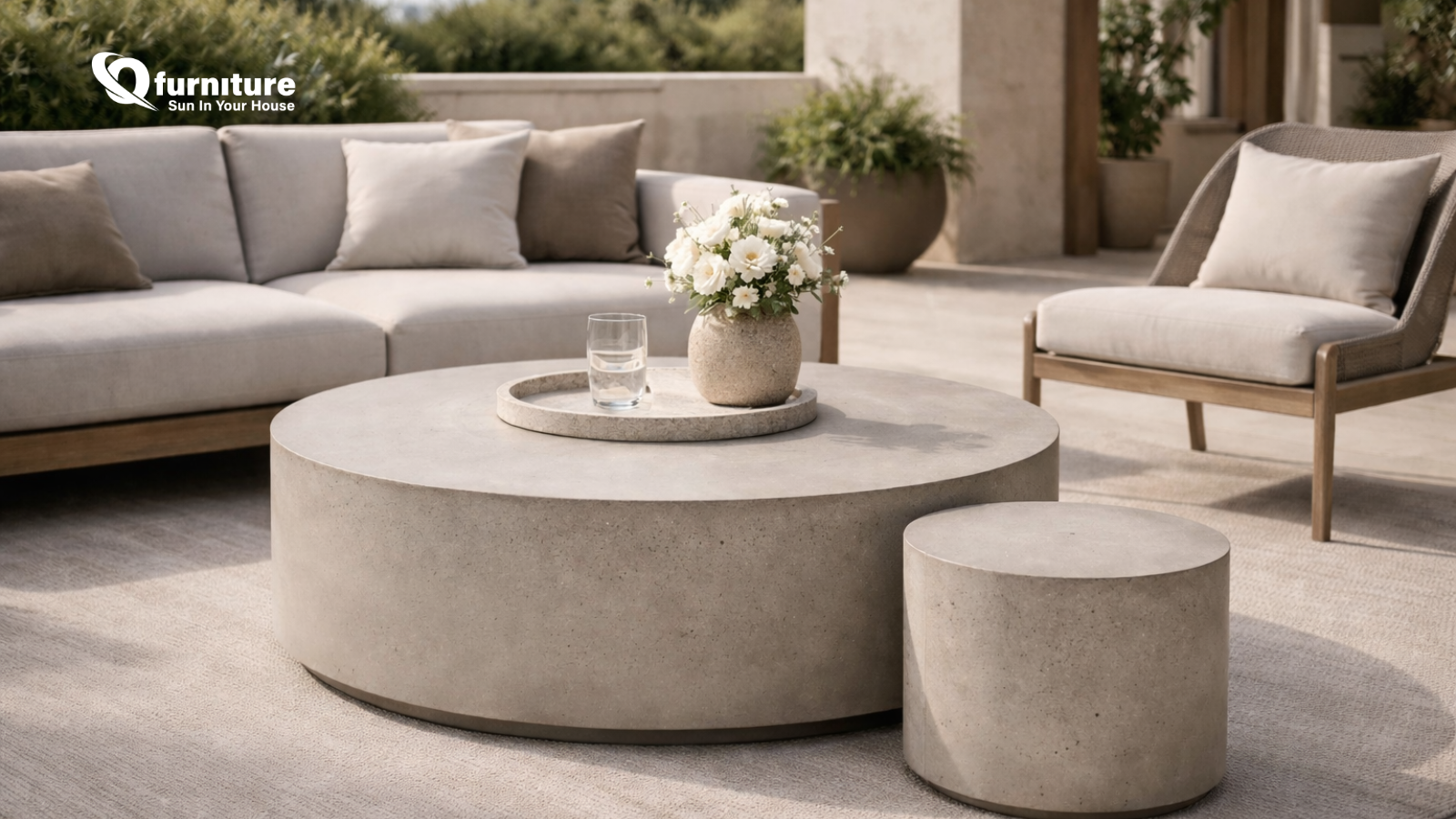
Concrete Outdoor Dining Table for Commercial Outdoor Spaces

A concrete outdoor dining table is more than a heavy table placed outside. For B2B buyers, it is a dining-specific product that must work with seating capacity, legroom, circulation, finish expectations, cleaning routines, freight, and installation. These factors make the category different from lower lounge tables or decorative accent pieces.
This guide focuses on commercial and project use for importers, wholesalers, distributors, hospitality buyers, and specifiers. It explains what to review before sourcing and where this table type is most practical.

Dining first: why the specification changes
At first glance, a concrete dining table may seem like a straightforward outdoor product. In practice, the dining function changes the specification. The table has to work around real seating positions, place settings, serving space, chair movement, and comfortable clearance – not simply look balanced in a product image.
This dining-specific focus also sits within the broader context of modern concrete outdoor furniture, where proportion, material performance, and commercial suitability need to be considered together. Dining-height products require closer attention to tabletop proportions, base placement, and the number of seats the design can support without compromising legroom or circulation.
For commercial buyers, this distinction is practical rather than semantic. A table that works well in a showroom can become difficult to use in a restaurant, resort, or shared amenity space if the base interferes with chairs, the surface is undersized, or the final weight has not been considered during delivery planning.

Key specifications for a concrete outdoor dining table
Sizing and seating clearance for a concrete outdoor dining table
Start with the intended seating plan. A four-seat table has different requirements from a six- or eight-seat configuration, so buyers should review length, width, usable surface area, and space per diner. The tabletop should not feel crowded once plates, serving items, and table accessories are added.
Clearance around the table matters just as much. Chairs need room to pull back, guests need comfortable leg space, and staff need circulation paths in restaurants or hospitality venues. A visually attractive base can still create problems if it blocks knees or limits chair placement.
Weight, base construction, and stability
Concrete is naturally substantial, which can be useful in semi-exposed outdoor settings where stability is valued. At the same time, weight affects freight cost, unloading, access, installation, and sometimes surface loading. Buyers should therefore treat weight as both a performance factor and a logistics factor.
Base design should also be checked carefully. Pedestal, slab, or sculptural bases may create a strong visual identity, but they still need to preserve practical legroom and seating flexibility. Dimensions should be reviewed together with the intended chairs rather than as an isolated table specification.
Surface finish and edge details
Dining use brings frequent contact, food service, and routine cleaning. A smoother or well-sealed finish can make daily wipe-down easier, while heavily textured surfaces may need more attention. Buyers should ask how the finish performs under normal outdoor exposure and cleaning conditions.
Edge treatment also affects comfort and perceived quality. Rounded or softened edges can feel more suitable for high-contact hospitality use, while sharper profiles may create a more architectural look. The best choice depends on the project concept and expected intensity of use.
Where a concrete outdoor dining table works best
This table type performs best where furniture is expected to remain relatively fixed and where material presence is part of the design language. It is less suitable for spaces that require frequent reconfiguration or daily movement.
Hospitality and restaurant settings
Restaurant terraces, hotel dining areas, and resort outdoor spaces can benefit from the stability and visual weight of concrete dining tables. In high-use commercial settings, long-term performance also depends on exposure, finish selection, cleaning routines, and maintenance. Buyers evaluating these factors can also review our guide on commercial outdoor furniture durability for a broader view of common durability risks in demanding outdoor environments.
In these environments, buyers should consider repeated guest use, staff service routes, cleaning frequency, and final placement. Delivery and installation should be planned early, especially when the site has narrow access, stairs, lifts, or rooftop restrictions.
Residential projects and shared amenities
Concrete dining tables can also work in villas, multifamily amenities, clubhouses, and shared outdoor dining zones. In these settings, the product should coordinate with the surrounding materials and seating without becoming an oversized focal point.
Proportion is especially important in smaller terraces or shared amenity areas. A table that looks balanced in a large resort setting may feel too heavy in a compact space, so buyers should review the actual layout before confirming dimensions.
When it may not be the right choice
A concrete outdoor dining table may be less suitable when furniture must be moved often, stored seasonally, or reconfigured for events. It can also be difficult for sites with limited delivery access or weight-sensitive floors. In those projects, the material advantages may become operational constraints.
Finish, maintenance, and outdoor exposure considerations
Finish should be selected according to weather exposure, cleaning routines, and service expectations. Dining tables in fully exposed locations face different conditions from tables under covered terraces, so buyers should provide the supplier with clear information about where the product will be used.
Ask about sealing, recommended cleaners, stain response, and whether periodic resealing is expected. These questions are important for downstream maintenance planning, especially for hotels, restaurants, and distributors that need consistent care guidance across multiple units.
Buyers should also consider how the finish will age visually. Minor tonal variation and subtle surface texture are natural characteristics of concrete, so approval samples should establish realistic expectations rather than promise a perfectly uniform appearance. This is particularly important when multiple tables will be installed together in one dining area.
B2B sourcing considerations for concrete outdoor dining tables
Packaging, freight, and installation
Heavy furniture needs packaging designed for international transport and on-site handling. Buyers should confirm how tabletops and bases are protected, whether components are shipped assembled or separately, how units are palletized, and what equipment may be needed for unloading or final placement.
Container efficiency should also be reviewed before ordering. A product can be commercially attractive but still create unnecessary landed cost if its packed dimensions are inefficient. Packaging and installation planning should therefore be discussed before the purchase order is finalized.
For larger programs, buyers should compare packed dimensions, units per pallet, and estimated container quantity before confirming the final table size. Small changes to a base or tabletop can sometimes improve loading efficiency without changing the overall design intent. This helps procurement teams evaluate landed cost instead of relying on unit price alone.
Customizing a concrete outdoor dining table for project specifications
Project buyers may need changes to dimensions, colors, finishes, or base profiles. Customization can improve project fit, but every change should be evaluated against production repeatability, lead time, packaging, and consistency across future orders.
A useful specification should identify the target dimensions, intended seating arrangement, finish reference, quantity, installation environment, and any access restrictions. Providing these details early gives the supplier a clearer basis for technical review and quotation, while reducing unnecessary revisions during sampling and pre-production.
Buyers who want to compare current product options can explore the concrete dining table collection before confirming a custom specification.

Supplier questions before placing an order
Before committing to a supplier, request dimensional confirmation, finish samples, estimated unit weight, packaging details, and maintenance guidance. It is also useful to clarify tolerance expectations, batch consistency, finish matching, lead time, and how repeat orders are handled.
A supplier should be able to connect these technical points with the intended application. Q-Furniture works with international buyers on concrete furniture requirements for commercial and project use.
For project-specific specifications, finish options, packaging details, or quotation requests, contact Q-furniture for further discussion.
What buyers should confirm before ordering
Before moving a product into sampling or quotation, buyers should confirm that the table is intended for true dining use, supports the required seating capacity, and provides comfortable legroom and chair placement. They should also check whether the final weight is practical for freight, site access, unloading, and installation.
Finish selection should match the project’s cleaning routine and level of outdoor exposure. Packaging, lead time, tolerance, batch consistency, and customization requirements should also be documented clearly so that the approved specification can be repeated reliably across the order.
FAQ
Is a concrete outdoor dining table suitable for restaurant use?
Yes, when the layout is relatively fixed and the project values stability, material presence, and long-term placement. Buyers should still review seating comfort, cleaning practicality, weight, and installation access before specification.
How heavy is a concrete outdoor dining table?
Weight varies by dimensions, construction method, and base design. For B2B buyers, the important point is how the final weight affects shipping, unloading, labor, surface suitability, and installation planning.
What finish is best for outdoor dining use?
There is no single best finish for every project. The preferred finish should balance the desired appearance with practical cleaning, weather exposure, stain management, and maintenance expectations.
What should importers confirm before ordering?
Importers should confirm dimensions, finish samples, weight, packaging method, handling requirements, tolerance, batch consistency, lead time, maintenance guidance, and any limits on customization.