From Factories to Fast-Shipping: How Global Supply Chains Are Delivering Vietnamese Furniture Worldwide
Vietnam’s furniture sector has evolved from dispersed workshops into a globally integrated manufacturing and logistics engine. Fueled by competitive labor, trade agreements, OEM relationships, and targeted investment in automation and materials engineering, Vietnamese manufacturers now deliver wood and concrete furniture at scale to the U.S., EU, Japan, and beyond. This overview synthesizes the full value chain — raw materials, factory production systems, ports and modal choices, trade compliance, and sustainability — and outlines practical steps for buyers and suppliers who need reliable, fast-shipping furniture sourced from Vietnam.
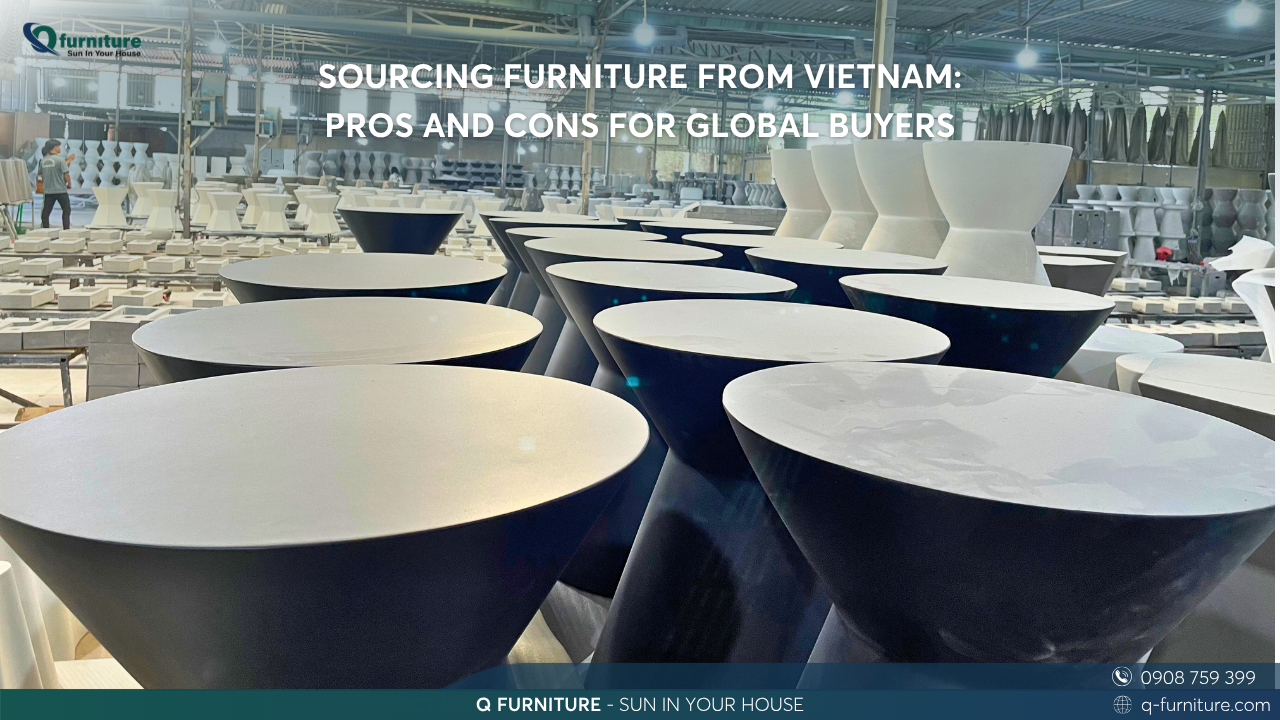
Production Engines of Global Supply: Vietnam’s Manufacturing Systems That Power Fast Shipping Q-Furniture Vietnam Factory” width=”508″ height=”286″ />
For commercial project developers and international importers, explore our specialized capabilities as a concrete furniture manufacturer for B2B export.
Manufacturing and production systems
Vietnam’s furniture industry scales global delivery by combining pragmatic factory engineering with logistics-aware product design. Factories translate design intent into export-ready modules through a tightly sequenced flow: CAD/CAM design and prototyping, nested cutting and milling, subassembly, finishing, quality testing, packing, and dispatch. Each stage is optimized around measurable KPIs — pieces per shift, first-pass yield, and cycle time — to meet buyers’ tight lead times and container-loading plans expressed in CBM per 40ft (TEU/FEU) metrics.
At the heart of this capability is equipment selection and process discipline. European-standard CNC routers, automated edge banders, and UV curing lines raise precision and throughput. CNC-controlled batching and digital mix records support reproducible concrete mixes for specialty pieces. Semi-automated cells remain common in SMEs; larger plants invest in robotics for sanding and repetitive finishing to reduce variability and labor hours. Nesting software and PLM reduce material waste and accelerate revision control. For concrete furniture, mold-making combines CNC and additive prototyping, followed by controlled vibration, steam or moist curing, and surface grinding and sealing to meet tight dimensional and aesthetic tolerances.
Raw material handling is engineered to minimize disruption. Plantation hardwoods, engineered panels, metal hardware, textiles, foams, and cementitious inputs arrive under scheduled receipt windows. Bonded warehouses and vendor-managed inventory mitigate lead-time spikes for critical fasteners and specialty veneers. Safety-stock levels are set by SKU volumetrics and CBM impact on container economics. Flat-pack and knock-down designs are prioritized where possible. These reduce volumetric waste in containers and lower per-piece FOB and landed costs.
Quality assurance is integrated from material intake to final packing. Incoming inspections check formaldehyde levels, panel thickness, and hardware dimensions. Production-stage checkpoints measure surface finish adhesion, load-bearing performance, and dimensional tolerances. Final QA combines stability and load tests with visual inspections. Compliance regimes follow ISO 9001 and ISO 14001 practices, and export-specific rules such as CARB/TSCA declaration or REACH documentation when required. Wooden packaging and crates meet ISPM-15 heat-treatment rules before export.
Concrete furniture manufacturing introduces additional technical parameters. Mix designs target specific w/c ratios and compressive strengths to balance weight and durability. High-performance mixes use w/c ratios from 0.28 to 0.45, aiming for compressive strengths from 30 MPa to 60 MPa where needed. Lightweight aggregates and hollow-core designs reduce mass and improve CBM efficiency. Surface treatments and densifiers improve abrasion and UV resistance for outdoor pieces. Packaging strategies include internal bracing, moisture control, and ISPM-15-treated outer crates to prevent damage during ocean transit.
Labor and cost dynamics shape production choices. Vietnam’s skilled workforce delivers strong joinery and finishing skills, but wage inflation nudges factories toward automation and productivity programs. Unit economics are calculated by combining direct labor, materials, finishing, inland drayage, port charges, and ocean freight per CBM. Flat-pack optimization directly reduces ocean cost per unit. For heavier concrete items, modular assembly and on-site joining reduce shipping weight and freight charges.
Logistics-aware factory planning shortens lead times. Production planning aligns container stuffing plans with vessel schedules, prioritizing 40ft high-cube utilization. Facilities near major ports coordinate drayage to Cai Mep, Cat Lai, Haiphong, or Da Nang to exploit direct services. Where speed matters, manufacturers use bonded forward stock in destination markets and partnered 3PLs to enable quick fulfillment. Digital tools such as TMS and WMS provide live visibility across the order lifecycle, enabling exception handling and prioritized bookings.
Risk mitigation is embedded in sourcing and production. Multi-sourcing of engineered panels, safety-stock for specialty hardware, and selective vertical integration reduce single-point failures. Traceability systems document origin and processing steps, aiding claims under preferential trade agreements. On the factory floor, production buffers and alternate routing plans cushion schedule deviations caused by material delays or port congestion.
Sustainability and compliance influence factory choices. Chain-of-custody certification and lower-VOC finishing lines meet buyer requirements and reduce market friction. For cement-based lines, specification of supplementary cementitious materials reduces embodied carbon without compromising performance.
Practical production recommendations center on design-for-transport, digital control, and strategic inventory. Design-for-manufacture-and-assembly reduces parts count and packing complexity. Digital batching, PLM, and ERP integrations improve material yields and shorten revision cycles. Establishing bonded warehouses and forward stocking networks in key markets supports fast-shipping promises while preserving capital through supply-chain finance.
For a closer look at mold creation and concrete tooling in Vietnamese plants, see this detailed guide on creating molds for concrete furniture in Vietnam.
External reference: https://www.cosmosourcing.com/blog/the-top-10-vietnam-furniture-manufacturers-2024
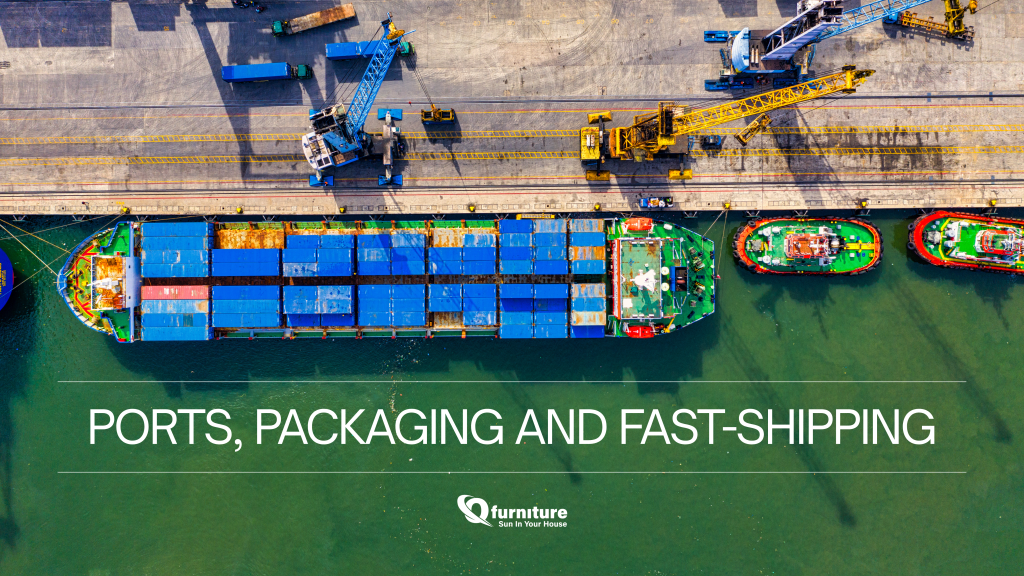
Ports, Packaging and Fast-Shipping: How Vietnam Turns Factories into Global Deliveries
Discover our latest collection of export-grade commercial concrete dining and outdoor tables engineered with lightweight GFRC.
Ports, Packaging and Fast-Shipping: logistics woven into manufacture
Vietnam’s global furniture footprint depends on more than production. It depends on tight coordination between factories, ports, carriers, and distribution hubs. The same factory that optimizes CNC nesting or concrete mix designs also must think in TEU, CBM and container load factors. That mindset drives decisions about product geometry, flat-pack design, and packaging systems. It reduces wasted cubic space in a 40ft high-cube and lowers the delivered cost per unit.
Major export clusters route goods to a small set of strategic gateways. Southern factories commonly use the Saigon/Cat Lai and Cai Mep–Thi Vai complex. Northern producers route through Haiphong. Central plants consolidate at Da Nang. Choosing a port is a commercial decision. Cai Mep’s deep-water capacity offers direct long-haul calls and fewer transshipments. Cat Lai provides dense feeder services and fast inland connections. Each option trades sailing time for terminal frequency and cost.
Containerization transformed Vietnamese furniture logistics. Standard units—20ft TEU and 40ft FEU—set how factories pack product. Engineers aim to raise pieces per 40ft by optimizing orientation and jointing for disassembly. Flat-packing and knock-down fittings compress bulky assemblies into tight CBM. For concrete furniture, designers combine hollow cores and lightweight aggregates to reduce mass and improve container density. The result is higher yield per container and better unit economics.
Packaging is both protection and insurance. Export-grade packaging combines internal bracing, shock-absorbing foam, and ISPM-15 treated wood crates for international compliance. For veneers and fabrics, humidity control via desiccants and sealed poly wraps prevents mold on long voyages. Concrete items need corner protection and distributed ties to avoid point loads. Premium lines often ship in full-crate formats with palletized bases to ease handling at destination. For an in-depth look at packaging approaches used by export-focused factories, see this guide to safe and convenient packing solutions.
Modal choice shapes lead times and costs. Ocean freight is dominant for finished goods. Typical transit windows vary: Asia intra-region shipments can be three to seven days. To the U.S. West Coast, expect two to three weeks. East Coast and Europe require longer sailings or transshipment, often 30 to 45 days. Air freight remains for urgent replenishment or high-margin SKUs. Rail solutions are emerging for certain routes, but sea remains the backbone for volumetric cargo.
Rate volatility is a constant. Carriers deploy blank sailings, adjust capacity, and reprice lanes according to demand. Smart exporters blend spot and contract bookings. They negotiate multi-year deals when possible and lock space during peak seasons. Some use premium services to guarantee vessel allocation for time-critical retail launches. Others mitigate cost by reducing CBM per unit and by consolidating smaller orders into FCLs.
Operational resilience depends on visibility and control. ERP, TMS and WMS platforms synchronize factory output with carrier ETAs and warehouse receiving schedules. Real-time container tracking and EDI reduce surprises at destination. Bonded warehouses and foreign-trade zones provide flexibility. Forward stocking in target markets shortens customer lead times. By holding inventory in bonded 3PLs, suppliers can claim preferential tariffs under free-trade agreements, and then dispatch to retailers with minimal customs delay.
Documentation and compliance are integrated into logistics workflows. Accurate packing lists with CBM and pallet details speed customs. Certificates of origin enable tariff benefits under regional agreements when rules of origin are met. ISPM-15 treatment records, emissions compliance papers, and MSDS for coating materials are routine attachments. Mistakes or missing documents create costly dwell time at terminals.
Risk management is operational and strategic. Multi-port routing reduces exposure to terminal congestion. Multi-sourcing critical hardware and finishes lowers supplier concentration risk. Safety stock policies and vendor-managed inventory soften supplier or carrier disruptions. Financial tools, including supply-chain finance and factoring, alleviate working capital strain from extended shipment cycles.
Fast-shipping strategies are pragmatic. For agreed SKUs, suppliers use forward stocking in destination markets for same- or next-day delivery. For new SKUs, they use small-batch air shipments for initial market testing, then shift to sea once demand stabilizes. Premium logistics lanes with prioritized stowage and guaranteed space shorten lead times for urgent retail programs. Digital demand sensing further reduces the need for emergency shipments by aligning replenishment with near-real-time sales.
Sustainability and compliance influence logistics choices. Carriers with cleaner fuel options and lower emissions profiles are preferred for environmentally conscious buyers. Lightweight packaging reduces fuel burn per unit. For concrete products, specifying supplementary cementitious materials lowers embodied carbon, making ocean shipments more acceptable to buyers with scope 3 mandates.
In practice, the most successful exporters merge factory planning with transport planning. They design parts for container efficiency, build packaging into the BOM, and align production cycles to carrier schedules. This integration turns port calls from bottlenecks into reliable milestones. It converts multi-week lead times into predictable commitment windows, enabling faster market response and competitive delivered pricing.
Further reading on practical export logistics from Vietnam is available here: https://vietnam.incorp.asia/furniture-export-logistics-from-vietnam/
Economic Forces, Geopolitics, and Sustainability: How Vietnam’s Furniture Supply Chains Power Fast Shipping
Vietnam’s furniture sector sits at the intersection of cost efficiency, strategic trade policy, and rigorous sustainability demands. The industry’s growth reflects a deliberate blending of lower unit labor costs, targeted foreign investment, and concentrated industrial clusters that compress supplier lead times. Production hubs near southern ports and northern manufacturing zones enable rapid movement from shop floor to vessel, and that geographic logic underpins the country’s fast-shipping capability.
A tight economic foundation supports operational scale. Manufacturers benefit from large workforces with furniture-specific skills. Automation investments such as CNC routing, robotic sanding, and digital batching boost throughput while preserving fine tolerances. These technologies reduce rework and increase first-pass yield, shortening production cycles and lowering the time gap between order and dispatch. At the same time, factory economics remain sensitive to raw-material swings. Plantation timber, imported engineered boards, and specialty hardware drive procurement complexity. Firms mitigate volatility through multi-sourcing, longer-term contracts, and in some cases vertical integration into component supply.
Geopolitics has actively reshaped demand flows. Global buyers pursuing diversification away from a single dominant supplier have accelerated investment into Vietnam. Free trade agreements expanded market access and created incentives to meet rules of origin requirements. Recent tariff volatility has forced exporters to reconsider market exposure and to accelerate moves up the value chain. Many factories now balance traditional OEM output with higher-margin, design-led assortments that command better resilience against tariff shocks. This strategic pivot also helps justify investments in traceability systems and certification.
Logistics architecture is equally decisive. Deep-water terminals, expanded container yards, and improved hinterland connectivity allow higher weekly vessel calls. Container optimization—flat-packing, nested components, and 40-foot high-cube loading—reduces wasted air and yields far more pieces per container. For denser product families, such as concrete pieces, design choices emphasize hollow cores, modular joins, and lighter aggregate blends. These choices manage both CBM and gross weight, avoiding penalties and enabling predictable sailing schedules.
Fast-shipping strategies blend operational and commercial tactics. Factories standardize SKUs for forward stocking and partner with third-party logistics providers for bonded warehouse capacity in destination markets. This model converts ocean transit into guaranteed same- or next-day fulfillment for stocked SKUs. Digitally integrated TMS and WMS platforms give visibility to container ETAs, enabling dynamic cutoffs and prioritized drayage. For urgent replenishment, air freight remains an option for high-margin items, but it is used sparingly due to cost.
Sustainability is now a commercial lever rather than a compliance cost. Buyers demand chain-of-custody documentation, low-VOC finishes, and Scope 3 emissions transparency. Manufacturers respond with certified sourcing, use of supplementary cementitious materials in concrete mixes, and process changes that lower embodied carbon. Social compliance audits and environmental management systems further anchor buyer trust. Those investments align with premium positioning and support longer-term contracts that smooth cash flow.
Risk management in this environment is pragmatic and layered. Supply risks are addressed through dual-sourcing for specialty hardware and maintaining safety stock for long-lead items. Logistics risk is mitigated by flexible port selection and multi-carrier contracts. Financial risk takes form through currency hedging and supply-chain finance solutions that relieve working-capital strain during peak order cycles. Together, these practices maintain both service levels and margin integrity.
Quality and repeatability remain non-negotiable. Formal testing for load capacity, emission levels, and finish durability is routine. Many operations publish and follow rigorous inspection protocols and corrective-action loops that drive continuous improvement. Those systematic quality procedures support premium channels and reduce costly returns. For a practical view of in-factory quality systems, see this overview of systematic quality procedures: https://q-furniture.com/systematic-approach-to-ensuring-flawless-quality/.
Looking ahead, the industry’s ability to couple design capability with logistics intelligence will determine which firms capture premium value. Investments in PLM, demand-sensing algorithms, and distributed inventory in target markets will compress lead times further. At the same time, sustainability measures and trade policy compliance will continue shaping product architectures and sourcing choices. The most resilient manufacturers will be those that design for efficient shipping, maintain traceable supply chains, and combine digital visibility with a flexible logistics playbook.
For those navigating this landscape, the most valuable lever is integration: align product design, materials sourcing, production systems, and shipping strategy to the same operational rhythm. When a factory thinks in CBM, origin compliance, and carbon intensity together, it turns a production schedule into a dependable, fast-shipping promise to global customers. For further reading on how trade agreements support these dynamics, see the EU briefing on the EU-Vietnam trade relationship: https://ec.europa.eu/trade/policy/countries-and-regions/negotiations-and-agreements/vietnam/index_en.htm.
Final Thoughts
Vietnam’s furniture sector has matured into a dependable global supplier by combining process engineering, port and logistics optimization, and compliance systems. Buyers and suppliers who align product design (DFMA, flat-pack), operational visibility (TMS/WMS), and sustainability credentials (chain-of-custody, low-VOC finishes, lower-carbon concrete mixes) unlock fast-shipping models that meet modern market demands. The winning suppliers will be those that convert manufacturing scale into consistent, compliant, and carbon-aware delivery — turning Vietnamese factories into fast-shipping partners across major markets.
Choose Q Furniture – Choose your SUSTAINABILITY
About Us
With over 15 years of experience in furniture manufacturing, Q-Furniture offers clients a wide range of premium wood and concrete furniture products and services. Founded by individuals with a deep understanding of the industry, Q-Furniture has grown to deliver an extensive portfolio that caters to various customer needs.
For complementary supply chain insights, read our evaluation on Ultimate furniture factory audit checklist for importers.
📩 Request a Direct Factory B2B Sourcing Proposal (FOB / CIF)
Are you evaluating furniture manufacturing partners in Vietnam or planning full container load (FCL) orders? Connect directly with Q-Furniture’s export engineering team to discuss CAD design specs, material finishes, and wholesale pricing.