


Durability, lifecycle cost control and evolving design tastes are pushing concrete and other robust materials to the forefront of hospitality furniture procurement between 2025 and 2030. Hotels and designers seek furnishings that withstand heavy use, reduce replacement frequency, and meet growing sustainability requirements. This article outlines the material and manufacturing advances that enable concrete furniture at scale, the market economics driving buyer preference (with practical notes on Vietnam as a supplier hub), and the operational, design and regulatory considerations hotel teams must manage to adopt concrete and durable designs successfully.
From Mix to Market: How Materials and Manufacturing Are Powering Concrete and Durable Hotel Furniture (2025–2030)
Materials, manufacturing and market fit
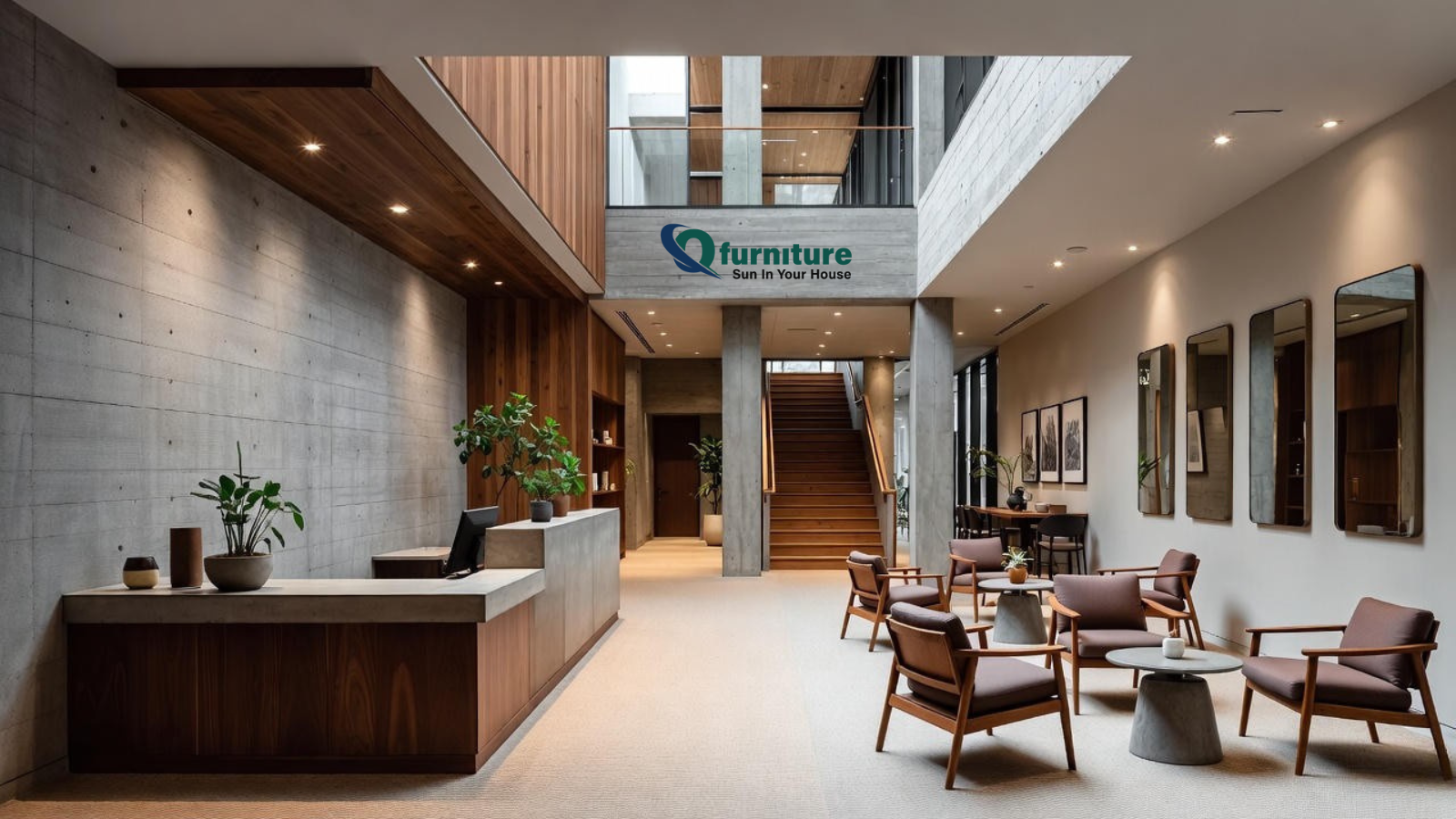
Concrete is no longer a novelty in hospitality. It has become a pragmatic design language and a performance choice. Advances in mixes and fabrication mean designers and operators can get slim profiles, tactile surfaces, and long service lives without sacrificing aesthetics. Glass-fiber-reinforced concrete and ultra-high-performance concrete allow thin tabletops, slender bases, and complex contours while reducing weight compared with traditional cast concrete. Geopolymer binders and high levels of supplementary cementitious materials lower embodied carbon, often by 20–60 percent depending on formulation and energy inputs. Fiber types — alkali-resistant glass, PVA, polypropylene, carbon and steel microfibers — are chosen for crack control, toughness, and the required finish.
These material improvements are matched by manufacturing innovations that make concrete furniture scalable for hotels. CNC-machined molds bring repeatability to textures and edge details. Vacuum and pressurized casting reduce voids and improve fiber dispersion. Foam-core sandwich panels and lightweight aggregates cut mass by 30–70 percent versus solid pieces. Robotic additive printing and automated finishing lines speed bespoke runs and maintain consistent surface quality across larger orders. Such methods keep cycle times predictable and lower the labor intensity of high-skill finishing work.
Vietnam emerges as a strategic manufacturing node for the region and beyond. Competitive labor costs, expanding port infrastructure, and a growing base of workshops specializing in GFRC and precast pieces enable mid-volume production at attractive lead times. Local expertise in mold-making and surface finishing supports complex commissions. For insight into practical mold production in that market, see this piece on creating molds for concrete furniture in Vietnam. Sea transit times from Vietnam to major markets remain competitive, and layered supply strategies — combining local SCM sourcing with forward procurement of binders — help manage commodity volatility.
Durability and lifecycle economics drive procurement decisions. High-quality concrete pieces often carry a 10–40 percent premium over wood equivalents. But whole-life costing flips that equation in many hospitality contexts. When a piece delivers 10–15 years of service and needs fewer repairs, total cost of ownership often falls by 8–25 percent relative to less durable alternatives. That equation matters in renovation cycles where owners seek materials that extend intervals between asset refreshes.
Operational realities shape specification. Sealers and protective coatings reduce staining and abrasion, but specifications must reflect housekeeping practices and approved cleaning chemistries. Penetrating silanes, siloxanes, and polymer impregnators extend surface life, while newer fluoropolymer-free stain resistants lower environmental risk. For outdoor or cold-climate use, freeze–thaw-rated mixes and robust drainage are non-negotiable. Designers should factor anchorage and distributed floor loads into layouts. Weight reduction strategies, such as foam cores, ease installation and reduce freight costs, but they also demand careful detailing at attachment points.
Quality assurance and testing underpin market acceptance. Contract buyers expect documentation for compressive and flexural strength, water absorption, chloride permeability, and freeze–thaw resilience. Furniture-specific standards for seating and surfaces remain relevant and must be harmonized with material tests. Indoor air quality testing should cover sealers and any adhesives used. Product-level EPDs and life-cycle data are becoming standard requirements in bids from chains that track embodied carbon.
Sustainability is both a constraint and an opportunity. Cement production remains carbon-intensive, yet manufacturers reduce embodied carbon through SCM substitution, local aggregate sourcing, and lower-lime binders. Renewable energy in factories and transparent life-cycle reporting help properties meet net-zero targets. Circularity benefits arise from durable pieces that are repairable and reupholsterable. Design for disassembly — bolted connections and separable upholstery modules — improves end-of-life outcomes compared with permanently bonded composites.
Market acceptance depends on aesthetics and perceived warmth. Concrete finishes can read raw, refined, or natural depending on aggregate, polish level, and integrated materials. Combining concrete with timber, metal, or textiles moderates the material’s visual temperature and widens appeal across segments. Modular concrete elements that bolt together or combine with lightweight inserts offer flexibility for event-driven spaces and reduce replacement costs.
For manufacturers, the path forward is clear: invest in GFRC/UHPC capabilities, lightweight core systems, and EPD-backed mixes. For hotel procurement, require whole-life costing, durability clauses, and clear maintenance protocols. Designers should specify mixes by exposure condition and collaborate early with operations teams to ensure cleaning and repair regimes match the chosen finishes. Together, these changes convert concrete from a statement material into a scalable, durable solution for hospitality furniture as the sector modernizes between 2025 and 2030.
Source: https://www.grandviewresearch.com/industry-analysis/hotel-furniture-fixtures-equipment-market-report
Durable Value: How Market Forces and Economics Are Driving Concrete Furniture in Hospitality (2025–2030)
Market Forces and Economic Rationale
Between 2025 and 2030, decisions about hotel furnishings are more financial than decorative. Owners and operators face tighter renovation cycles, rising labor and shipping costs, and stronger ESG scrutiny. Those pressures reshape procurement criteria. Concrete and other durable designs answer several of those needs at once. They carry higher upfront prices but deliver longer service lives, lower maintenance needs, and predictable replacement schedules. When hotels model total cost of ownership over a decade, concrete frequently outperforms wood and engineered-wood alternatives. That math matters most in midscale to luxury properties where guest expectations and asset-level revenue justify durable investments.
Demand growth stems from a mix of macro and micro drivers. Global travel recovery and higher per-room spending have restarted renovation pipelines. Boutique and luxury segments seek signature elements that last. Urbanization and new-build hotel projects, especially in Asia-Pacific and the Middle East, expand procurement volumes. Sustainability targets push chains to favor products with documented embodied-carbon improvements and durability claims that reduce replacement frequency. At the same time, manufacturers’ adoption of lightweight GFRC, UHPC, and geopolymer mixes has made concrete furniture more design-flexible and less costly to ship. These material advances bridge the gap between aesthetics, weight, and cost.
Cost dynamics are central to adoption. High-quality concrete pieces often cost 10–40% more up front than comparable wood items. Yet whole-life costing shifts the narrative. With realistic assumptions on renovation cycles and repair budgets, concrete can lower total lifecycle costs by roughly 8–25% over ten years in higher-usage contexts. Lower repair frequency, simpler cleaning, and better aesthetic retention explain much of that delta. Procurement teams are moving from price-per-unit thinking to quantified service-life models. They now request durability guarantees, repair protocols, and product-level EPDs during bid evaluation. Those requirements favor manufacturers who can deliver verifiable data and warranties.
Regional economics also shape supply. Asia-Pacific leads demand growth, with fast urbanization and tourism expansion. Vietnam emerges as a competitive manufacturing hub. The country combines skilled mold makers, improving port infrastructure, and cost advantages versus traditional production centers. For buyers, Vietnam offers mid-volume responsiveness and lead times of roughly 30–45 days to major markets. Local workshops specialize in GFRC/GRC and lightweight sandwich systems, and they increasingly meet export compliance and documentation needs. For a practical view of local capabilities, see this look at creating molds for concrete furniture in Vietnam: creating molds for concrete furniture in Vietnam.
But manufacturing advantages come with caveats. Raw-material price volatility, energy costs, and SCM availability all influence margins. Cement price shocks can rapidly erode cost models. Manufacturers mitigate this with SCM substitution, forward purchasing, and blended-binder strategies. Trade policy and non-tariff barriers matter too: compliance with regional chemical and safety regulations is required to preserve market access. As supply chains regionalize to reduce geopolitical risk, nearshoring trends will shift volumes, yet Vietnam’s scale and specialization keep it competitive for the foreseeable term.
Sustainability economics are increasingly front and center. Cement and cementitious binders remain carbon-intensive. Yet product-level strategies can reduce embodied carbon by 20–60% versus traditional mixes. Those strategies include high-SCM content, use of recycled aggregates, local sourcing, and renewable energy in factories. The commercial advantage is twofold. First, hotels under corporate ESG mandates favor products with EPDs and lower footprints. Second, future carbon regulation risks make early low-carbon adoption a hedge against compliance costs. Manufacturers that invest in validated LCAs and EPDs therefore unlock procurement opportunities with major hotel groups.
Operationally, concrete’s advantages are tangible. Lower daily maintenance and fewer replacements reduce housekeeping and capex pressures. Onsite repairability—through matched patch mortars and microtoppings—keeps visual consistency between refurbishments. Thermal mass and tactile finishes support biophilic and minimalist aesthetics that guests now expect. However, weight, anchorage, and logistics require attention. Design must account for floor loads, safe handling during delivery, and bolting strategies in seismic zones. Hybrid configurations—concrete surfaces paired with lighter internal cores—solve many weight and transport constraints while keeping the visual benefits.
For buyers and specifiers, the economic prescription is straightforward. Require whole-life costing in tenders and ask for durability metrics, maintenance protocols, and EPDs. Prioritize manufacturers with proven GFRC/UHPC capabilities and documented supply-chain resilience. For manufacturers, the imperative is to invest in low-carbon binders, lightweight systems, and quality assurance that meets contract-furniture standards. Those who can combine verified sustainability credentials with predictable delivery and finish consistency will capture the bulk of demand in higher-value hotel segments.
Market adoption will vary by segment. Budget hotels will continue favoring lower upfront cost solutions. Midscale and luxury properties, driven by guest experience and brand protection economics, will increasingly specify concrete and durable designs. The result is a steady but uneven shift, concentrated where lifecycle value and design identity align.
External reference for cement and climate context: https://www.ipcc.ch
Durable Design in Practice: Concrete Furniture, Sustainability Strategies and Operational Realities for Hotels (2025–2030)
Design, Sustainability and Operations in Harmony
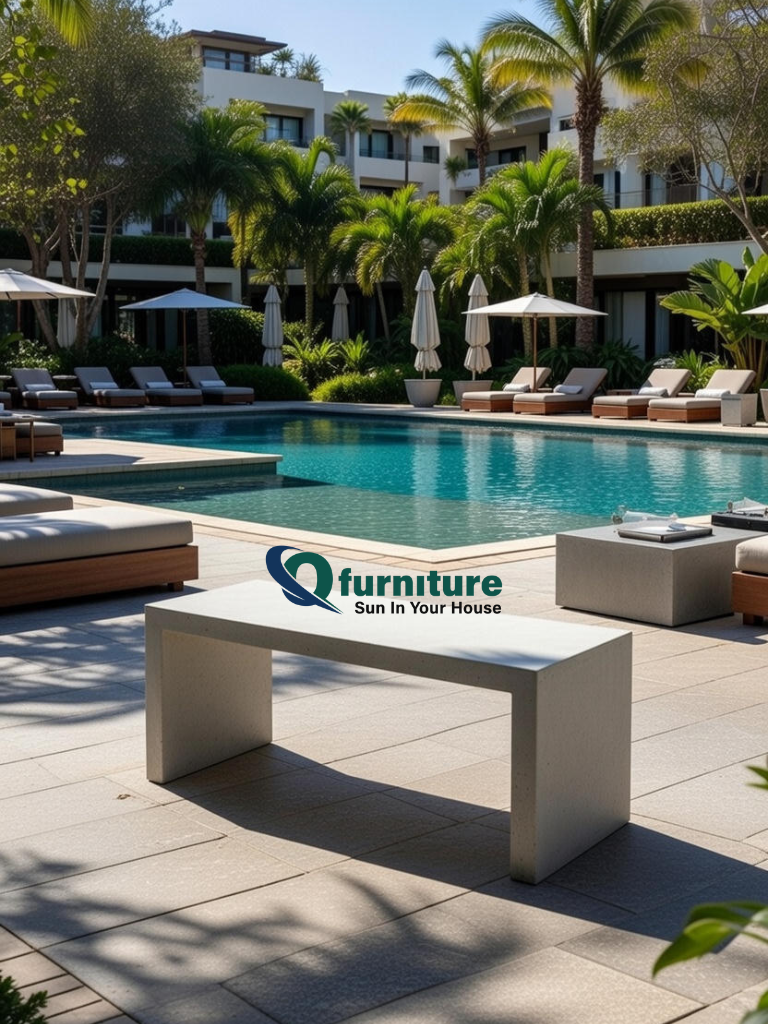
Concrete and other durable-material strategies are shifting from occasional feature pieces to core components of hospitality fit-outs. Designers use thin-section GFRC and UHPC to achieve elegant silhouettes while keeping mass manageable. These mixes allow slim tabletops, sculptural benches, and integrated planters that read as natural, tactile elements. Integral pigmentation and in-mold textures replace applied finishes. The result is a palette that supports biophilic, industrial, and minimalist schemes without sacrificing longevity.
Operationally, the case for concrete rests on whole-life economics. High-quality concrete furniture costs more at purchase, yet lower replacement frequency reduces total cost of ownership. Hotels aiming for a 10–15 year service life find concrete compelling for lobbies, terraces and high-traffic public spaces. Crucially, procurement teams must insist on lifecycle models rather than lowest-first-cost bids. Contracts should require durability guarantees and documented maintenance regimes. Specifying EPDs and embodied-carbon metrics aligns purchasing with corporate ESG goals and avoids future regulatory exposure.
Maintenance must be explicit in design documents. Penetrating sealers and hydrophobic treatments protect surfaces, but they demand periodic re-application. Cleaning protocols should specify pH-neutral agents and compatible disinfectants to preserve sealers. Localized damage is repairable with color-matched cementitious patches and microtopping systems. However, visual matches hinge on skilled workmanship. Hotels should train on-site teams or retain vetted contractors to maintain appearance standards. For outdoor pieces, freeze-thaw resistance, drainage provision, and UV-stable pigments are non-negotiable.
Weight and logistics influence where concrete is practical. Designers mitigate mass using lightweight aggregates and foam-core sandwich panels faced with GFRC shells. These systems cut weight substantially and ease shipping and installation. Nonetheless, anchorage and floor-load calculations remain essential. Designers must provide specified anchor points and check local live-load capacities for public areas. In seismic regions, bolted connections and engineered anchors ensure safety without compromising aesthetics.
Material innovation is addressing the sustainability trade-offs of cement. Blended cements, geopolymers, and use of SCMs such as GGBS reduce embodied carbon. Manufacturers able to produce EPDs and to disclose mix formulations gain procurement advantage. Circularity is improved through design for disassembly: bolted joinery, separable upholstery modules, and accessible cores extend usable life and simplify refurbishment. End-of-life strategies should prioritize refurbishment over demolition. When recycling is necessary, designers must avoid permanent bonds between dissimilar materials.
Harmonizing guest experience and hygiene is straightforward. Properly sealed concrete tolerates common disinfectants and maintains tactile warmth when paired with timber or soft upholstery. Antimicrobial surface systems can be specified for high-touch zones, but their environmental profile needs assessment. Coating selection must balance stain resistance, abrasion performance, VOC limits, and long-term durability. Low-VOC sealers and fluoropolymer-free repellents are recommended for indoor air quality compliance.
Manufacturing geography and supply-chain choices shape both cost and sustainability. Regional hubs with skilled GFRC and UHPC capabilities provide competitive lead times. Vietnam has emerged as a significant manufacturing center, offering specialized workshops, improving logistics, and access to regional SCMs. For teams sourcing from Vietnam, early coordination on mold design, surface finish expectations, and export documentation is critical. For practical guidance on mold production in that context, see this piece on creating molds for concrete furniture in Vietnam.
For designers and procurement teams, practical specifications matter. Call out freeze-thaw ratings where relevant, require EPDs and LCA summaries, and mandate finish performance metrics for abrasion and stain resistance. Include maintenance schedules and compatible cleaning chemistries in contract deliverables. Where weight or modularity is critical, specify foam-core sandwich systems or prefabricated bolted assemblies.
Adoption will vary across hotel segments. Upscale and lifestyle properties will adopt concrete broadly for its aesthetic and lifecycle benefits. Midscale operators will target concrete for public zones and mixed-material hybrids to control costs. Budget segments may use concrete accents to convey durability without large capital outlays. Across segments, the successful projects will be those that integrate material choice with operations, maintenance planning, and sustainability reporting.
External resource: https://censohome.com/blog/top-trends-in-hotel-furniture-design/
Final Thoughts
Concrete and durable-design furniture will expand in hospitality from 2025–2030 because it delivers measurable lifecycle savings, withstands heavy use, and now offers credible sustainability credentials via low‑carbon binders and EPDs. Material advances (GFRC, UHPC, geopolymers), lightweight fabrication, and Vietnam’s maturing supply chain combine to make concrete furniture both practical and competitive for mid‑to‑upper scale hotels. Successful adoption requires coordinated procurement specifications (whole‑life costing, EPDs, maintenance regimes), design choices that balance aesthetics with ergonomics and weight, and supplier investments in manufacturing controls and certifications. Choose Q Furniture – Choose your SUSTAINABILITY
Choose Q Furniture – Choose your SUSTAINABILITY
About Us
With over 15 years of experience in furniture manufacturing, Q-Furniture offers clients a wide range of premium wood and concrete furniture products and services. Founded by individuals with a deep understanding of the industry, Q-Furniture has grown to deliver an extensive portfolio that caters to various customer needs.








